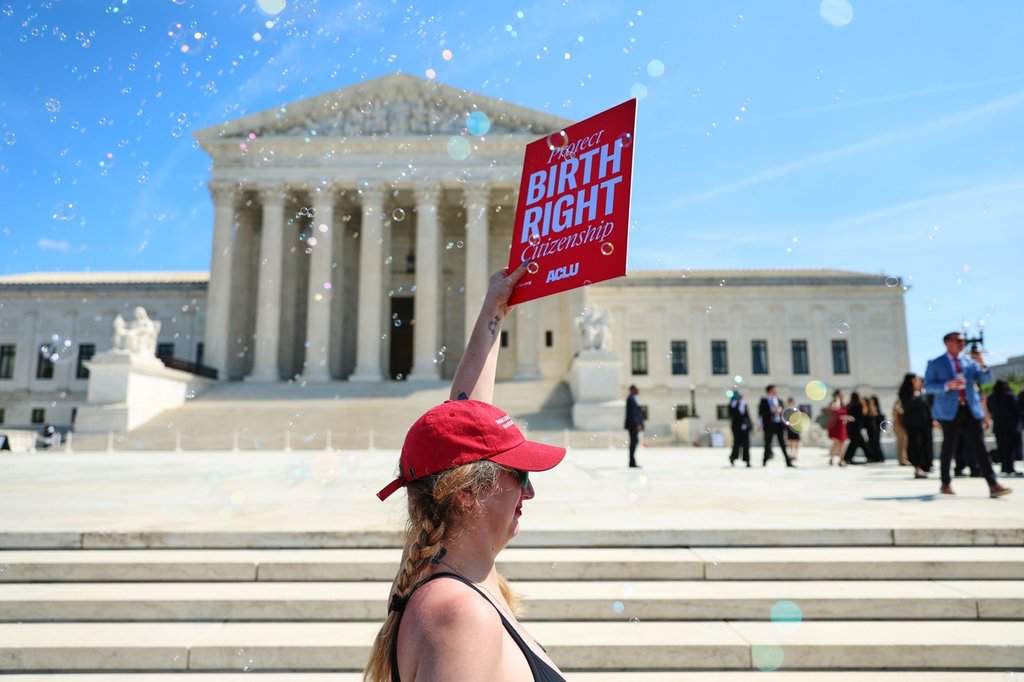
The air inside the Supreme Court felt heavy on Wednesday. It wasn't just the usual weight of high-stakes litigation. For the first time in history, a sitting president, Donald Trump, sat in the chamber to watch his own administration argue that the Constitution doesn't mean what we’ve thought it meant for over 150 years. At the center of the storm is Trump v. Barbara, a case that could fundamentally reshape who gets to call themselves an American.
If you’ve been following the headlines, you know the gist. Trump wants to end birthright citizenship for children born to undocumented immigrants or those on temporary visas. He calls the current system "stupid." I call it the bedrock of our democracy. The administration’s logic is a total pivot from a century of legal tradition. They're betting that the "subject to the jurisdiction thereof" clause in the 14th Amendment is a loophole they can finally close.
The ghost of Wong Kim Ark
Most people think birthright citizenship is just a vibe or a tradition. It’s not. It’s a 128-year-old precedent set by United States v. Wong Kim Ark. Back in 1898, the Court ruled that a man born in San Francisco to Chinese parents was a citizen. Period. It didn't matter that his parents couldn't become citizens themselves due to the racist laws of that era.
The Trump administration’s Solicitor General, D. John Sauer, is trying to tell the justices that Wong Kim Ark only applied to permanent residents. He’s pushing a theory of "consensual jurisdiction." Basically, he argues that if the government hasn't formally consented to your presence, you aren't truly under the "jurisdiction" of the U.S. in the way the 14th Amendment requires.
Honestly, it’s a stretch. During Wednesday's arguments, even the conservative wing of the court seemed to smell the desperation. Justice Ketanji Brown Jackson cut through the fluff with a practical question: "Is this happening in the delivery room?" She was pointing out the absolute logistical nightmare of turning hospitals into immigration checkpoints. You can’t just flip a switch on a century of civil law without creating total chaos in every maternity ward in the country.
Why originalism might fail the President
Trump’s legal team loves to cite "originalism"—the idea that we should interpret the Constitution exactly as the founders (or the 1868 drafters) intended. But that’s a double-edged sword here. When the 14th Amendment was written, the goal was to kill the legacy of the Dred Scott decision. The authors wanted to make sure that citizenship was based on where you were born, not who your parents were.
Justice Clarence Thomas brought up an interesting point. He asked how much the 1860s debates even touched on immigration. Back then, we didn't have the complex "legal vs. illegal" immigration system we have today. Border controls were practically non-existent. If you were here, you were under the law. You could be sued, you could be taxed, and you could be hanged for a crime. That sounds like "jurisdiction" to me.
The administration's argument effectively creates a permanent underclass. If a child is born here but isn't a citizen because of their parents' status, what are they? They’re "stateless." We haven't seen that kind of legal category in the U.S. since before the Civil War. It’s a dangerous path to walk.
What's actually at stake for families
This isn't just about people crossing the border without papers. The language of Trump’s Executive Order 14160 is broad. It targets:
- Children of undocumented parents.
- Children of people on H-1B work visas.
- Children of international students.
- DACA recipients' kids.
Think about that. You could be a high-skilled engineer here on a legal visa, pay taxes for a decade, have a kid in a Chicago hospital, and that kid might not be an American under this rule. It’s a radical departure from the "melting pot" ideal.
The ACLU's Cecillia Wang argued that the 14th Amendment was designed to settle this once and for all. It was meant to prevent politicians from using citizenship as a political football. When you start picking and choosing which babies are "American enough," you're not protecting the country—you're dismantling its core promise.
The Court's skepticism is showing
Despite the President's presence, the justices didn't seem intimidated. Trump stayed for about an hour, listening to his side of the argument, then bailed before the challengers took the podium. He immediately hopped on Truth Social to vent. That’s his style, but it doesn't win cases in the Marble Palace.
The most telling moment was the confusion from the bench. Several justices admitted they were "confused" by the government's stance. When you lose the room on the basic logic of your argument, you're in trouble. Even the justices Trump appointed have shown they care more about the long-term stability of the law than short-term political wins.
What happens next
We won't get a final ruling until late June or early July. Between now and then, the lower court injunctions stay in place. This means the executive order is currently a dead letter—it isn't being enforced anywhere.
If you're a parent or an immigrant worried about this, don't panic yet. The law of the land hasn't changed. But you should stay informed. Here is what you need to do:
- Keep your residency documents in order.
- If you have children born here, ensure you have their official birth certificates filed and safe.
- Follow the ACLU and the American Bar Association for updates on the Trump v. Barbara ruling.
The Supreme Court usually hates being the ones to trigger a national identity crisis. Based on the skeptical vibe in that courtroom, the 14th Amendment is likely to survive this challenge. We’ll know for sure by summer.