You’ve probably stood in a cold field before, staring at a blank sky and wondering if "shooting stars" are just an elaborate prank played by astronomers. I've been there. But if you’re in the UK, the night of Wednesday, April 22, 2026, is actually worth the lost sleep.
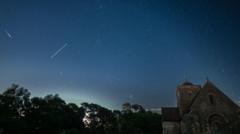
The Lyrid meteor shower isn't the busiest event on the celestial calendar—it usually manages about 18 to 20 meteors per hour—but it's famous for two things: high-speed fireballs and "trains" of glowing dust that linger for several seconds. In 2026, the timing is nearly perfect because the Moon won’t be around to ruin the view.
The 2am window you can't afford to miss
While the Lyrids are active from mid-April, the absolute peak hits in the early hours of April 22. Most people make the mistake of heading out at 10pm and giving up by 11pm. That’s a waste of time.
The radiant point—the spot in the sky where the meteors seem to originate—is near the constellation Lyra and the bright star Vega. This area of the sky doesn't get high enough in the UK until after midnight. This year, the waxing crescent Moon sets around 2am, leaving the sky properly dark just as the meteor activity starts to ramp up toward dawn.
If you want the best results, aim for that sweet spot between 2am and 4am. It’s the time when Earth is rotating directly into the debris stream of Comet Thatcher. Think of it like a car driving into a swarm of insects; the front windshield always gets the most hits.
Why Comet Thatcher makes the Lyrids special
We aren't just looking at random space rocks. Every Lyrid you see is a tiny piece of Comet C/1861 G1 Thatcher. This comet takes about 415 years to orbit the Sun. It hasn't been seen from Earth since 1861 and won't be back until 2276, but it leaves a trail of "litter" behind it every single time it passes through our neighbourhood.
When these particles hit our atmosphere at roughly 50km per second, they don't just burn; they compress the air in front of them so violently that it heats up to 1,600°C. That’s why you see those brilliant streaks. The Lyrids are some of the oldest recorded meteors in history, with Chinese astronomers documenting them as far back as 687 BCE.
Ditch the telescope and find a dark sky
The biggest rookie mistake is using a telescope or binoculars. Meteors move way too fast for that. You need a wide-view of the sky. Your eyes need at least 20 to 30 minutes to adjust to the darkness. If you look at your phone screen for even a second, you’ve just reset your night vision and won't see the fainter meteors for another half hour.
In the UK, light pollution is the enemy. If you’re in London, Birmingham, or Manchester, you’ll see the brightest fireballs, but you’ll miss 80% of the show. If you can, get yourself to an International Dark Sky Reserve.
- Exmoor National Park: The UK’s first dark sky reserve.
- Northumberland National Park: Features some of the darkest skies in England.
- South Downs: Great for those in the south, specifically spots like Ditchling Beacon.
- Eryri (Snowdonia): Offers incredible panoramas across the Welsh mountains.
Practical steps for a successful night
Don't just walk outside in your pyjamas. Even in late April, sitting still in a field at 3am in the UK is freezing.
- Bring a reclining chair: Looking straight up for an hour will kill your neck. A deckchair or a sun lounger is the pro move.
- Layer up: Bring more blankets than you think you need. A thermos of coffee or hot chocolate is basically mandatory.
- Look 45 degrees away from Lyra: While the meteors start near Vega, they actually look longer and more spectacular if you look slightly to the side of the radiant point.
- Check the cloud cover: Use an app like Clear Outside or a high-res weather satellite map. If it’s 100% overcast, stay in bed. Even the best meteor shower can't punch through thick UK cloud cover.
If the weather holds, 2026 is looking like a standout year for the Lyrids. The lack of moonlight after 2am means you’ve got a rare chance to see the subtle dust trains that usually get washed out by the lunar glow. Pack your gear, find a dark patch of grass, and keep your eyes off your phone.