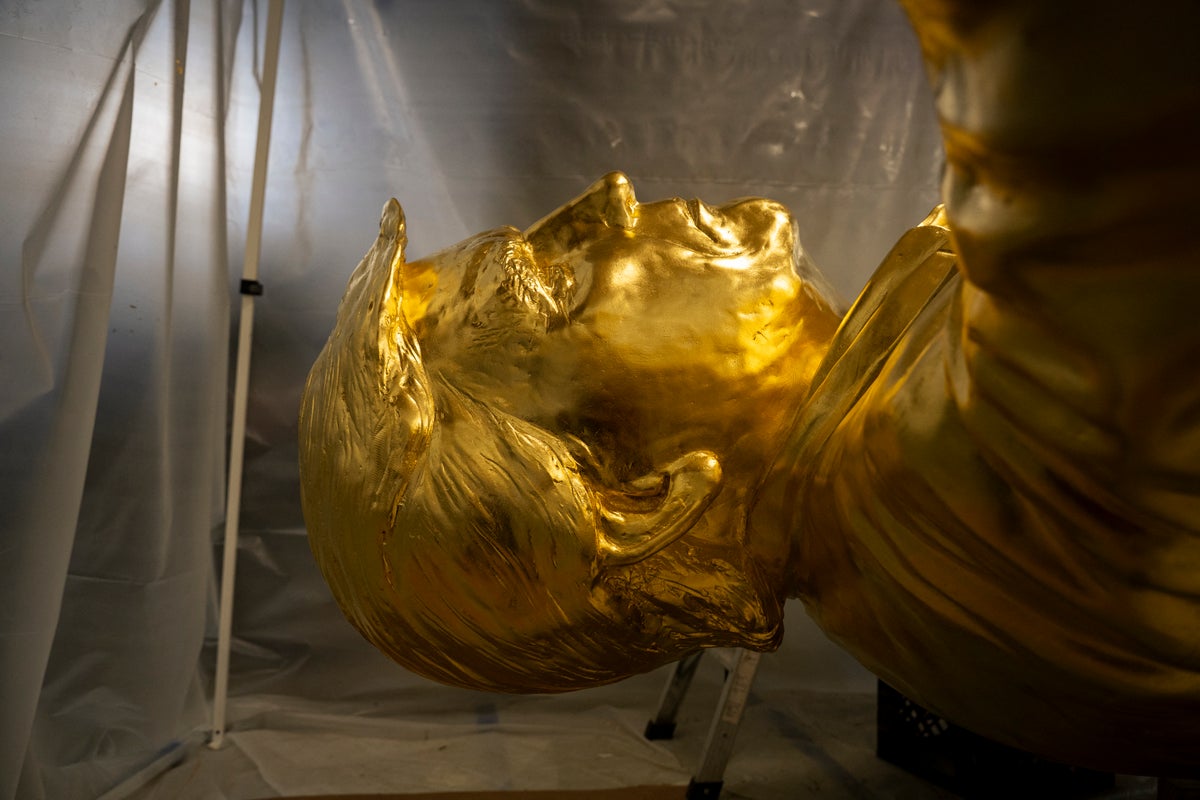
The media is currently hyperventilating over a sculptor’s claim that pitching gold-plated "add-ons" to the White House was like offering water to a man dying of thirst. The pearl-clutching is predictable. Commentators are framing this as a tale of vanity, excess, or predatory sales tactics. They are missing the entire point of how the high-end luxury economy actually functions.
This isn't a story about a statue. It is a story about the absolute failure of most professionals to understand the mechanics of price elasticity and the psychology of the "completionist" buyer.
When you are dealing with assets that possess no inherent utility—like a giant commemorative statue—the standard rules of "fair pricing" and "reasonable margins" do not apply. If you try to sell a luxury item based on the cost of materials plus a modest markup, you have already lost. The sculptor didn’t "exploit" a situation; he correctly identified a buyer whose demand for symbolic permanence was infinite.
The Myth of the Predatory Upsell
Most business schools teach you to solve a problem. In the ultra-high-net-worth (UHNW) market, you aren't solving problems. You are fulfilling identities. The "lazy consensus" suggests that a $60,000 gold leaf upgrade is an unnecessary luxury forced upon a distracted client.
Nonsense.
In the world of legacy-building, the "base model" is actually the insult. I have seen consultants try to play it safe with modest budgets for billionaire clients, only to be fired because the low price tag suggested the project wasn't important enough.
The sculptor’s "water to a man dying of thirst" analogy isn't an admission of guilt. It’s a clinical observation of a specific psychological state: The Achievement Void. When a client has reached the literal pinnacle of power or wealth, the only thing left to buy is the narrative of their own immortality. Gold isn't a material choice here. It’s a neurological requirement.
Why Value-Based Pricing Always Beats Cost-Plus
Let’s break down the math that the critics are getting wrong.
- The Relative Value Scale: To a standard consumer, $60,000 is a down payment on a house or a luxury SUV. To the White House or a multi-billion-dollar campaign apparatus, $60,000 is a rounding error. It is less than the cost of a few hours of private jet fuel.
- The Risk of the Ordinary: For a political figure, the greatest risk isn't overspending; it’s looking cheap. A statue that isn't "grand enough" becomes a punchline. The gold add-on is essentially an insurance policy against mediocrity.
- The Scarcity Premium: The sculptor isn't selling bronze. He is selling the exclusive right to own a specific vision.
If you are a service provider and you aren't offering a "Gold-Plated" tier that is five times more expensive than your standard offering, you are leaving money on the table. You are also denying your highest-tier clients the opportunity to feel like they’ve actually bought the best version of the truth.
The Thirst for Symbolic Capital
We need to stop pretending that government or high-level political spending is about efficiency. It never has been. It is about the acquisition of symbolic capital.
Pierre Bourdieu, the French sociologist, defined symbolic capital as the resources available to an individual on the basis of honor, prestige, or recognition. You cannot build symbolic capital through "sensible" spending. You build it through grandiosity.
The sculptor understood that his client wasn't thirsty for water; he was thirsty for a specific type of historical validation that only precious metals can signal. When the critic screams "excess," the insider sees "alignment." The sculptor aligned the physical weight and shine of the object with the perceived weight and shine of the office.
The Contrast Effect in High-Stakes Negotiation
People also ask: "How can anyone justify a $60,000 add-on?"
The answer lies in the Contrast Effect. If I walk into your office and ask for $60,000 for a gold-plated fountain pen, you'll kick me out. But if I am already building you a $2 million monument, $60,000 represents a 3% increase in total project cost to achieve a 100% increase in "wow factor."
In this context, the $60,000 isn't an "extra." It is a logic-gate. By saying "no" to the gold, the buyer is subconsciously admitting that the entire project might not be worth the ultimate effort. By saying "yes," they double down on the importance of the original investment.
Stop Apologizing for the Premium
The mistake the sculptor made wasn't the pitch. It was the way he spoke about it later. By using the "dying of thirst" analogy, he framed himself as a predator rather than a facilitator.
In business, if you provide a specialized, high-stakes service, you must embrace the "insane" price point.
- The Surgeon’s Fee: You don't pay for the 20 minutes of cutting; you pay for the 20 years it took to learn where to cut.
- The Artist’s Gold: You don't pay for the ounces of leaf; you pay for the courage to suggest that the work deserves it.
The downside to this contrarian approach is obvious: you will be called a grifter by those who don't understand the market. You will face public scrutiny. But you will also be the only one actually getting the commission. The "sensible" sculptors are the ones sitting in cold studios with empty order books, wondering why no one wants their "reasonably priced" busts.
The Brutal Reality of Legacy Projects
Legacy is not a budget-friendly endeavor. Whether it’s a tech founder building a $100 million bunker or a politician commissioning a giant statue, the goal is to outlast biological life.
When you are selling "forever," there is no such thing as an overcharge. The price is whatever the buyer is willing to pay to stop feeling mortal for five minutes.
If you want to disrupt your industry, stop looking at what things cost to make. Start looking at what they cost to miss. What is the cost of a statue that looks "just okay"? What is the cost of a branding campaign that feels "sufficient"?
The cost is irrelevance. And for the people at the top, irrelevance is a fate far worse than a $60,000 invoice.
Don't negotiate against yourself before you even walk into the room. If the man is thirsty, don't offer him a sip. Sell him the well, plate the bucket in gold, and send the bill to the history books.


