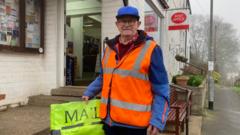
George Bailey isn't interested in your rocking chair or your morning talk shows. At 79 years old, he's still waking up at the crack of dawn to deliver newspapers in the village of Headcorn, Kent. Most people his age are busy figuring out which brand of orthopedic shoes to buy, but George is out there in the wind and rain, proving that the concept of "hanging it up" might be a massive mistake for our mental and physical health. It's a story that sounds like a relic of the past, yet it holds the secret to longevity that high-priced biohackers and Silicon Valley tech bros are desperately trying to bottle.
He started this "temporary" gig more than a decade ago. It was supposed to be a way to keep busy after he finished his career as a stockbroker and later worked in the golf industry. Now, several thousand papers later, he’s become a local legend. He covers a 2.5-mile route every single day. If you think that sounds easy, try doing it when the temperature hits freezing and your fingers are too numb to grip the newsprint. George doesn't care. He says he'll keep going until he literally can't walk anymore.
This isn't just a feel-good local news snippet. It's a direct challenge to the way we view aging. We’ve been sold a lie that the goal of life is to reach a finish line where we do absolutely nothing. George is showing us that the finish line is actually a trap.
The Physical Reality of the Daily Grind
Let’s talk about the biological advantage of being a 79-year-old paperboy. When you stop moving, you start dying. It’s that simple. Sarcopenia—the involuntary loss of skeletal muscle mass—is the enemy of anyone over 50. By staying active on a daily paper route, George is performing a functional workout that most gym-goers would envy. He’s walking, bending, reaching, and carrying weight. These are the exact movements that maintain bone density and balance.
Most elderly people fall because their stabilizer muscles have withered away from sitting on the couch. George is essentially training his body to stay upright every morning. He’s not doing it for the "gains." He’s doing it because the job requires it. That’s the key. When exercise is a byproduct of a meaningful task, you’re much more likely to stick with it than if you’re staring at a wall on a treadmill.
The numbers back this up. Studies from the Journal of Aging and Physical Activity show that consistent, low-impact movement is significantly better for long-term health than sporadic, high-intensity workouts. George’s 2.5-mile loop puts him well above the average step count for his age bracket. He’s outperforming people twenty years younger than him just by showing up for work.
Mental Sharpness and the Morning Routine
The hidden benefit of George’s lifestyle is the cognitive load. Delivering papers isn't just walking; it's logistics. You have to remember which house gets the Telegraph, who wants the Daily Mail, and who told you to leave the paper behind the blue planter instead of the porch. You’re navigating, timing your route, and interacting with neighbors.
This is "cognitive stimulation" in its purest form. When you retire and lose your routine, your brain starts to prune connections it thinks it no longer needs. If you aren't solving problems or meeting deadlines, your mental acuity drops. George has a deadline every single morning. People are waiting for their news. That sense of responsibility is a powerful drug for the human brain. It keeps the "executive function" of the prefrontal cortex engaged.
There’s also the social aspect. Loneliness is a literal killer for the elderly, often cited as being as dangerous as smoking fifteen cigarettes a day. George is a fixture in his community. He’s not isolated in a flat; he’s a visible, valued member of the neighborhood. He talks to people. He sees the world waking up. That connection to the community provides a sense of purpose that a pension check simply can't replace.
Why We Should All Be More Like George
We live in a culture obsessed with "passive income" and "early retirement." Everyone wants to quit the grind by 40. But look at the people who actually do it. Unless they find a massive, soul-consuming hobby, they often become miserable. They lose their "Why."
George Bailey has a "Why." His "Why" is making sure the people of Headcorn know what’s happening in the world before they’ve finished their first cup of coffee. It sounds small, but it's everything. It gives his day a structure and his life a narrative. Honestly, the idea of sitting around waiting for the end sounds a lot more exhausting than carrying a bag of newspapers in the rain.
We need to stop looking at work as a chore to be escaped and start seeing it as a mechanism for staying alive. Total leisure is a recipe for decay. George isn't working because he needs the money—he's a former stockbroker, after all. He’s working because he needs the work. He’s found the sweet spot between staying active and staying relevant.
The Logistics of Staying Active at 80
If you’re thinking about following in George’s footsteps—or at least staying active as you age—you can't just jump into a 2-mile hike tomorrow. George built up to this. He’s been doing it for eleven years. He started at 68, which is already past the standard retirement age.
For the rest of us, the lesson is about consistency over intensity. George doesn't skip days. He doesn't wait for "perfect weather." He’s out there in the "beast from the east" snowstorms and the summer heatwaves. That grit is what keeps him young. It’s a psychological toughness that translates into physical resilience.
If you want to maintain your health into your late 70s and 80s, you need to find your own version of the paper route. It could be volunteering at a local park, walking dogs, or even just committed daily gardening. The goal is to have a task that requires you to be somewhere at a certain time and involves physical movement.
What George Teaches Us About Modern Retirement
The traditional model of retirement—work for 40 years, then stop cold turkey—is fundamentally flawed. It’s a shock to the system that many people don't survive for long. George’s "bridge job" is a much healthier template. He transitioned from high-stress finance to low-stress, high-activity community service.
He’s not the only one. More and more seniors are returning to part-time work, not out of financial necessity, but for the "life force" it provides. The UK’s Office for National Statistics has noted a steady rise in the "unretirement" trend. People are realizing that the golf course gets boring after the first six months.
George’s story is a reminder that age is a number, but "old" is a state of mind. You become old when you stop contributing. You stay young by staying useful. As long as George can lift that bag and find the right front door, he’s not an old man—he’s just a man with a job to do.
If you’re staring down the barrel of retirement or already there, don't look for the easiest path. Look for the path that requires you to lace up your shoes and get outside. Find a reason to be out of the house before 8 AM. It doesn't have to be a paper route, but it should be something that people rely on you for. That weight on your shoulders might actually be what keeps you standing tall.
Start small. Find a local volunteer group that needs physical help. Offer to walk a neighbor’s dog at a specific time every day. Join a walking group that has a strict schedule. Build the habit of being "on the clock" for something other than yourself. Your brain and your body will thank you for the challenge.