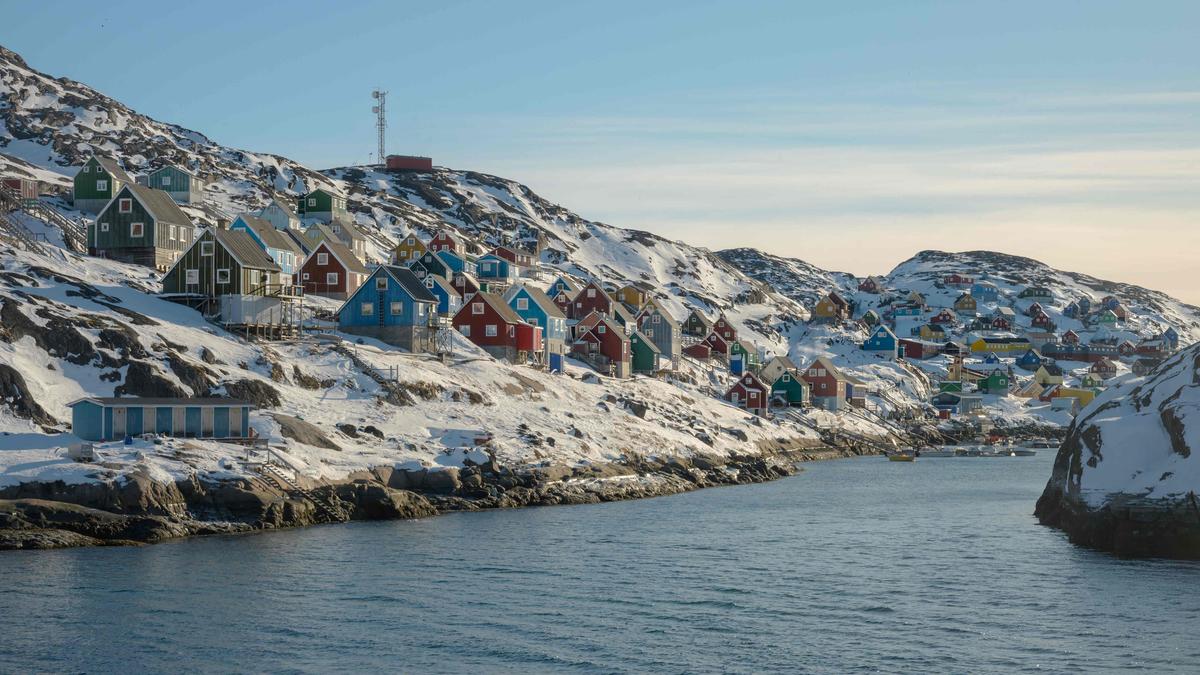
The proposed acquisition of Greenland by the United States is not a real estate transaction; it is a strategic maneuver to secure the North American Arctic perimeter and monopolize the critical mineral supply chains of the 21st century. While public discourse often focuses on the transactional rhetoric of the Trump administration, the underlying logic is driven by three distinct pillars of necessity: hemispheric security, resource hegemony, and the reconfiguration of Arctic logistics.
The Security Pillar: Closing the GIUK Gap 2.0
The primary driver for US interest is the structural vulnerability of the Arctic. As polar ice retreat opens new maritime corridors, Greenland has transitioned from a frozen buffer to a front-line geostructural chokepoint. The US military currently operates the Pituffik Space Base (formerly Thule Air Base) under a 1951 defense agreement, but this presence is limited by trilateral political complexities involving Nuuk and Copenhagen.
The "Golden Dome" defense strategy requires Greenland to serve as the northernmost node for integrated missile defense and early warning systems. Under current arrangements, the US lacks the sovereign authority to unilaterally expand infrastructure or deploy advanced sensors without navigating the Danish "Unity of the Realm" legal framework. Strategic control would effectively turn the island into an unsinkable aircraft carrier, sealing the "Greenland-Iceland-UK (GIUK) Gap" against Russian naval excursions and neutralizing Chinese ambitions to establish a "Polar Silk Road."
The Resource Pillar: Breaking the Rare Earth Monopoly
Greenland contains approximately 1.5 million tonnes of rare earth element (REE) reserves, ranking it eighth globally. The Kvanefjeld and Tanbreez deposits represent some of the world's largest untapped resources of heavy rare earths, tantalum, and niobium—elements essential for high-performance computing, missile guidance systems, and renewable energy infrastructure.
The current global REE supply chain is dominated by China, creating a single point of failure for US defense and technology sectors.
- The Extraction Bottleneck: High operational costs in Arctic environments have historically deterred private investment.
- The Sovereign Solution: By internalizing Greenland, the US could apply the Defense Production Act to subsidize extraction and processing, effectively de-risking the capital intensive mining sector.
- Hydrocarbon Potential: Estimates suggest 31 billion barrels of oil-equivalent lie off the northeastern coast. Control of these reserves would provide a strategic energy reserve for the North American bloc.
The Legal and Economic Friction Points
The acquisition face-off is defined by a clash between 19th-century territorial logic and 21st-century international law. The 2009 Greenland Self-Government Act recognizes Greenlanders as a "people" with a unilateral right to self-determination.
| Stakeholder | Position | Legal Leverage |
|---|---|---|
| United States | Annexation/Purchase | Economic pressure (tariffs) and security guarantees. |
| Denmark | Sovereign Guardian | Constitutional authority over foreign policy and defense. |
| Greenland | Self-Determination | Exclusive right to decide political status under the 2009 Act. |
The administration’s use of 10% to 25% tariffs on Denmark and other European allies in early 2026 illustrates a shift toward hyper-realism—using economic leverage to bypass traditional diplomatic norms. However, the legal bottleneck remains: Denmark cannot "sell" what it does not "own" in a fee-simple sense. The Greenlandic government’s "Open for Business, Not for Sale" stance signals a preference for a Resource-for-Infrastructure model over a Transfer-of-Sovereignty model.
The Strategic Path Forward
The path to US control likely involves a multi-stage integration rather than a singular purchase agreement. The "Davos Framework" established in early 2026 suggests a transition toward a "Compact of Free Association," similar to the relationship the US maintains with Palau or the Marshall Islands.
The first move in this sequence is the decoupling of Greenland's economy from the Danish block grant. Currently, Denmark provides an annual subsidy of approximately $600 million, representing roughly 20% of Greenland's GDP. A US strategy must focus on:
- Subsidy Replacement: Matching or exceeding the Danish block grant through direct federal transfers.
- Infrastructure Privatization: Funding the modernization of Greenlandic airports and deep-water ports through the US Export-Import Bank.
- Dual Citizenship Models: Offering US citizenship or special labor status to Greenlandic residents to mitigate "neo-colonial" resistance.
The failure to secure Greenland would leave a power vacuum in the North American Arctic. If the US cannot achieve sovereignty, it must move to establish a permanent, trilateral security zone that excludes non-Arctic actors (China) and limits Russian influence. The end state is clear: Greenland will either become a formal US territory or a high-security protectorate, as the cost of its neutrality has become too high for Washington to ignore.