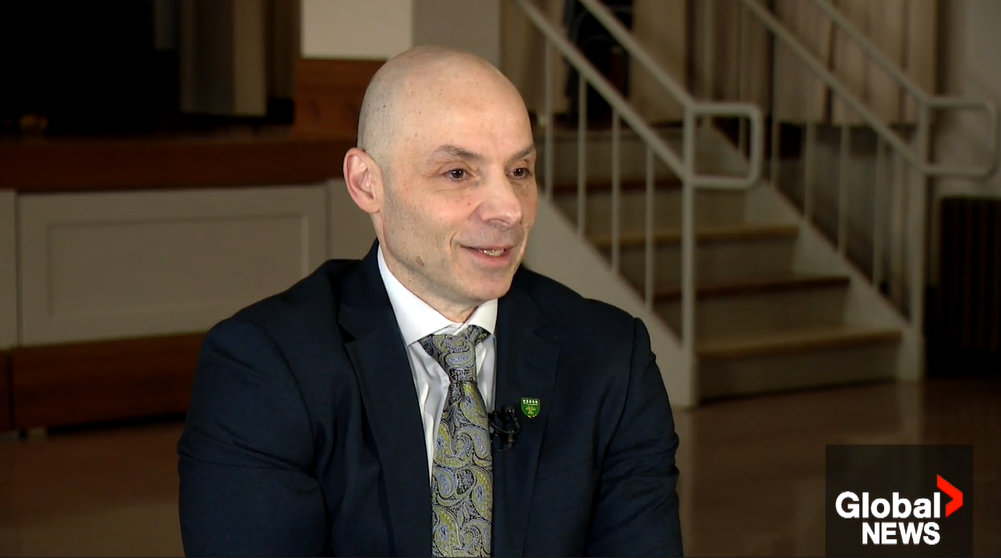
The air in a boardroom often tastes like stale coffee and recycled oxygen. It is a place where people go to trade certainties, to move numbers across a spreadsheet until the world makes sense again. But for Vince Bruni-Bossio, the boardroom isn't about the numbers. It is about the ghosts. Specifically, the ghost of what a company could be if it stopped tripping over its own feet.
Most people look at a bridge and see steel. They look at a university and see classrooms. They look at a Crown corporation and see a utility bill. Vince sees the tension. He sees the invisible web of governance, the unspoken rules of engagement, and the silent friction that occurs when two human beings try to accomplish a single task without a shared map.
He is not an architect of buildings. He is an architect of behavior.
The Friction of Being Human
Saskatchewan is a place defined by its vastness, but its true power has always been in how its people huddle together to survive the cold. This is the birthplace of the co-operative movement. It is a province that understands, perhaps better than any other, that we are stronger when we are organized. Yet, organization is the very thing that fails us most often.
Think of a hypothetical small-town council. Let’s call the town Oakhaven. The mayor wants a new hockey rink. The treasurer wants to fix the sewers. The citizens want lower taxes. In a standard "dry" world, this is a conflict of interest. In Vince’s world, this is a failure of governance.
Governance sounds like a word designed to induce sleep. It feels heavy, bureaucratic, and distant. But when a board of directors lacks a clear understanding of their role, the hockey rink doesn’t get built, the sewers overflow, and the taxes go up anyway. The human cost of bad governance is a community that loses its momentum.
Vince stepped into this gap not with a list of rules, but with a philosophy. He understood that you cannot force a group of people to work together by giving them a handbook. You have to give them a "why" that is louder than their "me."
The Classroom as a Laboratory
At the Edwards School of Business, the lectures aren’t just about theories. They are about the messy, unpredictable reality of leadership. When Vince stands in front of a room of MBA students, he isn't just delivering a curriculum. He is performing an autopsy on organizational failure.
Students arrive with a desire to "leverage" their skills—to use a word we should probably retire—but they leave understanding that leadership is an act of service. It is a gritty, often thankless process of aligning disparate egos toward a single horizon.
He teaches them that a strategy is a living thing. If you write it down and put it in a drawer, it dies. To keep it alive, you have to breathe into it every day through the way you treat your staff, the way you run your meetings, and the way you admit when you are wrong. It is about the "invisible infrastructure" of trust. Without it, the most expensive business plan is just expensive wallpaper.
The Weight of the Crown
In Saskatchewan, Crown corporations are the bedrock of the economy. They provide our power, our heat, our connection to the world. They are owned by the people. This creates a unique pressure. A private company answers to its shareholders; a Crown corporation answers to everyone who turns on a light switch.
When Vince works with these entities, the stakes are not merely financial. They are existential. If a Crown corporation loses its way, the entire province feels the shudder.
Governance here becomes a high-wire act. You have to balance the political desires of the government with the operational needs of the company, all while keeping the public’s trust. It is easy to see why so many boards succumb to "analysis paralysis." They are so afraid of making the wrong move that they make no move at all.
Vince’s approach is to strip away the clutter. He asks the questions that no one wants to answer:
- Who are we actually serving?
- What happens if we do nothing?
- Are we a board, or are we just a collection of opinions?
It is uncomfortable. It is necessary. It is the difference between a corporation that survives and one that thrives.
The Strategy of the Prairies
There is a specific kind of wisdom that comes from living in a place where you can see the weather coming from three days away. You learn to prepare. You learn that the harvest depends on the work you did months ago.
This Prairie sensibility runs through everything Vince does. He isn't interested in the latest management fads or the "disruptive" buzzwords that blow through Silicon Valley. He is interested in what lasts.
He looks at governance as a form of stewardship. You are holding the reins for a short time, and your only job is to leave the horse in better shape than you found it. This requires a level of humility that is rare in the upper echelons of business. It requires the leader to become invisible so the organization can become visible.
The Silent Architect
If you walk through Saskatoon, you won't see Vince’s name on a plaque on the side of a skyscraper. You won't see a "Bruni-Bossio Wing" at the hospital. His impact is found in the things that don’t happen.
It’s the crisis that was averted because a board had a clear conflict-of-interest policy. It’s the non-profit that didn't go bankrupt because their strategy was grounded in reality rather than wishful thinking. It’s the student who, ten years later, remembers that leadership is about people, not power.
We often celebrate the "visionaries"—the loud, charismatic figures who command the stage. But the world is actually held together by the people who fix the foundations. They are the ones who realize that if the basement is flooding, it doesn't matter what color you paint the living room.
Vince Bruni-Bossio is a reminder that the most important work is often the work no one sees. It is the quiet, steady pressure of a hand on the tiller, ensuring that the ship doesn't just move, but moves in the right direction.
In a world that is increasingly loud, chaotic, and divided, there is something deeply comforting about the idea of governance. It is the promise that we can, in fact, organize ourselves. We can be better. We can build things that outlast us.
But only if we are willing to look at the ghosts in the room. Only if we are willing to do the hard, unglamorous work of making sure the invisible infrastructure is strong enough to hold us all.
The next time you turn on a light, or walk through a university campus, or watch a local government debate, think about the structure beneath the surface. Think about the rules of the game. Then, think about the person who spent their life making sure those rules actually work for the people they are meant to serve.
One man. A thousand invisible successes. A province shaped by the quiet power of doing things right.
The coffee in the boardroom might still be stale, but the vision is finally clear.
Would you like me to develop a specific case study on how these governance principles saved a struggling organization?