The media is currently hyperventilating over a capsule falling into the Pacific Ocean. They call it a "triumphant return." They call it the "dawn of a new era." In reality, we are watching a $4 billion physics project prove that we are still remarkably bad at leaving our own backyard.
Ten days in high Earth orbit and a slingshot around the Moon is a glorified orbital loop-the-loop. While the press treats the Artemis II re-entry as a massive leap forward, the uncomfortable truth is that we are essentially using 1960s ballistics wrapped in 2020s touchscreens. We haven't solved space travel; we’ve just figured out how to afford the nostalgia trip.
The Heat Shield Delusion
The "success" of the Artemis II re-entry relies on the Orion thermal protection system (TPS). Everyone talks about the 5,000°F temperatures as if they are a badge of honor. They aren't. They are a symptom of inefficiency.
When Orion hits the atmosphere at 25,000 mph, it is performing a "skip re-entry." Think of a stone skipping across a pond. It’s a clever way to bleed off velocity and control where the capsule lands, but it is also a desperate admission that we have no better way to stop.
We are still throwing multi-billion dollar hardware at the atmosphere and praying the Avcoat ablative material burns off at exactly the right rate. If you want to know how far we haven't come, look at the chemistry. We are still using epoxy resins and silica fibers. We are essentially using a high-tech version of a charcoal grill cover to protect the "future of humanity."
True progress isn't surviving a fire-ball. True progress is avoiding the fire-ball entirely. Until we move toward magnetic braking or high-thrust propulsion that allows for powered descents from deep space, we are just playing a high-stakes game of lawn darts with human lives.
The Rocket Equation is Winning and NASA is Losing
The industry consensus is that Artemis is the foundation for Mars. That is a lie.
The tyranny of the rocket equation, famously expressed as $$\Delta v = v_e \ln \frac{m_0}{m_f}$$, remains undefeated. To get a tiny capsule back to Earth, we have to launch a skyscraper-sized SLS rocket. The mass fraction is embarrassing.
I’ve spent years looking at mission architectures where the "payload" is less than 2% of the total launch mass. Artemis II doesn't fix this. It doubles down on it. We are using expendable stages—throwing away the most expensive parts of the machine every time we fly—to keep a legacy supply chain alive.
If you want to get to Mars, you don't do it with a capsule that requires a 10-day recovery operation by the U.S. Navy. You do it with infrastructure. You do it with orbital refueling and nuclear thermal propulsion (NTP). NASA knows this, but the Artemis program is built on political optics, not kinetic efficiency. We are celebrating a splashdown because it’s easy to film. It’s "The Right Stuff" for the TikTok era.
The Astronaut Myth
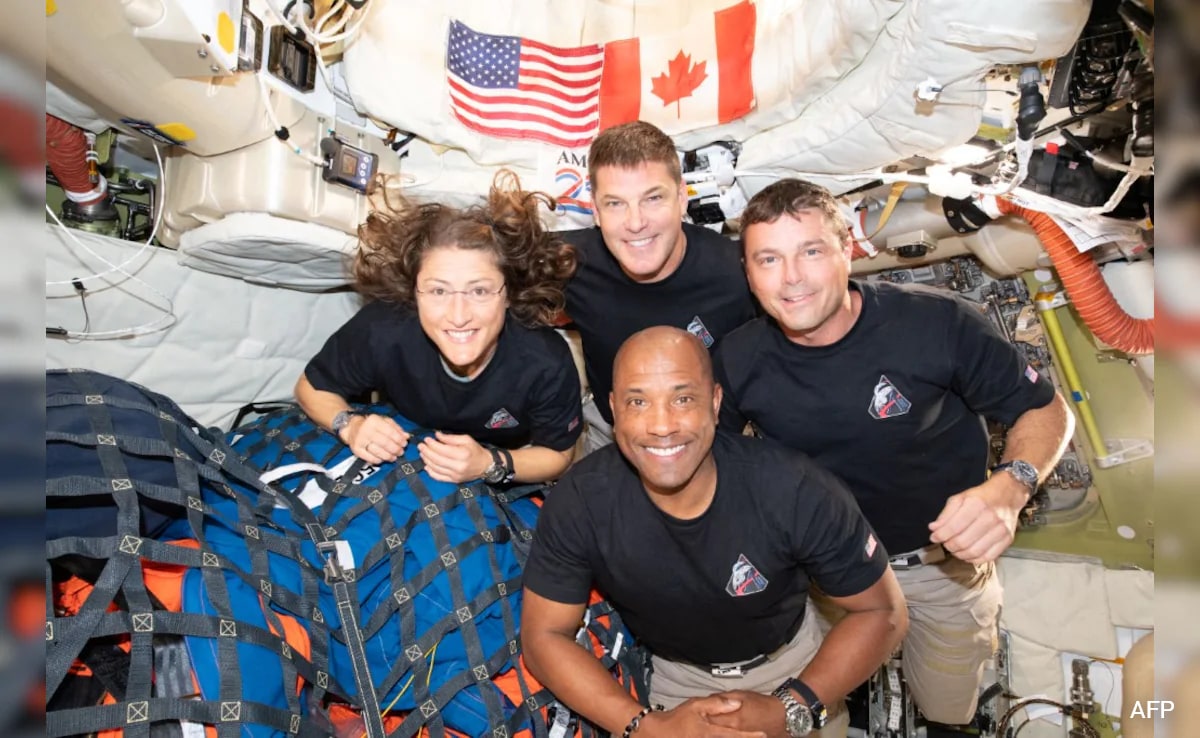
We treat the four crew members like explorers. They are, in fact, highly trained passengers.
On a 10-day mission, the Orion capsule is almost entirely autonomous. The crew is there for data collection and, more importantly, for the narrative. Space exploration has become a soft-power exercise rather than a scientific one.
The "People Also Ask" sections of the internet are filled with questions like, "Why is it taking so long to go back to the Moon?" The answer isn't "safety" or "complexity." The answer is that we lost the industrial capacity to be bold. We have traded the risks of the 1960s for the bureaucracy of the 2020s.
We are so risk-averse that we spend $100,000 on a single bolt, yet we still rely on parachutes—a technology that predates the airplane—to ensure the crew doesn't turn into a crater upon impact.
The False Economy of Deep Space
The competitor articles will tell you that Artemis II is "cost-effective" compared to Apollo. This is a creative accounting trick.
The Space Launch System (SLS) costs roughly $2 billion per launch. That doesn't include the $20 billion plus spent on development. When you factor in the Orion capsule and the ground systems, each Artemis mission is a fiscal black hole.
Compare this to the private sector's approach. While NASA is patting itself on the back for a successful splashdown, companies like SpaceX are iterating on Starship—a vehicle designed to land vertically, be refueled in orbit, and carry 100 tons, not four people and some freeze-dried ice cream.
The Artemis II re-entry is the swan song of the "Single-Use Space" era. It is the final gasp of a philosophy that treats space as a place to visit, rather than a place to stay.
The Radiation Problem No One Mentions
The media loves the "10-day" figure. It sounds manageable. But Artemis II sends humans through the Van Allen radiation belts and into deep space without the Earth’s magnetosphere for protection.
NASA will tell you the Orion shielding is sufficient. But "sufficient" is a legal term, not a biological one. We are still guessing about the long-term effects of galactic cosmic rays (GCRs) on human DNA. By focusing on the "victory" of the splashdown, we are ignoring the fact that we have no viable solution for the 180-day transit to Mars.
Orion is a lifeboat being marketed as a cruise ship.
Stop Applauding the Bare Minimum
We have been conditioned to accept incrementalism. We see a capsule bobbing in the water and we think "Space Age."
If you want to be a contrarian, stop looking at the capsule. Look at the water. Look at the fact that we still need a massive naval fleet to retrieve our "cutting-edge" tech.
A real spacefaring civilization doesn't land in the ocean. It lands on a pad, recharges, and flies again. Artemis II is a feat of engineering, but it is a failure of imagination. It is a $28 billion dollar way of saying we still don't know how to fly.
The splashdown isn't the beginning. It's the most expensive victory lap in history for a race we already won sixty years ago.
Quit cheering for the firework and start demanding the engine.