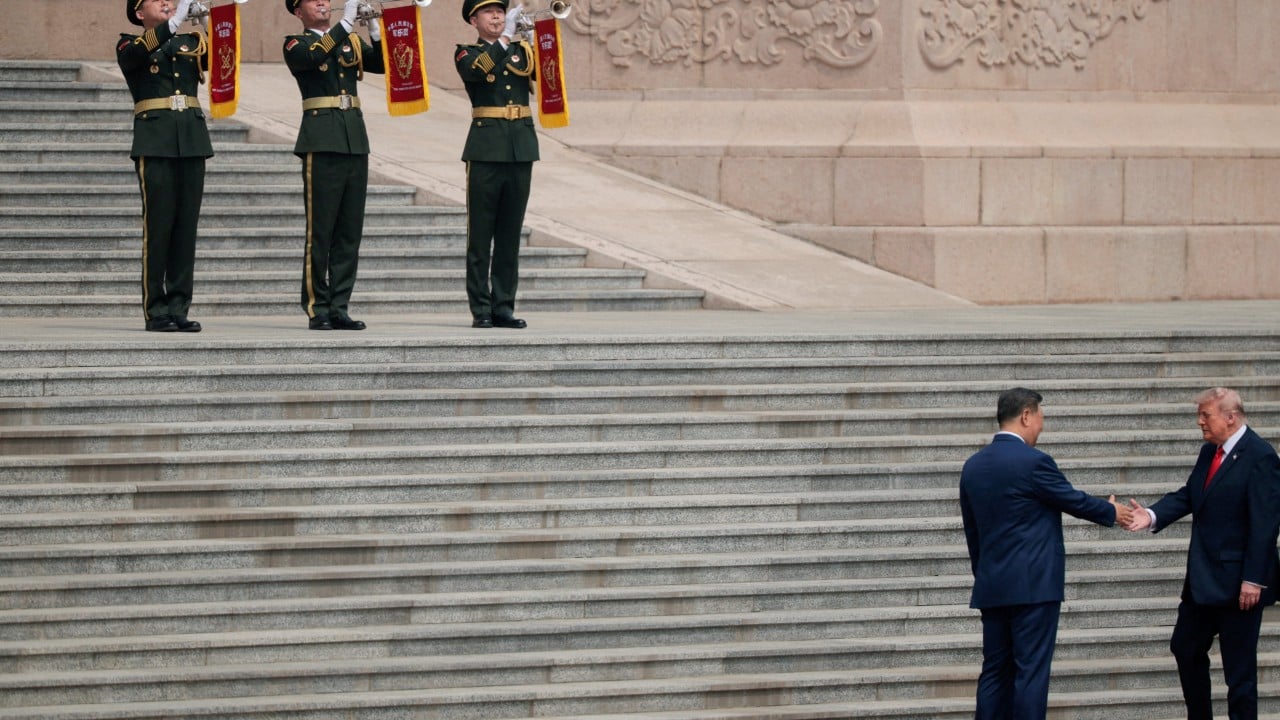
The strategic outcome of the Trump-Xi summit was codified not in the final communiqué, but in the structural preconditions established months before the principals met. Beijing’s victory was a function of asymmetric anchoring: the process of defining the negotiation’s success through the restoration of a status quo that favored China, while simultaneously pricing in American threats as sunk costs. By the time negotiations commenced, the U.S. executive branch was negotiating against its own political clock, whereas the Chinese Communist Party (CCP) was negotiating against a static geopolitical architecture.
The Mechanics of Structural Inertia
Beijing’s primary strategic objective was the decoupling of trade concessions from systemic industrial policy reform. To achieve this, they employed a three-tier defensive framework:
- Temporal Arbitrage: Recognizing that the U.S. electoral cycle creates a "decay function" on negotiation leverage, Beijing extended the timeline. Every month of delay increased the political cost of failure for the American administration, shifting the burden of reaching a "deal" onto Washington.
- Commodity Substitution as a Tactical Valve: By halting purchases of U.S. agricultural products and then offering to resume them as a "concession," Beijing effectively sold the same horse twice. They transformed a standard trade flow into a high-value bargaining chip without making a single structural change to their state-owned enterprise (SOE) model.
- Regulatory Entrenchment: While the U.S. focused on tariffs—a transparent and easily reversible tool—China deepened its internal "Dual Circulation" strategy. This ensured that even if tariffs were lowered, the internal Chinese market remained structurally biased toward domestic champions through non-tariff barriers that are notoriously difficult to quantify or litigate.
The Cost Function of American Escalation
The U.S. strategy relied on the assumption that the Marginal Cost of Tariffs (MCT) for China would eventually exceed the Political Cost of Reform (PCR). This was a fundamental miscalculation of the Chinese state’s internal utility function.
For the CCP, the PCR is effectively infinite because structural reform—specifically the removal of state subsidies and the protection of intellectual property—directly undermines the party’s control over the economy. Conversely, the MCT is manageable through currency devaluation and state-directed credit expansion. When $MCT < PCR$, the escalation strategy fails to induce behavioral change and instead becomes a tax on the domestic American consumer.
The American side entered the summit seeking a "Game-Changing" realignment of the global order but lacked the domestic consensus to sustain the long-term economic pain required to force that shift. Beijing identified this lack of internal cohesion. They observed the pressure from the U.S. agricultural and manufacturing lobbies and correctly hypothesized that Washington would eventually accept a "Purchase-Plus" agreement—large-scale buying of U.S. goods—in lieu of the fundamental structural overhaul originally demanded.
The Asymmetry of Success Definitions
Success for Washington was defined by Verification and Enforcement: the ability to legally compel China to change its domestic laws. Success for Beijing was defined by De-escalation and Preservation: stopping the immediate tariff increases while keeping the "Made in China 2025" framework intact.
Beijing’s victory was secured by moving the goalposts from "Structural Change" to "Stability." By creating a volatile global market environment, they forced the U.S. into a position where "success" was simply the absence of further chaos. This is a classic defensive maneuver in high-stakes diplomacy: make the alternative to your proposal so unpalatable that your opponent views a return to the previous, unfavorable equilibrium as a win.
The logic follows a specific sequence:
- Step 1: Absorb the initial shock of tariffs to demonstrate resilience.
- Step 2: Initiate targeted retaliation against the opponent’s most politically sensitive sectors (e.g., the Midwest).
- Step 3: Offer a "path to peace" that addresses the symptoms (trade deficit) while ignoring the pathology (forced technology transfer).
- Step 4: Secure a handshake that provides the opponent a political exit ramp while preserving the long-term strategic trajectory.
The Intellectual Property Extraction Bottleneck
A central pillar of the U.S. argument was the theft of intellectual property (IP). However, the summit failed to address the Velocity of IP Absorption. Even if China agreed to stop forced transfers today, the previous decade of extraction has already moved Chinese firms up the value chain to a point of self-sustaining innovation in sectors like 5G, AI, and battery technology.
The U.S. was negotiating for the return of the stable door long after the horse had not only bolted but had already built its own ranch. The "victory" claimed by Beijing lies in the realization that the U.S. has no mechanism to claw back lost advantage. Financial penalties are a poor substitute for lost technological hegemony.
Strategic Divergence in Capital Allocation
During the lead-up to the summit, the divergence in how both nations utilized the "pause" in hostilities was telling. The U.S. private sector remained in a state of paralysis, delaying Capital Expenditure (CapEx) due to uncertainty. Beijing, meanwhile, used the state-controlled banking system to aggressively fund domestic semiconductor and aerospace development.
This creates a permanent shift in the Total Factor Productivity (TFP) of the two nations. While Washington viewed the summit as a discrete event to be won or lost, Beijing viewed it as a maintenance interval in a multi-decade cycle of industrial displacement.
The Failure of Multilateral Alignment
The U.S. chose to engage in a bilateral confrontation, which allowed China to play the role of the "defender of the global trading system" in forums like the WTO. This is a profound irony, but a successful one. By not aligning with the EU and Japan—who share similar grievances regarding Chinese subsidies—the U.S. allowed Beijing to isolate the conflict as a "Trump-Xi" personality clash rather than a systemic challenge to the global order.
China’s ability to maintain trade relations with the rest of the world while in a trade war with the U.S. meant that the "Iron Curtain" was only one-sided. American companies lost market share to European and South Korean competitors, a cost that Beijing was happy to facilitate to weaken American resolve.
The Tactical Superiority of the "Phase One" Trap
The "Phase One" agreement, which emerged as the summit's centerpiece, was a masterclass in tactical containment. It focused on quantifiable metrics—billions of dollars in soybean and aircraft purchases—which are easy for a central government to mandate but provide zero long-term security for the American economy.
These purchase agreements are inherently fragile. They can be turned off as easily as they were turned on, giving Beijing a permanent "kill switch" for American agricultural prosperity. By accepting this framework, the U.S. traded its primary leverage (tariffs) for a temporary revenue stream that is entirely dependent on the goodwill of the Chinese state.
Definitive Forecast: The Institutionalization of Cold Peace
The trajectory following the summit does not point toward a resolution, but toward the Institutionalization of Cold Peace. Both powers are now incentivized to continue the theater of negotiation while simultaneously accelerating the "Great Decoupling."
China will continue to:
- Onshore Critical Supply Chains: Reducing vulnerability to U.S. sanctions (the "Huawei Lesson").
- Weaponize its Consumer Market: Using access to 1.4 billion people as a deterrent against foreign policy "interference."
- Diversify Reserves: Moving away from USD-denominated assets to insulate against potential financial warfare.
The U.S. has effectively exhausted the "tariff-first" model of diplomacy. Future administrations will find that the "China shock" has been absorbed and that the leverage required to force systemic change has been permanently diluted. The strategic play for the U.S. must now shift from trying to change China to aggressively subsidizing its own industrial base and forming a "Buyer’s Club" of democratic economies to dictate the terms of the next generation of technology standards.
Beijing won not because they are stronger, but because they understood the U.S. system better than the U.S. understood theirs. They recognized that in a democracy, the loudest voices are the ones losing money today, whereas in an autocracy, the only voice that matters is the one planning for ten years from now. The summit was merely the formal recognition of this asymmetrical reality.