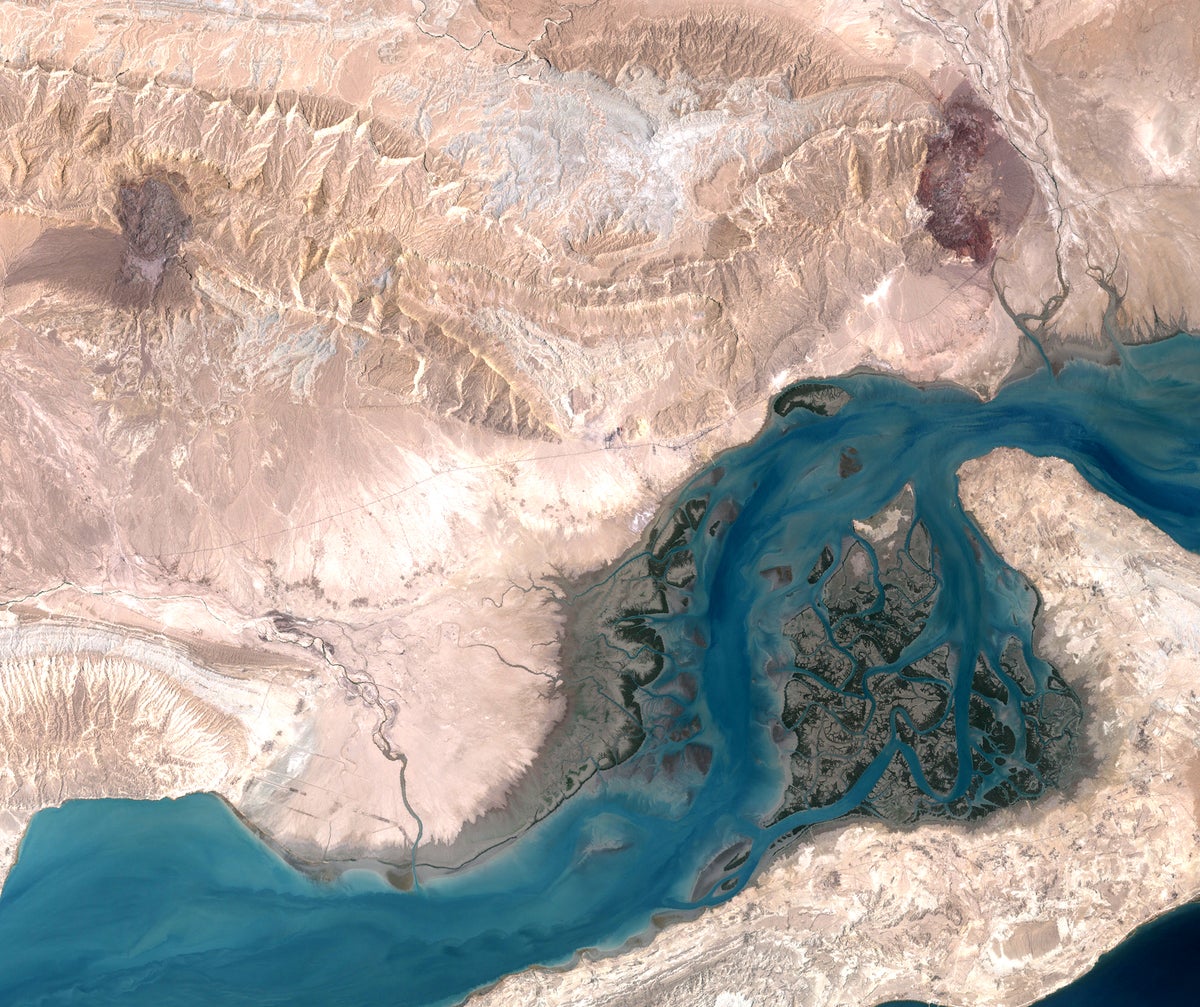
The Strait of Hormuz serves as a 21-nautical-mile choke point where 20% of global petroleum liquids pass daily, creating a high-stakes environment where geography dictates military strategy. Qeshm Island, the largest landmass in the Persian Gulf, functions not merely as a defensive outpost but as a fixed aircraft carrier integrated into a sophisticated subterranean network. This "missile city" architecture represents a shift from conventional naval engagement to a strategy of persistent, land-based maritime denial. By embedding kinetic assets within the island’s geological strata, Iran has established a survivable launch platform that threatens the operational freedom of U.S. Fifth Fleet assets and commercial shipping alike.
The Geostrategic Calculus of Qeshm
Qeshm’s utility is defined by its proximity to the world’s most vital maritime transit lanes. The island sits at the elbow of the Strait, allowing for overlapping fields of fire that cover both the inbound and outbound shipping lanes. This creates a structural bottleneck where the speed of decision-making for a naval commander is compressed by the short flight times of land-based projectiles. For a different look, check out: this related article.
The Triad of Coastal Denial
The Iranian strategy on Qeshm relies on three distinct technical pillars:
- Subterranean Survivability: The use of "missile cities"—hardened underground facilities (UGFs)—negates the traditional advantage of aerial surveillance and precision strikes. These facilities are tunneled into the island’s salt domes and sandstone, providing hundreds of meters of natural shielding against bunker-buster munitions.
- Distributed Lethality: Rather than concentrating force in a single visible base, assets are dispersed across mobile transporter-erector-launchers (TELs) that emerge from UGFs, fire, and relocate within minutes. This "shoot-and-scoot" cycle exploits the time-lag in enemy targeting loops.
- Sensor Fusion and Multi-Domain Targeting: Qeshm acts as a hub for coastal radar, signal intelligence (SIGINT) stations, and drone launch pads. This integrated network provides a real-time Common Operational Picture (COP), allowing for the synchronization of missile strikes with fast-attack craft swarms.
Technical Specifications of the Missile Arsenal
The effectiveness of the Qeshm fortress is predicated on the specific physics of the munitions housed there. The Islamic Revolutionary Guard Corps (IRGC) has transitioned from unguided rockets to high-precision anti-ship cruise missiles (ASCMs) and anti-ship ballistic missiles (ASBMs). Further coverage on this trend has been published by BBC News.
Kinetic Profiles and Engagement Envelopes
The arsenal typically includes the Noor and Ghadir series of ASCMs. These systems utilize active radar homing and fly at sea-skimming altitudes to delay detection by shipborne Aegis Combat Systems.
- Noor (C-802 Variant): Range of approximately 120km, turbojet-powered, carrying a 165kg semi-armor-piercing warhead.
- Ghadir: An evolved variant with a range extending to 300km, allowing it to strike targets well into the Gulf of Oman or deep within the Persian Gulf from the safety of Qeshm’s interior.
- Khalij Fars (ASBM): This is a supersonic, solid-fueled ballistic missile. Unlike cruise missiles, it approaches from a near-vertical terminal angle at speeds exceeding Mach 3, making interception via standard Close-In Weapon Systems (CIWS) significantly more difficult.
The mathematical reality of a saturation attack from Qeshm is a function of "leaking" probabilities. If a carrier strike group’s defense system has a 95% intercept rate, a simultaneous launch of 20 missiles from Qeshm creates a statistical certainty that at least one projectile will impact the hull.
The Engineering of Subterranean Fortresses
The construction of "missile cities" on Qeshm is an exercise in hardening the kill chain. These are not simple bunkers; they are self-contained ecosystems designed to sustain operations during a sustained bombardment.
Structural Logic of UGFs
The IRGC utilizes the island's unique geology—specifically the Namakdan salt caves and surrounding ridges—to mask heat signatures and electronic emissions. The UGFs are characterized by:
- Vulnerability Mitigation: Entry and exit points are often angled or shielded by heavy blast doors to redirect the overpressure from thermobaric weapons.
- Logistical Redundancy: Internal rail systems and automated loaders allow for the rapid rearming of TELs without exposing personnel to the surface.
- EMCON (Emission Control) Protocols: Fiber-optic communication lines buried deep underground prevent the interception of command-and-control signals that would otherwise give away launch sequences.
This architectural approach shifts the burden of proof to the attacker. To neutralize the threat from Qeshm, an adversary must commit to a high-intensity campaign of "bunker busting" that risks significant collateral damage and international condemnation, given the island's civilian population and UNESCO Global Geopark status.
The Economic Attrition Model
The Qeshm missile infrastructure introduces a massive cost-imbalance in maritime security. The financial and strategic "rent" extracted by Iran simply through the presence of these systems is substantial.
The Cost-Exchange Ratio
Consider the economic disparity in a standard engagement:
- Iranian Cost: A single Ghadir missile costs an estimated $100,000 to $150,000.
- U.S./Allied Cost: A single RIM-162 Evolved SeaSparrow Missile (ESSM) or SM-2 interceptor costs between $1 million and $2 million.
In a prolonged conflict, the IRGC can achieve "mission kill" on a multi-billion dollar destroyer by simply exhausting its magazine of expensive interceptors using a flurry of low-cost munitions. This is the essence of asymmetric warfare: forcing the high-tech actor to trade expensive, limited resources for cheap, mass-produced threats.
Electronic Warfare and the Fog of the Strait
Qeshm is not just a platform for physical projectiles; it is a center for electronic disruption. The IRGC Navy (SNA) employs sophisticated GPS jamming and spoofing techniques from the island to misdirect commercial shipping. By altering the perceived position of a vessel, Iran can maneuver ships into territorial waters, providing a legal pretext for seizure.
The integration of unmanned aerial vehicles (UAVs) like the Ababil and Mohajer series from Qeshm provides over-the-horizon targeting. These drones serve as the "eyes" for the missile cities, transmitting mid-course guidance corrections to ASCMs. This reduces the reliance on land-based radar, which is easily detected and targeted by anti-radiation missiles.
Strategic Bottlenecks and Counter-Interdiction
The primary objective of the Qeshm fortress is the enforcement of a "Closed Strait" scenario. If hostilities break out, the IRGC does not need to destroy every ship; it only needs to sink one or two large tankers in the narrowest part of the channel.
The Wreckage as a Weapon
A sunken VLCC (Very Large Crude Carrier) in the shipping lane creates a physical and environmental barrier that would take weeks, if not months, to clear. Qeshm’s missiles are the tools to create this blockage. The threat alone inflates insurance premiums (war risk surcharges), effectively taxing the global economy without firing a single shot.
The limitations of this strategy, however, are found in its binary nature. Once the "missile city" assets are utilized, the element of ambiguity is lost. The static nature of the island means that while the launchers are hidden, the general location of the threat is known. This allows for the pre-positioning of specialized counter-battery assets and the use of hyper-spectral imaging to identify subtle changes in the terrain that indicate UGF exits.
Operational Forecast for the Hormuz Corridor
The presence of the Qeshm missile city necessitates a transition in Western naval doctrine from "Presence" to "Distributed Maritime Operations" (DMO). Large, concentrated naval formations are increasingly liabilities in the face of Qeshm’s land-based reach.
The immediate strategic play involves:
- Passive Defense Scaling: Increased reliance on directed-energy weapons (lasers) to alter the cost-exchange ratio of missile defense.
- Autonomous Counter-Swarms: Deploying undersea and surface drones to provide a screening layer that can identify and neutralize ASCM launches at the source.
- Kinetic Decoupling: Shifting the reliance of regional energy exports toward pipelines that bypass the Strait, such as the East-West Pipeline in Saudi Arabia or the Habshan–Fujairah pipeline in the UAE, to devalue the leverage provided by the Qeshm fortress.
The escalation ladder in the Strait of Hormuz is now anchored to the geological stability of Qeshm. As long as the "missile cities" remain operational and hidden, the island functions as a permanent veto on the flow of global energy, requiring a total recalibration of how maritime power is projected in confined waters.