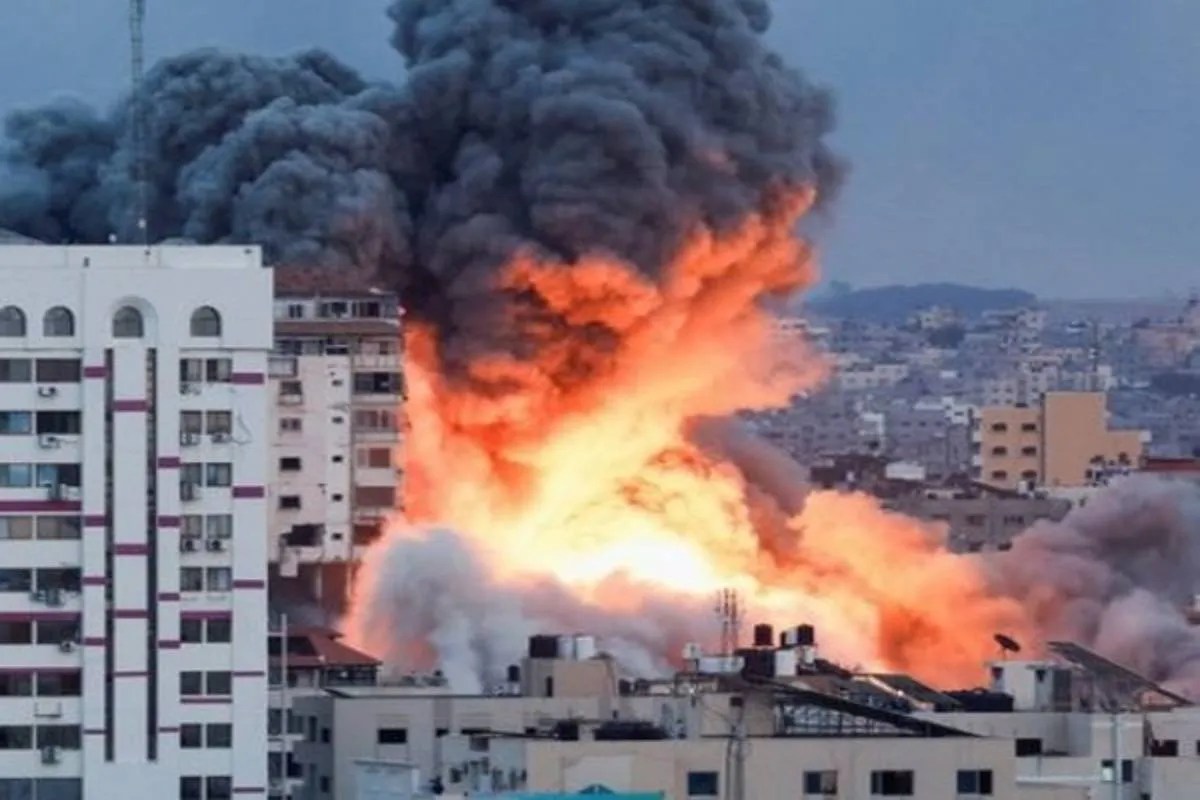
The recent intensification of hostilities between Israel and Hezbollah along the Blue Line represents a shift from reactive skirmishing to a systematic attrition model. While headline-driven reports focus on the visceral impact of individual strikes, the underlying reality is a calculated exchange of "Escalation Dominance." This concept dictates that the side capable of responding to any level of force with a slightly higher, more painful level of force maintains strategic control. Currently, this dominance is being tested through dual-axis strikes—simultaneous kinetic actions targeting both frontline military infrastructure and rear-area logistical nodes.
The Mechanics of Dual-Axis Offensive Operations
The "simultaneous big attacks" referenced in regional reports are not random acts of aggression. They function within a specific operational framework designed to overwhelm Integrated Air Defense Systems (IADS).
- The Saturation Variable: By launching large volumes of low-cost projectiles (Katyusha rockets or mortar fire) in conjunction with high-precision assets (Anti-Tank Guided Missiles or One-Way Attack drones), Hezbollah attempts to force a binary choice on the Iron Dome and David’s Sling systems. The defender must either deplete high-cost interceptors on low-value targets or risk allowing high-precision munitions to reach critical infrastructure.
- Geospatial Divergence: Attacking two distinct border sectors simultaneously forces the redistribution of Israeli Intelligence, Surveillance, and Reconnaissance (ISR) assets. When focus is split between the Western sector (near Rosh HaNikra) and the Eastern sector (near Kiryat Shmona), the probability of a successful "blind spot" penetration increases.
- The Sensor-to-Shooter Gap: The primary objective of these dual strikes is to widen the window between a launch being detected and an interceptor being fired. By creating multiple points of origin, the attacker forces the automated command-and-control systems to re-prioritize targets in real-time, inducing millisecond delays that can be the difference between a successful interception and a kinetic impact.
The Cost Function of Attrition
The economic and psychological toll of this conflict is better understood through a cost-benefit analysis of the "Buffer Zone" strategy. Israel has effectively evacuated a significant portion of its northern population, creating a self-imposed internal displacement crisis.
- The Maintenance Cost of Displacement: For every month the northern border remains a high-risk zone, the Israeli state incurs massive expenditures in housing subsidies, lost agricultural productivity in the Galilee, and the degradation of civilian morale.
- The Ammunition Asymmetry: There is a profound disparity in the "Unit Cost of Kill." A Hezbollah-launched drone or unguided rocket may cost between $500 and $10,000. An Iron Dome Tamir interceptor costs approximately $40,000 to $50,000. In a protracted war of attrition, the financial drain on the defender scales faster than the drain on the attacker, provided the attacker maintains a steady supply chain of low-tech munitions.
- The Degeneration of Deterrence: Deterrence is a psychological state backed by physical capability. When Hezbollah demonstrates the ability to strike "two large targets at once," they are communicating that the Israeli "Red Lines" are porous. This erodes the perceived security of the Israeli state, which is a core pillar of its national identity and economic stability.
Structural Vulnerabilities in Border Defense
Defending a mountainous, densely vegetated border like the one between Israel and Lebanon presents unique topographical challenges that favor the insurgent actor.
The Topographical Advantage
Hezbollah utilizes the high ground of the Jabal Amel region to maintain line-of-sight (LOS) for direct-fire weapons like the Kornet-EM. Because these missiles utilize laser beam riding or wire-guidance, they are largely immune to electronic warfare (EW) jamming that might disrupt GPS-guided munitions. This creates a "Kill Zone" within 5-10 kilometers of the border where armored vehicles and fixed outposts are perpetually vulnerable.
The Tunnel-Infrastructure Multiplier
The tactical depth of Hezbollah is not found in its surface footprint but in its subterranean network. This infrastructure allows for the "Pop-Up" attack method: teams emerge from hidden shafts, fire a salvo, and retreat before Israeli counter-battery radar can triangulate the position and direct a strike. This negates the traditional Israeli advantage in air superiority, as the Israeli Air Force (IAF) cannot loiter indefinitely over every potential exit point.
The Role of Precision Loitering Munitions
The evolution of the conflict has seen an increased reliance on "Kamikaze" drones. Unlike traditional rockets, these systems provide a "Man-in-the-Loop" capability, allowing the operator to adjust the target in real-time or loiter until a high-value target (such as a command vehicle) appears.
The technical bottleneck for Israel in countering these drones is not just detection but classification. Small, low-RCS (Radar Cross Section) drones made of carbon fiber or plastic are difficult for traditional radar to distinguish from birds or ground clutter. Even when detected, their low-speed, low-altitude flight profiles make them difficult to engage with high-speed jet interceptors, necessitating the use of electronic jamming or localized "Iron Beam" laser systems which are still in the process of full-scale deployment.
Strategic Constraints and the Risk of Total War
Both actors are currently operating under a "Limited War" protocol, despite the escalating rhetoric. A transition to "Total War" would involve a fundamental shift in target selection and volume.
- Target Hierarchy: Currently, strikes are largely confined to military targets, communication towers, and border towns. A shift to "Total War" would see Hezbollah targeting the Haifa refineries or the Tel Aviv power grid, while Israel would likely target Lebanese national infrastructure (airports, bridges, and the power utility) to create internal political pressure on Hezbollah.
- The Intelligence Paradox: Israel possesses world-class signals intelligence (SIGINT), yet it struggles to stop localized tactical strikes. This is because SIGINT is most effective against centralized command structures. Hezbollah’s decentralized "Cell" structure allows local commanders to execute strikes autonomously based on broad directives, leaving few electronic footprints for Israeli intelligence to intercept before the launch occurs.
The Logic of the Response Cycle
The "fierce strike" reported is a component of a larger "Feedback Loop."
- Action: Hezbollah strikes a sensitive target (e.g., a surveillance hub).
- Reaction: Israel conducts deep-penetration strikes in the Bekaa Valley or Southern Lebanon.
- Re-calibration: Hezbollah assesses the damage and responds with a "Dual-Axis" strike to prove that the Israeli reaction did not degrade their capability.
This loop is inherently unstable. Each cycle requires a slightly more aggressive response to maintain the "Deterrence Balance." If Israel strikes deeper, Hezbollah responds with more volume. If Hezbollah uses more volume, Israel considers a ground maneuver. The risk of a "Cascade Failure"—where a single strike causes accidental high-volume civilian casualties, forcing a political mandate for full-scale invasion—is at its highest point since 2006.
Operational Recommendations for Strategic Stabilization
For the Israeli defense establishment, the current "Active Defense" posture is reaching its limit of effectiveness. To break the attrition cycle without a full-scale ground invasion (which carries immense political and human costs), a shift in the operational "Payoff Matrix" is required.
- Kinetic Decoupling: Israel must decouple its response from the immediate geographic area of the Hezbollah strike. By targeting the financial and logistical pipelines that sustain the organization—specifically those entering via the Syrian border—Israel can degrade Hezbollah’s long-term capability without necessarily triggering a localized escalation on the Blue Line.
- Infrastructure Hardening vs. Mobility: The reliance on fixed border outposts is a liability in an era of precision ATGM fire. The IDF must transition toward a "Mobile-Sensing" posture, where the border is monitored by unmanned ground vehicles (UGVs) and high-altitude long-endurance (HALE) drones, reducing the "Target Profile" for Hezbollah’s direct-fire teams.
- Electronic Shielding Expansion: Widespread deployment of localized GPS-spoofing and high-powered microwave (HPM) systems can create "Dead Zones" for drone navigation, effectively neutralizing the loitering munition threat without the high cost of kinetic interceptors.
The conflict has moved beyond a simple border dispute; it is now a laboratory for 21st-century asymmetric warfare. The side that wins will not be the one with the most firepower, but the one that manages its "Atrophic Costs" most effectively while maintaining the technical edge to negate the opponent's precision strikes. The immediate strategic priority is the restoration of the northern population, which requires not just a ceasefire, but a fundamental restructuring of the border's physical and digital defense architecture.