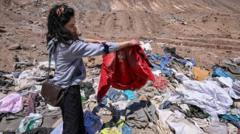
The Atacama Desert in Chile is famous for its Martian landscapes and crystal-clear skies, but a new, synthetic mountain range is rising against the horizon. It is composed of discarded hoodies, fast-fashion dresses, and unsold holiday sweaters. Most of these items still have their price tags attached. This is the terminal point for a global supply chain that begins with a "recycled" donation bin in a Western city and ends as an ecological disaster in South America.
The core of the problem is a fundamental breakdown between public perception and industrial reality. When you drop a bag of old clothes at a donation center, you likely believe those items will reach a local family in need or be processed into new textiles. The reality is far more transactional. Roughly 60,000 tons of used clothing arrive at the Chilean port of Iquique every year. Much of this cargo is "deadstock"—merchandise that never sold or was returned by consumers. Because the global market is currently saturated with low-quality polyester garments, as much as 40% of this clothing has no resale value. It cannot be sold, and under Chilean law, it cannot be disposed of in municipal landfills because it is considered textile waste. Consequently, it is hauled into the desert and abandoned.
The Free Trade Loophole That Created a Wasteland
Iquique sits in a tax-free zone, known as the Zofri. This designation was intended to spur economic growth by making the region a hub for South American imports. However, it has inadvertently created a massive incentive for the global second-hand clothing trade. Importers buy "bales" of clothes from the United States, Europe, and Asia at bargain prices, hoping to find high-value vintage items or wearable staples they can flip for a profit in local markets.
The business model relies on a high-stakes gamble. An importer might pay for a container full of unsorted textiles, but if that container is filled with "fast fashion" items made of cheap synthetics, the math fails. The labor cost of sorting, washing, and transporting these low-grade garments exceeds their market value. In a traditional economy, this waste would be taxed or regulated. In the Zofri, it is simply pushed out the back door.
The desert becomes the path of least resistance. Because these clothes are largely made of synthetic fibers like polyester and nylon, they are essentially plastic. They do not biodegrade. They sit under the intense Andean sun, leaching chemicals into the soil and occasionally catching fire. These fires, often started intentionally to clear space for more waste, release toxic fumes that drift into the nearby communities of Alto Hospicio. This is not a failure of the recycling system. It is the system working exactly as designed to protect the bottom line of global retailers.
The Polyester Trap and the False Promise of Circularity
Retailers love to talk about "circularity." They install collection bins in their flagship stores and offer discount vouchers in exchange for old rags. It makes the consumer feel a sense of relief. But the technology to turn an old polyester t-shirt back into a new polyester t-shirt at scale does not exist in any meaningful way.
Most "recycled" polyester in the fashion industry actually comes from rPET, which is recycled plastic bottles. While this sounds positive, it is a linear dead-end. When a plastic bottle is turned into a fleece jacket, that plastic can no longer be recycled again. It has been diverted from a closed-loop bottling system into a garment that will eventually shed microplastics in a washing machine and end up in a Chilean ravine.
True textile-to-textile recycling is hindered by the complexity of modern fabrics. A standard pair of "stretchy" jeans is a chemical nightmare for recyclers. It contains cotton, polyester, and elastane, all woven together. Separating these fibers requires expensive chemical solvents and massive amounts of energy. For a brand producing a $12 shirt, the investment required to recycle that shirt is higher than the cost of simply pumping more oil to create virgin polyester.
Why Sorting is a Losing Battle
The global North exports its waste because sorting is a labor-intensive process that Western economies refuse to fund. We have outsourced the manual labor of "recycling" to the Global South. When a bale of clothing arrives in Chile or Ghana, it requires human hands to touch every single item, evaluate its condition, and categorize it.
- Grade A: Near-new condition, high resale value in local boutiques.
- Grade B: Visible wear but functional, sold in open-air markets.
- The Remainder: Stained, torn, or made of such poor material that no one wants it.
In the past, the "Remainder" was shredded into insulation or carpet padding. But the sheer volume of production has overwhelmed the industrial demand for shoddy materials. We are producing garments at a rate that far outstrips our ability to find a secondary use for them. The result is a permanent surplus of garbage disguised as charity.
The Legal Shell Game of Textile Waste
One of the most frustrating aspects of the Atacama crisis is the lack of legal accountability for the brands whose labels are clearly visible in the desert sands. Under current international law, once a clothing brand sells its product to a consumer, it bears no further responsibility for that product's lifecycle.
Even more shielding occurs when brands "donate" their unsold inventory to liquidators. Once the clothes are sold to a third-party exporter, the original brand can claim they are no longer the owners of the waste. They have essentially laundered their trash through a series of transactions until it becomes the problem of a municipal government in a developing nation.
Chile has recently attempted to address this through Extended Producer Responsibility (EPR) laws. These regulations are designed to force companies that import products to be responsible for the management of the waste those products generate. However, enforcing these laws against a shadowy network of textile importers and international wholesalers is a logistical nightmare. The desert is vast, and the trucks move at night.
The Myth of the Conscious Consumer
We are told that our individual choices—buying "green" labels or donating to bins—will fix this. This narrative is a convenient distraction for the industry. The problem is not that consumers are "lazy" or "uninformed"; the problem is that the business model of fashion is predicated on volume.
The industry currently produces upwards of 100 billion garments per year. This is double the amount produced in 2000. Our clothes have become disposable by design. The fabric is thinner, the seams are weaker, and the trends move faster. Even the most "conscious" consumer cannot offset the sheer weight of this overproduction through domestic recycling.
If we want to stop the growth of the Atacama clothing mountains, the focus must shift from "end-of-life" solutions to "start-of-life" restrictions. This means taxing virgin synthetic fibers to make them less attractive than recycled or natural alternatives. It means banning the destruction of unsold inventory, a practice brands use to maintain "exclusivity" and price points.
Global Consequences of Local Dumps
The environmental impact of the Atacama dump sites is not confined to Chile. When these mountains of synthetic clothing burn, they release pollutants like dioxins and furans into the atmosphere. These are persistent organic pollutants that can travel long distances.
Furthermore, the microplastics released as these garments break down in the desert heat eventually find their way into the water table or are carried by the wind into the Pacific Ocean. The Atacama is not a vacuum. It is part of a global ecosystem that we are treating as a basement for our unwanted junk.
We see similar patterns in the Korle Lagoon in Ghana and the suburbs of Nairobi. The Global North is effectively colonizing these regions with waste, using the "second-hand trade" as a moral and legal shield. We call it "giving," but to the people living next to a burning mountain of polyester, it looks a lot like a slow-motion environmental assault.
The solution requires more than a better bin or a new sorting machine. It requires a radical contraction of the fashion industry's output. Until the cost of managing the waste is integrated into the price of the new garment, the desert will continue to grow. The labels in the Atacama are a map of our own excess, and right now, every road leads to the sand.