The transition from aerial dominance to terrestrial automation marks the second phase of the first high-intensity drone war. While Unmanned Aerial Vehicles (UAVs) redefined the reconnaissance-strike complex, Unmanned Ground Vehicles (UGVs) are currently restructuring the fundamental unit economics of frontline attrition. The integration of land robots is not a secondary tactical evolution; it is a forced response to a saturated electronic warfare (EW) environment and the soaring human cost of "the last mile" logistics.
The Tri-Node UGV Classification Framework
To analyze the current battlefield, one must move beyond the vague descriptor of "land robots" and categorize hardware by operational objective. The Ukrainian theater has bifurcated UGV development into three distinct functional tiers:
- Logistics and Evacuation Platforms (The Mule): High-torque, multi-wheeled or tracked chassis designed to transport 200kg to 500kg of cargo. These platforms solve the "extraction bottleneck" where four to six soldiers are typically required to evacuate one wounded comrade under fire.
- Kinetic Strike and Minelaying Units (The Saboteur): Low-profile, expendable tracked vehicles equipped with anti-tank mines (as mobile IEDs) or automated minelaying racks. These operate as a terrestrial equivalent to FPV drones but with significantly higher payload-to-weight ratios.
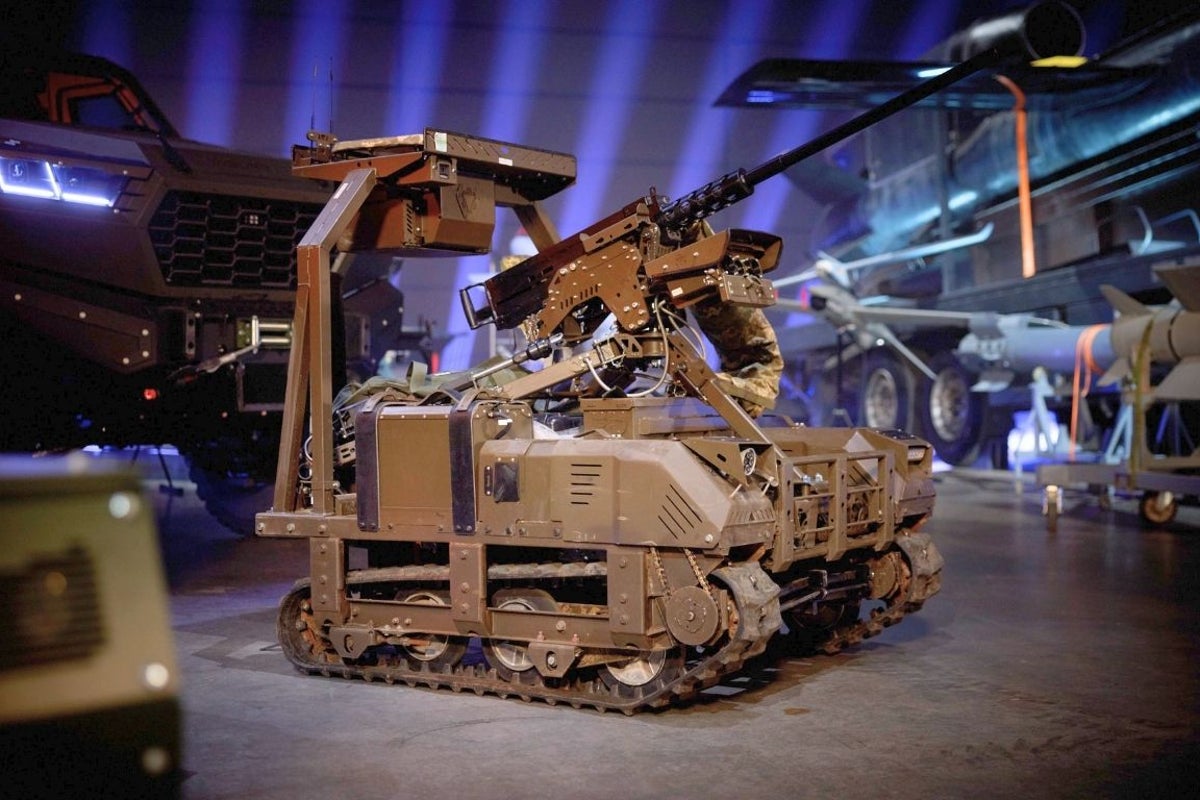
- Remote Weapon Stations (The Sentry): Stabilized platforms mounting 7.62mm or 12.7mm machine guns. These serve as force multipliers in defensive trench networks, allowing a single operator to cover a fire sector from a hardened bunker 500 meters away.
The Geography of Attrition: Solving the Last Mile
The primary driver of UGV adoption is the "Grey Zone" mortality rate. In modern peer-to-peer conflict, the area between the forward edge of the battle area (FEBA) and the secondary support lines is under constant surveillance.
The mathematical reality of manual resupply is grim. A standard logistics team moving on foot at 3km/h is a high-contrast target for thermal-equipped UAVs. By replacing this team with a UGV, the military commander shifts the risk from biological assets to industrial assets. The cost-benefit analysis favors the UGV even with a 50% loss rate, as the replacement cost of a mid-tier UGV ($5,000–$15,000) is several orders of magnitude lower than the training, equipment, and compensation costs associated with a human casualty.
Engineering Constraints and the EW Bottleneck
The shift to ground-based robotics introduces physical complexities that aerial platforms do not face. The "Line of Sight" (LoS) requirement for radio frequency (RF) control is significantly more difficult to maintain at ground level due to vegetation, terrain undulations, and urban wreckage.
Signal Degradation and Multi-Path Interference
Radio waves at the 433MHz, 900MHz, or 2.4GHz bands suffer from ground-clutter interference. While a UAV at 100 meters altitude has a clear path to the operator, a UGV at 0.5 meters altitude faces signal absorption by the earth itself. This creates a hard limit on the operational radius of non-autonomous units.
The Rise of Tethered and Mesh Control
To circumvent Russian EW dominance, which can jam GPS and command signals across wide sectors, Ukrainian developers are pivoting toward two technical workarounds:
- Fiber-Optic Tethers: Physical wires spooled behind the UGV. These are unjammable and provide high-bandwidth video feeds but limit range to roughly 5–10 kilometers and are susceptible to entanglement.
- Signal Relays: Using "Mother" UAVs as airborne signal repeaters to maintain LoS with the ground robot even when it dips into valleys or behind ruins.
The Cost Function of Mechanical Autonomy
True autonomy on the ground is significantly harder to achieve than in the air. A drone in 3D space deals with fewer obstacles than a robot navigating a cratered landscape filled with mud, tangled wire, and varying soil density.
The current Ukrainian strategy utilizes Semi-Autonomous Pathing. This involves "Follow Me" protocols where the UGV tracks the thermal signature of a lead soldier or uses Waypoint Navigation via pre-mapped GNSS coordinates. However, as GNSS-denied environments become the norm due to Russian R-330ZH Zhitel jamming systems, the reliance on Computer Vision (CV) and Edge-AI processing increases.
The cost of a UGV scales non-linearly with its level of autonomy:
- Level 1 (Direct RC): $2,000 - $5,000. High operator risk, high EW vulnerability.
- Level 2 (Waypoint/GNSS): $7,000 - $12,000. Moderate EW vulnerability.
- Level 3 (CV-based Obstacle Avoidance): $20,000+. Low EW vulnerability, high hardware complexity.
Structural Implications for Infantry Doctrine
The proliferation of UGVs is forcing a rewrite of small-unit tactics. We are seeing the emergence of the Integrated Robotic Platoon. In this structure, the traditional infantry squad is no longer just a group of riflemen, but a combined-arms team managing a fleet of terrestrial sensors and shooters.
This creates a new "Technical Debt" on the battlefield. Units must now manage battery logistics, field repairs, and the bandwidth management of multiple simultaneous streams. The bottleneck has shifted from physical stamina to electromagnetic spectrum management.
Strategic Play: The Industrialization of the Trench
The conflict has moved beyond the "innovation" phase into the "industrialization" phase. For UGVs to fundamentally alter the outcome of the war, the focus must shift from bespoke, high-tech prototypes to modular, attritable mass.
The winning strategy for 2026 involves the standardization of the "Common Chassis." By developing a universal, low-cost tracked base with standardized power and data interfaces, the Ukrainian defense industry can enable third-party developers to "plug and play" different modules—be it a stretcher, a claymore rack, or a sensor mast.
The objective is to achieve a production scale where the UGV becomes as ubiquitous and disposable as the 155mm artillery shell. When the cost of the robot is lower than the cost of the munition required to destroy it, the defender achieves an "Economic Interdiction" that makes traditional offensive maneuvers unsustainable for the adversary. Evolution in this sector will not be defined by a single breakthrough in AI, but by the relentless optimization of the assembly line and the hardening of the data link.