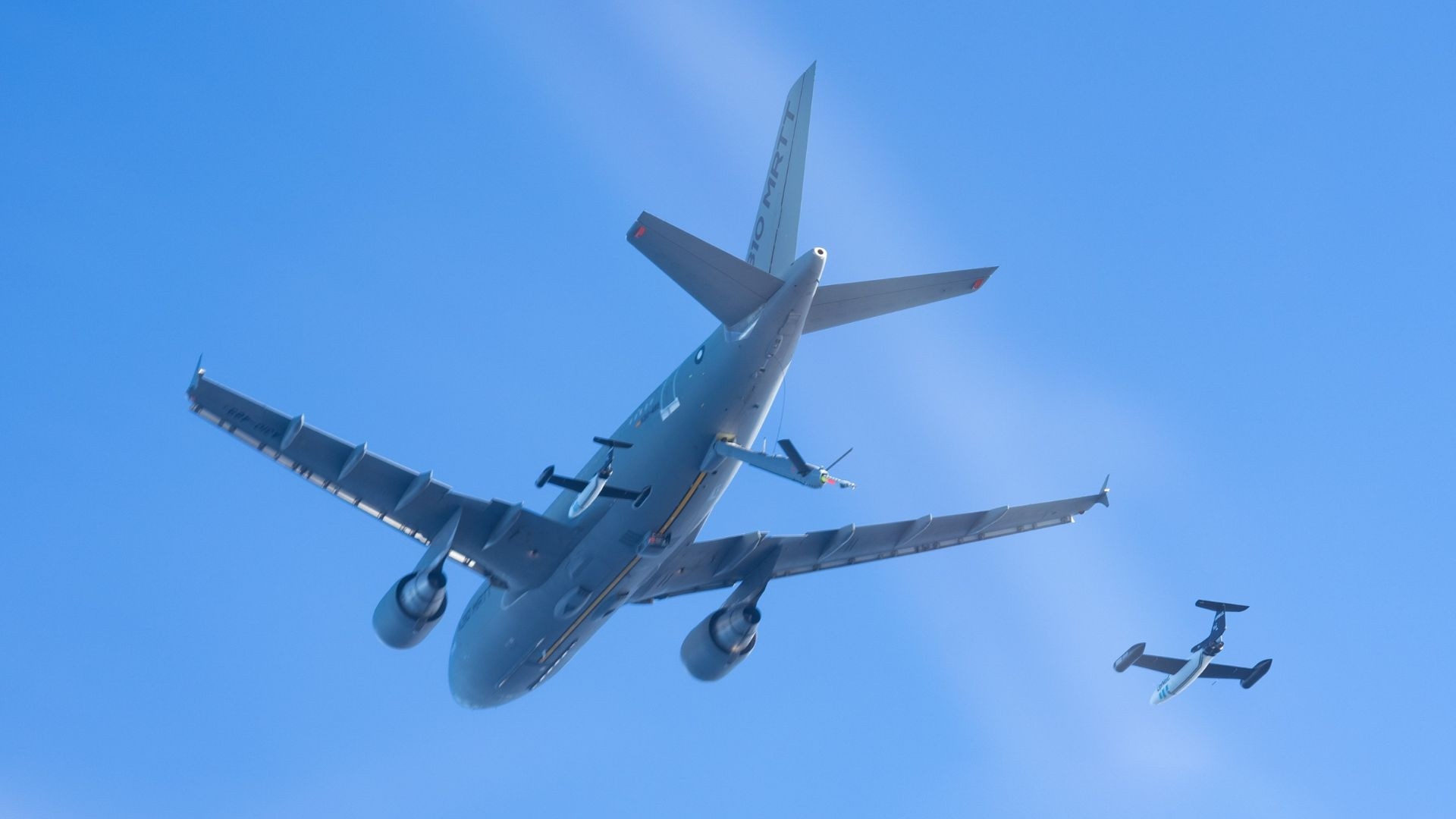
The defense industry is currently obsessed with a singular, panicked narrative: the United States has fallen behind in the race for autonomous air superiority. CEOs of emerging defense startups stand on stages, clutching their slide decks, and warn that if we don’t mass-produce cheap, autonomous drones right now, we’ve already lost the next war.
They are wrong. They are selling you a hardware solution to a software problem, and they’re doing it because hardware has better margins and more impressive factory tours.
The "lazy consensus" suggests that whoever has the most "attritable" aircraft wins. It assumes that quantity has a quality all its own. But in the high-stakes environment of electronic warfare and peer-level conflict, a swarm of cheap drones is nothing more than a collection of expensive targets if the underlying architecture is flawed. We aren’t losing the drone race. We are waiting for the race to actually start while everyone else sprints toward a cliff.
The Attritability Trap
The term "attritable" is the most dangerous word in modern defense. It’s a polite way of saying "disposable," and it has convinced a generation of planners that we can trade lives and sensors for pennies on the dollar.
The argument goes like this: China or Russia can build ten thousand drones for the price of one F-35. Therefore, they win.
This logic ignores the reality of the kill chain. A drone is only as good as its link to the person or algorithm pulling the trigger. In a contested environment, the electromagnetic spectrum is a mess. If you cannot guarantee communication, your ten thousand drones are just wandering pieces of plastic and lithium.
I have seen companies burn through tens of millions of dollars trying to solve "autonomy" while ignoring the fact that their platforms can be downed by a $500 jammer. The US isn't "behind" because we lack the airframes; we are "behind" because we refuse to field systems that don't actually work in a real-world electronic warfare environment.
The Software-Defined Fallacy
Most autonomous aircraft developers are hardware guys trying to code. They build a sleek wing, slap some sensors on it, and call it "AI-ready."
Real air power in the 21st century isn't about the plane. It’s about the data fabric. The US Air Force’s Collaborative Combat Aircraft (CCA) program isn't just about building "loyal wingmen." It’s about creating a distributed processing network that can survive the total loss of satellite GPS and long-range comms.
While critics point to the rapid proliferation of drones in localized conflicts—like the war in Ukraine—as proof of US obsolescence, they are misreading the data. Those drones are effective because they are fighting in a vacuum of high-end electronic countermeasures. Try flying a consumer-grade FPV drone against a dedicated carrier strike group's integrated defense system. It doesn’t just miss; it ceases to function miles before it sees a target.
Why "Leading" is a Death Sentence
Being the first to mass-produce a technology often means you are the first to lock yourself into an obsolete standard.
In the 1930s, the French had more tanks than the Germans. They were technically superior in many ways—heavier armor, better guns. But they lacked the radio integration and the combined-arms doctrine to use them. They had the "lead" in hardware, and it failed them in weeks.
Currently, we see a rush to field autonomous systems that rely on centralized cloud processing. It looks great in a demo. But in a peer-to-peer fight, the cloud is the first thing that gets cut. The US is currently pivoting toward "edge" processing—putting the heavy-duty computing on the aircraft itself. This is harder. It is more expensive. It takes longer. But it is the only way to win a war where the internet doesn't exist.
The Pilot in the Loop is Not the Weakness
You’ll hear "disruptors" claim that the human pilot is the bottleneck. They say the human body can't handle the G-forces and the human brain can't process the data.
This is a fundamental misunderstanding of what a pilot does. A pilot isn't a driver; a pilot is a moral and tactical arbiter.
Autonomous systems excel at "if-this-then-that" scenarios. They fail spectacularly at "what-if" scenarios. If an autonomous wingman sees a target that fits 90% of its parameters but is actually a civilian hospital, it will fire. A human pilot sees the context.
The US lead isn't in the drone; it's in the interface between the human and the machine. We are perfecting the "Centaur" model—the combination of human intuition and machine speed. Throwing away the human element to save a few bucks on a cockpit is a tactical error of the highest order.
The Logistics of the Swarm
Let’s talk about the nightmare no one mentions: the logistics.
Advocates for autonomous swarms talk about thousands of drones as if they magically appear on the front lines. They don't. Each one requires fuel, maintenance, a launch platform, and a recovery team.
If you field 5,000 drones, you have created 5,000 new maintenance problems. You have tripled your fuel requirements. You have created a massive signature that any satellite can see from space.
The US approach—fewer, higher-end, more capable autonomous systems—is a recognition of the reality of the Pacific theater. You cannot maintain a swarm of 10,000 short-range drones in the middle of the ocean. You need systems with legs, systems that can loiter, and systems that can fix themselves.
The Real Winner in Autonomous Flight
If you want to see who is actually leading, don’t look at the number of airframes. Look at the open-architecture standards.
The US is moving toward a modular system where any software company can plug a "brain" into any airframe. This is the death of the traditional defense prime contractor model, and that’s why you see so much pushback. The "old guard" wants to sell you a proprietary drone. The "new guard" wants to sell you a proprietary AI.
The winner is the one who controls the OS.
By forcing the industry toward the Universal Command and Control Interface (UCI), the US is building the "iOS of the sky." It doesn’t matter if China builds a faster drone if that drone can’t talk to the rest of the battlefield. We are building the infrastructure that will make every other nation's autonomous fleet look like a collection of pagers in a smartphone world.
The Danger of Over-Correction
There is a risk. In our quest for the perfect, un-jammable, high-end system, we could leave ourselves vulnerable to "good enough" mass.
If we only build ten "perfect" autonomous jets, and the enemy has ten thousand "okay" ones, the math eventually works against us. But the answer isn't to build ten thousand "okay" drones ourselves. The answer is to build the kinetic and non-kinetic systems that make those ten thousand drones irrelevant.
We need to stop asking "How many drones do we have?" and start asking "How many drones can we render useless in the first sixty seconds of an engagement?"
The Brutal Reality of AI "Learning"
Finally, we must address the "AI Training" myth. CEOs claim their drones "learn" from every flight.
In a laboratory, yes. In a dogfight? No.
Machine learning requires massive datasets and thousands of iterations. You don't get those iterations in a real war. You get one shot. If your algorithm hasn't seen a specific type of atmospheric interference or a specific maneuver before, it doesn't "learn" on the fly—it crashes.
The US is the only nation with the high-fidelity simulation environments—like the Air Force Research Laboratory's "Skyborg" testbed—to actually train these systems against a thinking, breathing adversary. Having the most drones is useless if your drones are "stupid" the moment they encounter something not in their training data.
Stop Buying the Hype
The next time a CEO tells you the US is falling behind in autonomous air power, ask them three questions:
- How does your system operate in a GPS-denied environment?
- What is the logistical footprint for a thousand of these units in a distributed maritime environment?
- Can your software run on a competitor’s hardware?
If they can’t answer, they aren’t building the future of air power. They’re building a toy for a war that will never happen.
The US isn't losing. We're just the only ones who realize that the drone itself is the least important part of the equation.
Stop looking at the wings. Start looking at the wires.