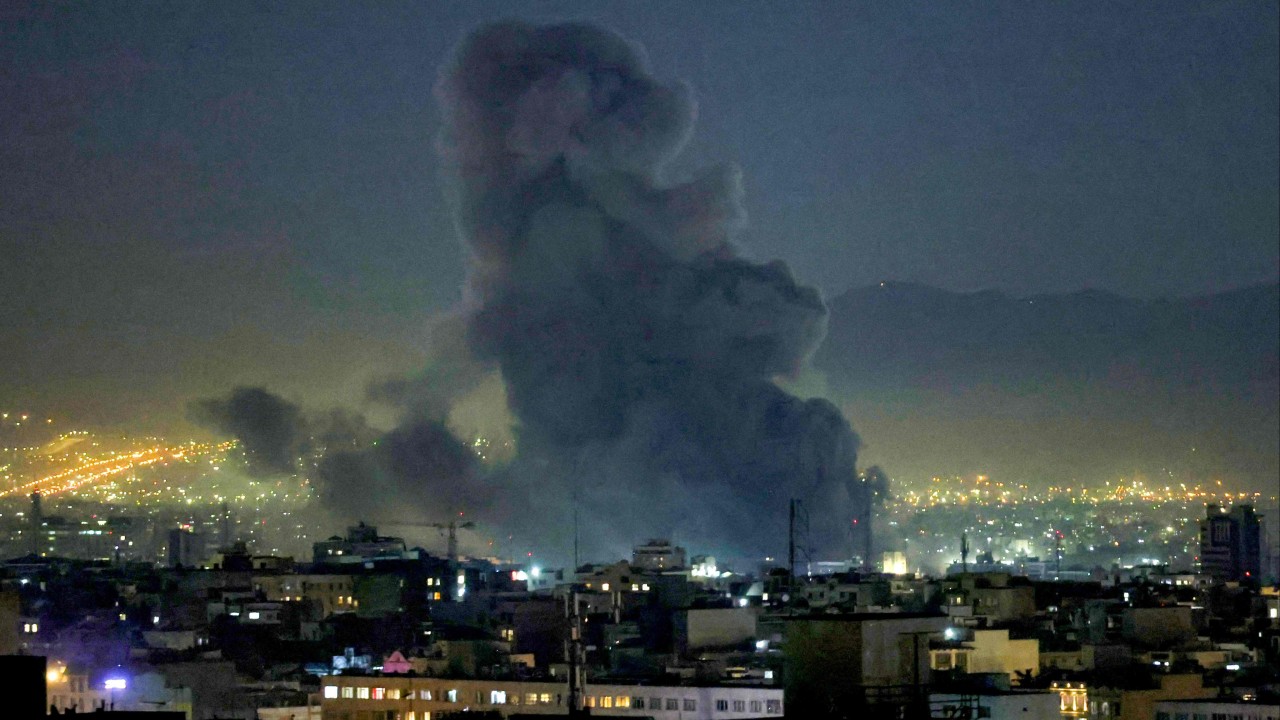
Commercial aviation in the Middle East functions as a high-stakes optimization problem where the variables are kinetic risk, sovereign airspace viability, and the diminishing marginal utility of rerouting. While mainstream reporting focuses on the surface-level resumption of flights by carriers like Emirates, Qatar Airways, and Etihad, the underlying reality is a sophisticated recalibration of the Aviation Risk-Yield Matrix. Gulf hubs—Dubai, Doha, and Abu Dhabi—are geostationary bottlenecks. Their business models depend on global connectivity; however, when regional airspace becomes a patchwork of "no-fly" zones and missile corridors, the operational cost of maintaining that connectivity begins to outweigh the revenue of the "Super-connector" model.
The Tri-Border Airspace Constraint
The geography of the Middle East dictates that flight paths between Europe and Asia must navigate a narrow corridor bounded by the airspace of Iran, Iraq, and Syria. When these specific tranches of sky are closed or deemed high-risk by EASA (European Union Aviation Safety Agency) or the FAA, the resulting bottleneck creates a spatial tax on every flight.
- Fuel-Burn Penalty: Rerouting a flight from Dubai to London to avoid Iranian or Iraqi airspace typically adds 45 to 90 minutes of flight time. In the context of a Boeing 777-300ER, this translates to an additional 6,000 to 12,000 kg of fuel.
- Crew Duty Limitations: Aviation regulations mandate strict "Flight Duty Periods" (FDP). A 90-minute detour on an already long-haul sector can push a crew past legal limits, requiring "slip crews" or unplanned layovers, which cascades through a carrier’s global scheduling system.
- Airframe Utilization Erosion: If every aircraft in a fleet of 250 stays in the air 10% longer per mission due to detours, the total capacity of the airline shrinks by 10% without a single plane being grounded.
The decision to resume flights is not an indicator of "peace," but rather a calculation that the cost of these detours has reached an equilibrium point with current insurance premiums and passenger demand.
The Insurance Premium Escalation Function
Aviation insurance operates on a "Hull War, Hijacking and Other Perils" basis. In active conflict zones, standard coverage is often suspended, requiring "seven-day notices" and the negotiation of specific "war risk" surcharges.
The resumption of flights signifies that carriers have successfully negotiated a sustainable War Risk Surcharge (WRS). This is a variable cost that most passengers never see, often baked into the "fuel surcharge" or "taxes" line item of a ticket. If the WRS exceeds the expected profit margin of a route—specifically the high-yield business class segments—the flight is canceled. When Gulf carriers resume flights to cities like Amman, Beirut, or Erbil, they are effectively signaling that the WRS has stabilized at a level where the route remains cash-flow positive.
The Hub-and-Spoke Fragility Coefficient
The business model of Emirates or Qatar Airways relies on a "Hub-and-Spoke" system. Unlike "Point-to-Point" carriers (like Ryanair or Southwest), the profitability of a flight from New York to Dubai is contingent on the ability of those passengers to connect to secondary destinations like Mumbai, Bangkok, or Cairo.
When a "spoke" (e.g., Tel Aviv or Beirut) is severed due to conflict, the "hub" (Dubai or Doha) experiences a Connectivity Decay. The New York-Dubai flight doesn't just lose the passengers going to the conflict zone; it loses the economies of scale for the entire aircraft.
- The First-Order Effect: Loss of direct revenue from the canceled route.
- The Second-Order Effect: Decreased load factors on long-haul "feeder" flights from the West.
- The Third-Order Effect: Brand erosion as a "reliable global transit point."
Resuming flights is a desperate attempt to arrest this decay. By restoring even a 50% frequency to disrupted regions, carriers can maintain the integrity of their hub schedules and prevent passengers from switching to alternative hubs like Singapore, Istanbul, or Addis Ababa.
The Geopolitical Neutrality as an Asset
Gulf carriers leverage a unique form of "Sovereign Shielding." Because their parent governments often act as mediators in regional conflicts, these airlines are rarely the primary targets of state-level kinetic action. However, the risk of "accidental intercept" remains the primary threat.
The 2020 downing of Ukraine International Airlines Flight 752 over Tehran serves as the modern baseline for this risk. The mechanism of failure in that instance was "target misidentification" during a period of high military alert. Therefore, the "safety" of resuming flights isn't based on the absence of missiles, but on the Command and Control (C2) Transparency between civil aviation authorities and military battery operators.
Carriers only resume operations when they receive "Non-Interference Assurances" from the relevant Ministries of Defense. This is a level of risk management that goes far beyond standard weather or mechanical checks. It involves a "Red Line" data feed where civilian transponder data is synchronized with regional air defense systems to ensure that a passenger jet is never mistaken for a drone or a cruise missile.
Tactical Rerouting Logic and the "Great Circle" Deviation
The shortest distance between two points on a sphere is a Great Circle. Conflict forces airlines to abandon this efficiency. We can quantify the impact of conflict through the Great Circle Deviation Index (GCDI).
If a flight from London to Dubai (standard distance: ~3,400 miles) is forced to fly over Egypt and the Red Sea to avoid the Levant, the GCDI increases. This isn't just a distance problem; it’s a Congestion Problem. When all carriers avoid a specific piece of airspace simultaneously, the remaining corridors (such as the Cairo-Jeddah-Dubai track) become saturated.
Air Traffic Control (ATC) in these "safe" corridors must increase the separation between aircraft, leading to:
- Linear Holding: Planes flying slower to wait for an entry slot.
- Step-Climb Delays: Planes being forced to stay at lower, less fuel-efficient altitudes because the "sweet spot" (FL360-FL390) is occupied.
The Strategic Play: Aggressive Fleet Flexibility
The only way to survive these disruptions is through Gauge Switching. A carrier like Emirates, which operates an all-widebody fleet (A380s and B777s), has less flexibility than a carrier like Qatar Airways, which has a mix of narrow-body A320s and widebody A350s.
During periods of conflict-driven demand volatility:
- Down-gauging: If demand drops 40% due to fear, the carrier swaps a 350-seat 777 for a 160-seat A320. This maintains frequency (keeping the hub viable) while protecting the load factor.
- Night-Ops Concentration: Carriers may shift all flights into "safe windows"—typically daylight hours—to avoid the higher visual and signal noise of nighttime military operations.
- Revenue Management Pivots: When a route is resumed, airlines often slash prices for the first 14 days to "prime the pump" and prove the route is safe, before aggressively raising prices to recover the WRS costs mentioned earlier.
The resumption of flights by Gulf carriers is a calculated bet on the Normalization of Risk. They are banking on the fact that global travel demand is highly "elastic" regarding price but "inelastic" regarding long-term fear. By being the first to return to disrupted markets, they capture a "first-mover advantage" in capacity that competitors—often more risk-averse Western legacy carriers—are too slow to match.
The strategic imperative for any global firm operating in this space is to decouple "safety" from "peace." In the modern aviation landscape, safety is a managed technical state, while peace is a political one. The Gulf carriers have mastered the art of operating in the gap between the two.