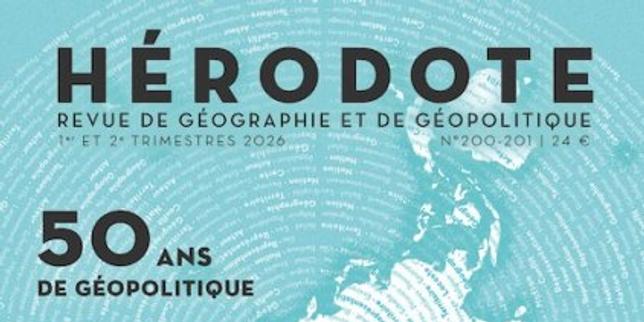
In 1976, a radical French geographer named Yves Lacoste launched a journal that did something unthinkable to the academic establishment of the era. He declared that geography was not a harmless study of maps, rivers, and terrain, but a weapon of war. Five decades later, Hérodote remains a formidable force in global political analysis, proving that control over spatial narrative dictates the survival of nations. While the journal celebrates its fiftieth anniversary by honoring its founder, the real story lies in how this single publication systematically dismantled the state’s monopoly on geographical knowledge and forced the public to realize that maps are never neutral.
The traditional academic world viewed geography as a passive, descriptive cataloging of the earth. Lacoste blew that illusion apart. His foundational premise was brutal in its simplicity. If the citizens of a democracy do not understand the strategic value of the space they inhabit and contest, the military and the state will use that ignorance to manipulate them.
The Weaponization of the Terrain
To understand why Hérodote shifted the intellectual landscape, one must look back at the Vietnam War. This was the catalyst for Lacoste’s radicalization. In 1972, he traveled to the Nile delta and later studied the American bombing campaign over the Red River in North Vietnam. The intellectual community was focused on the ideological battle between capitalism and communism. Lacoste looked at the mud.
He discovered that the American military was not just dropping bombs on soldiers. They were systematically targeting the dyke systems to trigger catastrophic flooding during the monsoon season. This was a deliberate attempt to cause mass starvation while claiming the destruction was a natural disaster. The press missed it. The politicians denied it.
Lacoste used geographical analysis to prove intent. He demonstrated that the bomb craters were precisely aligned with the structural weak points of the hydraulic engineering systems. Geography was the smoking gun.
When Hérodote emerged four years later, it brought this investigative rigor to the broader public. The journal argued that states use maps to hide reality just as much as they use them to reveal it. A map isolates certain features while completely erasing others, depending on who is paying the cartographer.
Breaking the Academic Ivory Tower
Before 1976, French geography was dominated by the legacy of Paul Vidal de la Blache, a school of thought that favored regional descriptions, agricultural patterns, and human-environment interactions. It was polite. It was safe. Most importantly, it was entirely useless for understanding the violent reordering of the post-colonial world.
Lacoste and his early collaborators saw this university tradition as a form of intellectual sedation. By treating geography as a harmless science of landscapes and folklore, academics were actively disarming the public. They left the strategic application of geographical knowledge entirely in the hands of general staffs and corporate boardrooms.
The journal took its name from Herodotus, the ancient Greek chronicler. This was a deliberate provocation. Herodotus was not just a historian; he was a traveler who understood that political power was inextricably linked to the control of territory, resources, and the perception of distance. By reclaiming this ancient view, the publication bypassed centuries of academic sanitization.
The establishment reacted with predictable fury. Critics accused Lacoste of politicizing a pure science. The reality was the exact opposite. He was exposing the politics that had always been embedded in the science. The state had long understood that knowing the exact layout of a mountain pass or the depth of a river was matters of life and death. The university had simply agreed to look the other way.
The Mechanics of Representation
The core methodology that Hérodote developed relies on the concept of diatopic analysis. This approach examines a single geopolitical conflict through multiple scales simultaneously, moving from the global theater down to the local neighborhood.
Consider a modern maritime dispute in the South China Sea. A standard news report focuses on international treaties and national sovereignty. A Hérodote analysis breaks the conflict into distinct, overlapping layers of spatial reality:
| Scale of Analysis | Focus of Geopolitical Observation | Strategic Objective |
|---|---|---|
| Global Scale | Superpower trade routes and naval choke points | Maintaining global hegemony and shipping freedom |
| Regional Scale | Exclusive Economic Zones (EEZs) and continental shelves | Securing undersea oil reserves and fisheries |
| Local Scale | Construction of military installations on specific coral reefs | Physical denial of terrain to tactical adversaries |
This multi-level view prevents analysts from falling into the trap of accepting a single, state-sponsored narrative. It forces the observer to see that what looks like an ideological crusade at the global level is often a crude resource grab at the local level.
The journal also introduced the critical concept of geopolitical representations. These are the collective ideas, myths, and historical grievances that a population holds about a specific territory. These ideas do not need to be factually accurate to have devastating real-world consequences. If a nation believes a piece of land is their ancestral cradle, that belief becomes a hard geopolitical factor that can trigger invasions and sustain decades of warfare.
The Modern Crisis of Borderless Warfare
As Hérodote enters its fifty-first year, the nature of geography is undergoing a radical transformation that threatens to outpace the journal’s original framework. The digital redefinition of space has created territories that cannot be found on a traditional map.
Cyber warfare, algorithmically driven disinformation campaigns, and transnational supply chains have complicated the old model of sovereign states fighting over lines in the dirt. A foreign adversary can destabilize a city's critical infrastructure without a single soldier crossing a physical border. The terrain has become virtual, yet the consequences remain physical.
This shift has created a split within the field of modern geopolitics. Some contemporary analysts argue that the classic focus on physical geography is obsolete, claiming that technology has effectively annihilated distance.
The veteran editorial board of Hérodote maintains a far more grounded position. Satellites and fiber-optic cables must still land somewhere. Data centers require massive amounts of physical water for cooling. The rare earth minerals required to build high-tech infrastructure must still be dug out of the ground in specific, often highly unstable, regions of the world.
The digital world has not replaced physical geography. It has merely added another complex layer to the diatopic model. The struggle is still over territory, resources, and control. The map has simply grown more crowded.
The Danger of the Intellectual Consensus
The greatest risk to the legacy of Hérodote does not come from its external detractors, but from its own success. Over the past fifty years, the term "geopolitics" has been completely co-opted by the mainstream media and corporate consulting firms. It has been diluted from a radical investigative tool into a lazy catch-all phrase used to describe any international news event.
When every corporate risk assessment firm uses the word geopolitics to justify their quarterly predictions, the term loses its subversive edge. The original mission of the journal was to give citizens the tools to challenge state power, not to help multinational corporations protect their supply chains.
To remain relevant, the publication must resist becoming an institutional relic that merely celebrates its past triumphs. The true way to honor Yves Lacoste is not to turn his life's work into a museum piece, but to apply his aggressive, skeptical methodology to the new cartographers of the digital age. The state ministries of defense are no longer the only entities drawing the maps that control our lives. Tech conglomerates now dictate how we navigate physical cities and perceive global events through algorithmic feeds.
These digital platforms create their own geography, filtering reality to maximize engagement and control narrative flow. If citizens do not learn to analyze these virtual territories with the same skepticism that Lacoste applied to the bombing charts of the Red River, they will find themselves utterly disarmed in the conflicts of the future. The map remains a weapon, and the fight to control it is more vicious than ever.