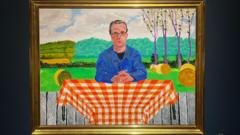
The headlines are dripping with the kind of syrupy sentimentality that makes serious art critics want to retire to a cave. We’ve all seen the story: a humble optometrist gets the "once-in-a-lifetime" chance to sit for David Hockney. The media calls it a "pinch me moment." They frame it as a brush with immortality, a secular canonization by the grand old man of British painting.
They are dead wrong.
If you are a professional with a reputation to uphold, being immortalized by a late-career blue-chip artist isn't a career highlight. It is a brand-management nightmare. While the public swoons over the vibrant acrylics and the iPad sketches, they miss the cold reality of the sitter’s predicament. You aren't being "captured." You are being consumed by a style that has become more famous than its subjects.
The Hockney Tax on Identity
When David Hockney paints you, you cease to be an individual. You become a "Hockney."
In the art market, the subject is secondary to the provenance and the signature. For a professional—like an optometrist whose entire career is built on the precision of other people’s vision—there is a profound irony in becoming a distorted, flat, neon-hued caricature. The "pinch me" sentiment assumes that being a muse is an upgrade from being a practitioner.
It isn't. It’s a demotion.
I’ve watched high-net-worth individuals spend millions to be "seen" by world-class artists, only to realize that the artist wasn't looking at them at all. They were looking at a mirror of their own established aesthetic. In the case of Hockney’s recent portrait series, the subjects are often rendered with a deliberate, faux-naive clunkiness. To the art world, this is "celebrating the medium." To a professional who prides themselves on clinical accuracy, it’s a public record of their own dissolution into a background of primary colors.
The Myth of Artistic Immortality
The "lazy consensus" suggests that a portrait in a gallery ensures you live forever. This is a fundamental misunderstanding of how art history works.
Do you know the names of the people in the backgrounds of Rembrandt’s "The Night Watch" without looking them up? Of course not. They paid to be there, and they’ve been reduced to "Man in Red" or "Standard Bearer." They are decorative elements.
By sitting for a global icon like Hockney, you aren't achieving immortality; you are achieving anonymity-by-association. In fifty years, no one will care about the optometrist’s contribution to eye care in Cambridge. They will care about Hockney’s use of the iPad Pro or his transition back to canvas. The human being in the chair is just a carbon-based mannequin used to justify the artist’s latest technical pivot.
The Optometry of the Soul vs. The Optometry of the Canvas
There is a specific tension here that the puff pieces ignored. An optometrist deals in the objective. They measure the $refractive index$ of the eye. They use tools like the phoropter to determine exactly how light hits the retina. Their world is one of 20/20 clarity and mathematical certainty.
Hockney’s world is the opposite. He is obsessed with the flaws of human vision. He rejects the "one-eyed" perspective of the camera. He wants to represent how we move our eyes, how we focus on one detail while blurring another.
When an optometrist sits for Hockney, they are consenting to the destruction of their professional ethos. They are trading the "Correct View" for the "Artistic View." While that makes for a nice human-interest story, it’s a tactical error for anyone who wants to be taken seriously as an expert. You are literally letting a man with a different theory of vision redefine how the world sees you.
Why the "Pinch Me" Narrative is Dangerous
We’ve become obsessed with the idea that proximity to fame is the ultimate validation. This "pinch me" rhetoric implies that the subject’s life was somehow incomplete until a celebrity noticed them.
- Validation via Proxy: It suggests that your work (treating patients, running a clinic) is less valuable than your status as a "subject."
- The Power Imbalance: The artist holds all the cards. They choose the pose, the lighting, and the level of "flattery."
- The Digital Afterlife: Once that image is out, it’s a meme. It’s a thumbnail. It’s a postcard in the Royal Academy gift shop. You lose control over your own likeness.
I have seen professionals in the tech and medical sectors lose their "edge" the moment they start believing their own hype after a brush with the arts. They stop focusing on the $diopters$ and start focusing on the "dialogue."
The Superior Path: Functional Obscurity
If you truly want to be a master of your craft, you should avoid the spotlight of the arts. True authority doesn't need to be painted. It needs to be exercised.
The most successful people I know—the ones who actually move the needle in science, finance, and health—don't want to be in the National Portrait Gallery. They want to be in the room where the decisions are made. Being a "muse" is a passive act. It requires you to sit still, be quiet, and let someone else interpret your existence.
Imagine a scenario where the roles were reversed. Imagine David Hockney sitting in the optometrist’s chair. Who has the power then? The person with the lens, the person diagnosing the cataracts, the person ensuring the world remains in focus. That is where the real "pinch me" moment resides—in the mastery of a vital skill, not in the privilege of being someone else's Saturday afternoon project.
Stop Celebrating the Muse
The next time you see a story about a "normal person" being elevated by an artist, ask yourself who is actually benefiting. The artist gets a fresh face to practice on. The gallery gets a hook for their press release. The media gets a feel-good story to fill the gap between tragedies.
And the subject? They get a bit of temporary "fame" that usually results in them being the answer to a trivia question ten years down the line.
If you are an expert in your field, stay in your lane. Don't trade your professional dignity for a splash of Hockney Blue. Your patients don't need you to be a masterpiece; they need you to be an optometrist.
The most contrarian thing you can do in a celebrity-obsessed culture is to refuse to be a prop.
Get out of the chair. Give the brush back. Go back to work.