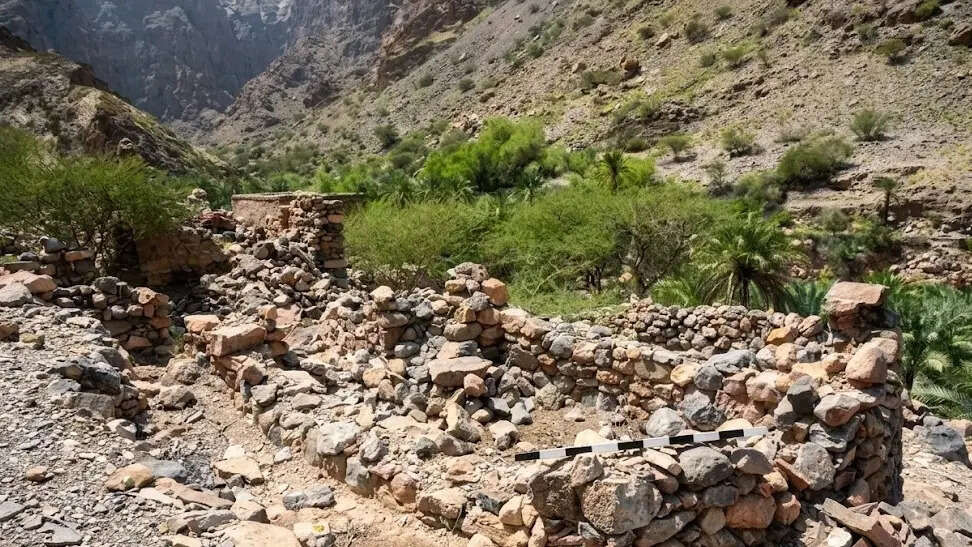
Modern infrastructure rarely yields to the ancient world without a fight, but in the North Al Batinah Governorate of Oman, the past has effectively seized the right of way. What started as a standard road expansion project in Saham has transformed into a high-stakes forensic investigation into a civilization that vanished three millennia ago. Construction crews clearing earth for new asphalt didn't just find rocks; they struck a massive subterranean complex of Iron Age graves that are currently rewriting the narrative of Arabian funerary customs.
The discovery centers on a series of communal tombs dating back to the first millennium BCE. These are not the modest, isolated burials one might expect from nomadic tribes of the era. Instead, archaeologists have unearthed sophisticated stone structures containing organized skeletal remains and an array of grave goods that suggest a society with deep pockets and even deeper spiritual anxieties. The site offers a rare, unfiltered look at how people lived—and more importantly, how they honored their dead—during a period of intense social transition in the Arabian Peninsula.
The Collision of Progress and Prehistory
The Saham site is a classic example of "rescue archaeology," a frantic race against the clock where scientists work mere feet away from heavy machinery. When the Ministry of Heritage and Tourism stepped in to halt the roadwork, they found more than just bones. They found a blueprint for Iron Age survival.
The graves are constructed using local limestone, stacked with a precision that indicates professional craftsmanship rather than hurried burial. These were communal pits. In the Iron Age, death was a collective experience. Families or clans were interred together over decades, their bones eventually mingling as new bodies were added to the chamber. This practice speaks to a social cohesion that defined the region long before the modern borders of the Sultanate were drawn.
The Material Wealth of the Afterlife
It is the artifacts that tell the most haunting story. Within the dusty chambers, researchers recovered bronze weaponry, intricately carved softstone vessels, and beads made from semi-precious stones. These objects weren't manufactured by amateurs. The bronze daggers and arrowheads found at Saham imply a culture that was both militarized and highly skilled in metallurgy.
Copper mining has been the backbone of the Omani interior for five thousand years, but by the Iron Age, the residents of Saham had mastered the art of alloying and casting. They were part of a vast trade network that stretched from the Indus Valley to Mesopotamia. The presence of carnelian and shell jewelry suggests that even 3,000 years ago, this coastal strip was a cosmopolitan hub. People here weren't just surviving the desert; they were thriving in it, decorating their dead with imports that would have cost a fortune in local currency—likely livestock or copper ingots.
Why Saham Changes the Map
For decades, archaeological focus in Oman remained fixed on the "beehive" tombs of Bat or the frankincense trails of the south. Saham was often overlooked as a transit corridor. This find proves that the Batinah plain was a densely populated powerhouse during the Iron Age.
The complexity of these rituals suggests a belief system that required significant investment. To build a stone tomb of this magnitude requires a sedentary or semi-sedentary population. You don't build permanent stone houses for the dead if you are constantly on the move. This discovery forces a re-evaluation of how quickly the transition from nomadic pastoralism to settled agricultural society occurred in northern Oman.
The sheer volume of burials at this single site suggests a nearby settlement that has yet to be fully uncovered. We are looking at the cemetery, but the city of the living is likely buried under the very road the construction crews were trying to build. This creates a recurring tension for the Omani government: the need for 21st-century logistics versus the preservation of 10th-century BCE heritage.
The Preservation Crisis
Archaeology in the Gulf is a battle against the elements. The humidity of the coast and the scorching heat of the interior conspire to turn ancient organic matter into dust. Every hour these graves sit exposed to the open air, the risk of degradation increases. The Ministry has deployed specialized teams to stabilize the site, but the scale of the find is overwhelming.
There is also the ever-present threat of looting. Ancient sites in remote areas are often targeted by "treasure hunters" looking for marketable artifacts like the softstone bowls found in Saham. By the time an official team arrives, the context of the burial—where the body was placed, what it was holding—is often destroyed. In Saham, the speed of the government intervention saved the site from this fate, allowing for a "pure" excavation that provides a clean data set for future carbon dating and DNA analysis.
Rituals of the Iron Age
The Iron Age in Oman wasn't just about metal; it was about the management of water and the soul. This was the era of the falaj, the ingenious underground irrigation system that turned the desert green. It is no coincidence that where we find sophisticated water management, we find sophisticated burial rituals.
The Saham graves show evidence of "secondary burial." This is a process where the body is allowed to decompose elsewhere before the bones are cleaned and moved into the communal stone chamber. It is a labor-intensive way to handle the dead. It requires a society that values the physical remains of the ancestors as a permanent fixture of the landscape.
The daggers found with the remains weren't just for defense. They were symbols of status. To be buried with a bronze blade in 900 BCE was to be identified as a protector or a person of high standing. The fact that so many individuals in these communal graves were buried with weapons suggests a warrior class or a society that viewed the afterlife as a place where one still needed to be armed.
The DNA Frontier
The next phase of the Saham investigation will move from the trenches to the laboratory. Advances in ancient DNA (aDNA) sequencing now allow scientists to extract genetic material from even the most degraded bone fragments. This could finally answer where these people came from. Were they the direct descendants of the Bronze Age "Magal" people, or did a new wave of migration from the north or across the sea bring these Iron Age customs to the coast?
The pottery styles found at the site show clear links to other Iron Age sites in the United Arab Emirates and Iran. This confirms that the Gulf was not a barrier, but a highway. The people of Saham were watching ships pass by daily, likely trading their copper and agricultural surplus for the luxury goods found in their graves.
The Cost of Discovery
Every time a shovel hits a bone during a public works project, the budget bloats and the timeline stretches. For the locals in Saham, the road expansion is a necessity for daily life and commerce. For the global scientific community, the site is an irreplaceable archive of human history.
The Omani government has taken a firm stance: heritage takes precedence. This isn't just about sentiment; it’s about the "Vision 2040" plan to diversify the economy through cultural tourism. Sites like Saham are the raw materials for a future where Oman is known not just for oil, but as the "open-air museum" of the Middle East.
However, the reality on the ground is grittier. Archaeologists are working in 40-degree heat, meticulously brushing sand off molars while trucks idle nearby. It is a grueling, unglamorous process of documenting a tragedy that happened three thousand years ago. Each skeleton represents a life cut short—a mother, a soldier, a child—whose final resting place was disturbed by the progress of a world they could never have imagined.
The artifacts recovered from Saham are currently being moved to the National Museum in Muscat for conservation. There, they will be cleaned of three millennia of grime and placed under glass. But the real story remains in the dirt of the Batinah plain. As the road eventually bypasses or paves over these chambers, the data extracted will serve as the only evidence that a powerful, wealthy, and organized society once stood exactly where the traffic now flows.
The iron-willed people of Saham’s past have successfully halted the machinery of the present. They have demanded to be seen. In the silent, stone-lined pits of North Al Batinah, the ancestors are finally getting their say, proving that even the most ambitious road project must eventually bow to the weight of the dead.