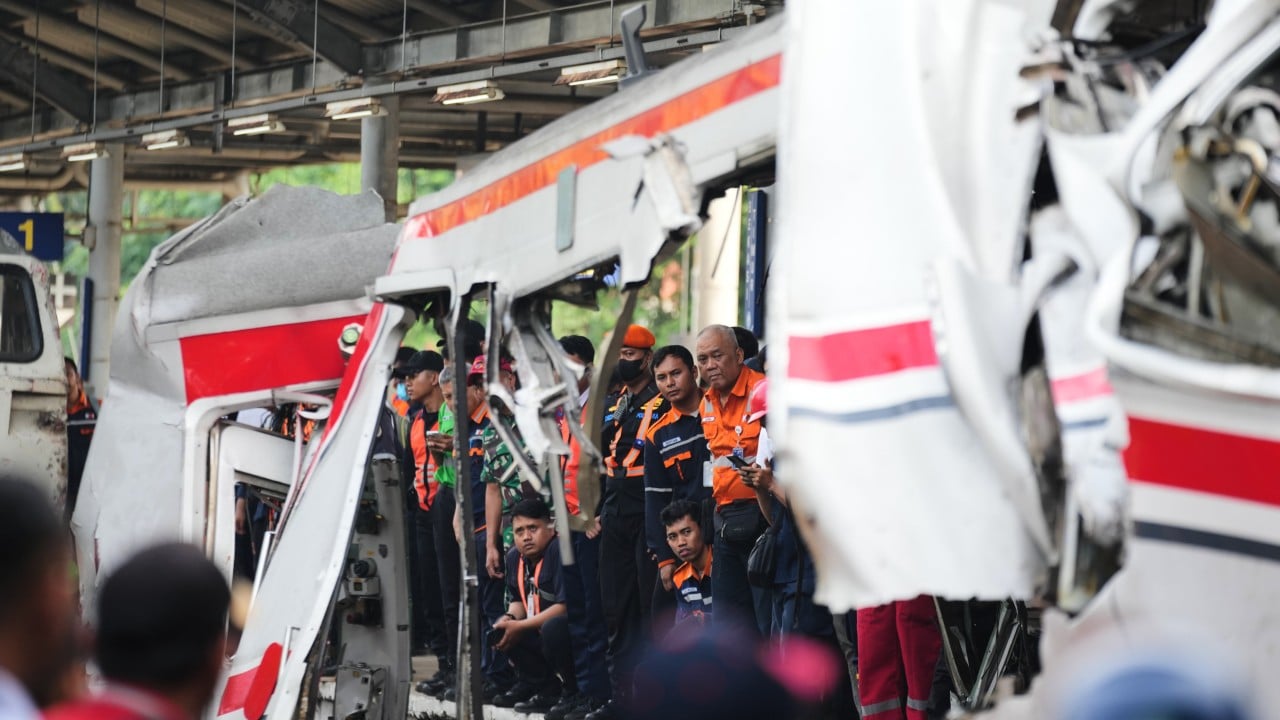
Indonesia’s railway system is currently trapped in a deadly contradiction between high-tech aspirations and a primitive reality on the ground. While the government celebrates the launch of high-speed rail links and urban light rail, the backbone of the national network is crumbling under the weight of systemic neglect and thousands of illegal, unmonitored level crossings. These gaps in the infrastructure are not mere accidents of geography. They are the predictable result of a decades-long failure to integrate local governance with national transportation strategy. Every time a locomotive broadsides a passenger vehicle at an unmarked rural junction, the conversation follows a weary script of "human error" and "lack of discipline," neatly sidestepping the uncomfortable truth that the system is designed to fail.
The Anatomy of an Avoidable Disaster
To understand why Indonesian trains keep colliding with cars and other trains, one has to look past the mangled steel and into the bureaucratic void. The primary culprit is the level crossing—a point where road and rail meet at the same grade. Across the archipelago, there are over 5,000 of these crossings. More than half are officially classified as "unauthorized" or "unmanaged." This means there are no gates, no sirens, and no lights. There is only a sign, if you are lucky, and the hope that a driver isn't distracted.
The tragedy is baked into the math of the tracks. As PT Kereta Api Indonesia (KAI) increases the frequency and speed of its services to meet economic demand, the window of safety at these crossings narrows. A train traveling at 90 kilometers per hour cannot stop on a dime. It requires nearly a kilometer of track to come to a full halt. When a truck stalls on an illegal crossing in East Java or a motorbike darts across the rails in Cirebon, the engineer is essentially a passenger in their own cabin, watching a disaster unfold with their hand on a useless brake.
The Decentralization Trap
Responsibility for these death traps is a legal quagmire. Under Law No. 23 of 2007 on Railways, the responsibility for managing crossings is split between the central government, provincial authorities, and local regencies. In practice, this split creates a vacuum where no one takes ownership. Local regencies often claim they lack the budget to install expensive gate hardware or hire 24-hour guards. The central government argues that since the roads are local, the safety measures must be local too.
While the officials bicker over line items, communities take matters into their own hands. "Voluntary" guards—often local residents with no formal training—stand at these crossings, waving flags and collecting small tips from drivers. This is the "Swakarsa" system, a desperate, grassroots band-aid on a hemorrhaging wound. Relying on the vigilance of an untrained civilian to manage the safety of a 400-ton train is not a safety strategy. It is an admission of state failure.
The Myth of the Disciplined Driver
The most common defense from transport officials is that accidents are caused by "undisciplined" citizens who ignore signals. This narrative is convenient because it shifts the financial burden of safety onto the victim's behavior rather than the infrastructure. It is true that Indonesian traffic culture is aggressive. However, safety engineering is supposed to account for human fallibility. If a system requires 100% human perfection to avoid a mass-casualty event, then the system is fundamentally flawed.
In modern safety science, this is known as the "Swiss Cheese Model." Every layer of protection—from the gate to the siren to the driver’s eyes—is a slice of cheese with holes in it. An accident happens when the holes line up. In Indonesia, the government has removed most of the slices, leaving only the driver’s judgment as the final barrier. When that fails, there is nothing left to catch the fall.
High Tech Gloss over Low Tech Rot
The optics of Indonesian rail are currently dominated by the Whoosh high-speed rail and the Jabodebek LRT. These are symbols of a modernizing nation, featuring automated signaling and Grade of Automation (GoA) technology that minimizes human intervention. They are impressive. They are also an expensive distraction from the reality of the conventional tracks that carry the vast majority of the country's freight and passengers.
While billions of dollars flow into prestigious "National Strategic Projects," the funding for basic safety upgrades on the legacy lines—such as building underpasses or overpasses—remains a secondary priority. Closing an illegal crossing is not just a matter of putting up a fence. It often cuts off a village’s only access to a main road, meaning the government must build alternative routes. This is expensive, politically sensitive work that doesn't look as good in a press release as a sleek new bullet train.
The Economic Cost of Inertia
Safety gaps are not just a humanitarian issue; they are a drag on the national economy. Every major collision results in hours of track closure, damaging rolling stock and delaying the transport of goods. For a country trying to lower its logistics costs to compete with regional neighbors, these disruptions are a self-inflicted wound.
KAI has made strides in modernizing its internal operations and its ticketing systems, but it cannot fix the world outside the tracks on its own. The company is often blamed for accidents it has no power to prevent. Until there is a mandatory, federally funded program to eliminate all level crossings on high-frequency lines, the cycle will repeat. The technology to fix this exists. It isn't complex. It involves concrete, steel, and the political will to prioritize the lives of rural commuters over the vanity of urban megaprojects.
The Invisible Toll on Railway Workers
Often lost in the headlines are the train drivers and onboard crew. These workers suffer from significant psychological trauma after "unavoidable" collisions. They are the ones who have to see the impact, who have to wait for the authorities to clear the tracks, and who often face the misplaced rage of local mobs immediately following a crash. The failure to secure the tracks is a failure of the duty of care the state owes to its own employees.
A Blueprint for Genuine Security
Fixing the Indonesian rail crisis requires more than just more "socialization" or "awareness campaigns." It requires a hard pivot in how infrastructure is funded and managed.
- Federalization of Crossing Safety: The legal loophole that allows local governments to ignore crossing safety must be closed. The Ministry of Transportation should have the direct authority and budget to secure any crossing that meets a specific risk threshold, regardless of whose road it is.
- The Underpass Mandate: For any line where trains exceed 80 km/h, the goal should be zero grade crossings. Building a bridge is more expensive than a gate, but it is a one-time cost that eliminates the risk entirely.
- Acoustic and Visual Standards: Many existing crossings use antiquated sirens that are easily drowned out by tropical rain or heavy truck engines. Standardizing high-intensity LED lighting and long-range acoustic devices is a low-cost interim step.
- Automated Enforcement: In areas where gates are installed, they are frequently bypassed by motorbikes. High-definition cameras linked to the national electronic traffic law enforcement (ETLE) system would provide a real deterrent that "educational" posters cannot.
The current trajectory is unsustainable. As the population grows and the rail network expands, the number of contact points between human life and heavy machinery will only increase. We cannot continue to treat these deaths as the "price of progress." They are the price of a budget that values the speed of the few over the safety of the many.
If the government can find the billions required to tunnel through mountains for high-speed rail, it can find the millions required to ensure a school bus doesn't get pulverized in a quiet village in Central Java. The blood on the tracks isn't just an accident; it's a line item that hasn't been paid. Stop talking about the lack of discipline and start talking about the lack of a fence.
The next disaster is already scheduled. It is waiting at the next unmapped crossing, where the grass has grown over the warning sign and the only thing protecting the public is a volunteer with a plastic flag. We know exactly where it will happen. The only question is whether the check will be signed before the impact.


