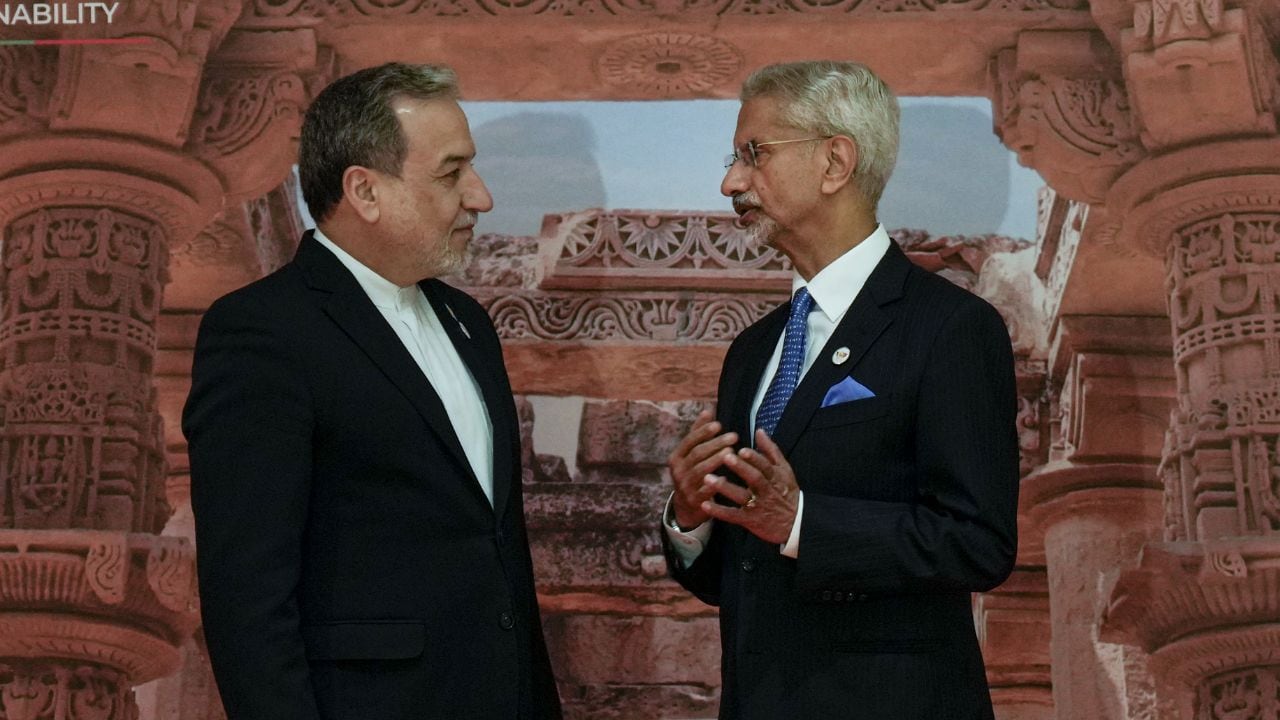
The inclusion of Iran into the BRICS framework transforms the bloc from a symbolic alternative to the G7 into a high-stakes corridor for energy security and logistical bypass. When Indian External Affairs Minister S. Jaishankar met Iranian Foreign Minister Abbas Araghchi on the sidelines of the BRICS gathering, the dialogue was not merely a diplomatic formality; it was a synchronization of two distinct geopolitical survival strategies. India seeks to insulate its supply chains from Western-led volatility, while Iran seeks to formalize its reintegration into the global economy through non-Western multilateralism.
The Triad of Indo-Iranian Strategic Interdependence
The relationship between New Delhi and Tehran within the BRICS+ context functions through three specific operational vectors: energy arbitrage, logistical sovereignty, and regional stabilization.
Energy Arbitrage and Payment Resilience: India remains one of the world's largest energy consumers. The primary constraint on Indo-Iranian trade has never been demand, but rather the friction of the USD-denominated financial system. Within BRICS, the push for "de-dollarization"—or more accurately, the diversification of settlement currencies—allows India to hedge against secondary sanctions. By developing a rupee-rial mechanism or utilizing a BRICS-wide digital currency framework, both nations aim to reduce the transaction cost of energy imports.
Logistical Sovereignty via the INSTC: The International North-South Transport Corridor (INSTC) is the physical manifestation of this alliance. While the Suez Canal remains a bottleneck subject to maritime insecurity and geopolitical chokepoints, the INSTC provides a land-and-sea hybrid route that connects India to Russia and Central Asia through Iran's Chabahar Port.
The logic here is a "Cost Function of Distance":
- Time Reduction: A 40% reduction in transit time compared to the Suez route.
- Freight Savings: An estimated 30% decrease in total transport costs.
- Geopolitical Bypass: A direct route that avoids Pakistani territory, neutralizing a primary regional constraint for Indian exports.
- Regional Stabilization and Afghanistan: Security in the Eurasian heartland is a shared prerequisite for economic growth. Both New Delhi and Tehran view the instability in Afghanistan as a source of "External Negative Externalities"—specifically drug trafficking and extremist spillover. Their dialogue within BRICS serves to coordinate intelligence and political leverage to ensure that regional chaos does not devalue their shared infrastructure investments.
Deconstructing the BRICS+ Multipolarity Framework
The expansion of BRICS to include Iran, Egypt, Ethiopia, and the UAE signals a shift from "Identity Politics" to "Interest-Based Realism." Critics often point to the internal contradictions of the bloc—such as the China-India border dispute—as evidence of its eventual failure. This analysis misses the "Minimum Viable Cooperation" (MVC) threshold.
The MVC Threshold posits that members do not need total ideological alignment; they only require a shared interest in reducing dependency on unipolar financial levers. For India, BRICS is a tool of "Multi-alignment." It allows New Delhi to sit at the table with the West (via the Quad and G20) while simultaneously anchoring its interests in the Global South.
The Chabahar Port Calculus: A Case Study in Strategic Patience
India’s 10-year agreement to operate the Chabahar Port is the cornerstone of its engagement with Iran. The project’s success is measured by its ability to serve as a gateway to the landlocked markets of Central Asia. However, the operationalization of this port faces a specific "Risk Profile":
- Sanction Sensitivity: Despite specific exemptions in the past, the threat of U.S. sanctions remains a deterrent for private sector investment and insurance for shipping.
- Infrastructure Gaps: The missing rail link between Zahedan and Chabahar creates a "Last-Mile Inefficiency" that prevents the port from reaching its full throughput capacity.
- Competitive Pressure: The proximity of Pakistan’s Gwadar Port, backed by Chinese capital, creates a competitive landscape where efficiency and security are the primary differentiators.
Mechanical Drivers of the Jaishankar-Araghchi Dialogue
The meeting between the two ministers focused on the "Dialogue Key" amid global uncertainty. In analytical terms, "uncertainty" refers to the breakdown of the rules-based order and the rise of protectionism. The dialogue serves to calibrate their response to three specific disruptions:
1. The Red Sea Crisis: As Houthi attacks disrupt traditional maritime routes, the Iranian-Indian axis gains value. If the Red Sea remains a high-risk zone, the INSTC transitions from a "luxury alternative" to a "critical necessity."
2. The 2024 Global Election Cycle: With leadership changes in both the West and within BRICS nations (like Iran’s own recent transition), diplomatic continuity is essential to prevent project paralysis. Araghchi’s presence at BRICS signifies that Tehran’s commitment to the bloc is institutional, not just tied to a specific administration.
3. Technological Sovereignty: BRICS is increasingly focusing on the "Digital Public Infrastructure" (DPI) model pioneered by India. The export of India’s Unified Payments Interface (UPI) technology to Iran and other BRICS members would create a parallel financial architecture that is immune to Western-controlled SWIFT disconnects.
The Cost of Inaction: A Comparative Risk Assessment
If India fails to deepen its engagement with Iran within the BRICS framework, it faces a "Strategic Vacuum" that would likely be filled by China. Beijing’s 25-year strategic partnership with Iran already provides a massive capital infusion. Without Indian involvement in Chabahar and the INSTC, Iran would be forced to integrate more deeply into the Belt and Road Initiative (BRI), effectively giving China a monopoly over Eurasian trade routes.
For Iran, the risk of ignoring India is the "Monopsony Trap." If China becomes the sole buyer of Iranian energy and the sole provider of infrastructure investment, Tehran loses its bargaining power. India provides the necessary "Third Way" balance.
Constraints and Structural Bottlenecks
Despite the optimism, the Indo-Iranian relationship within BRICS is limited by two structural realities:
- The Israel Factor: India’s deepening strategic and technological ties with Israel create a "Diplomatic Friction Point." Tehran’s hostility toward Tel Aviv requires New Delhi to perform a high-wire act of compartmentalization. Any escalation in the Middle East that draws Iran into a direct conflict would force India into a neutrality that would satisfy neither side.
- Capital Scarcity: Unlike China, India does not have an infinite supply of state-led capital for overseas projects. Every dollar spent in Iran must be justified against domestic infrastructure needs. This creates a "Deployment Lag" where Indian projects often take years longer to materialize than their Chinese counterparts.
Strategic Recommendation for Regional Integration
To capitalize on the BRICS expansion, the Indo-Iranian partnership must move beyond high-level diplomatic statements and focus on Technical Interoperability. This requires three specific actions:
- Harmonization of Customs Protocols: Standardizing the paperwork and digital tracking for the INSTC to ensure that a container moving from Mumbai to St. Petersburg does not face administrative delays at the Iranian border.
- Creation of a Joint Special Purpose Vehicle (SPV): A dedicated financial entity, perhaps funded through the BRICS New Development Bank, specifically designed to insulate Chabahar’s operations from secondary sanctions.
- Energy-for-Infrastructure Swaps: Revisiting the model where Iranian crude oil is exchanged for Indian engineering services and industrial equipment, bypassing the need for hard currency reserves and stabilizing the trade balance.
The shift in the global order is no longer a theoretical debate; it is a measurable reallocation of trade flows and political capital. The Jaishankar-Araghchi meeting confirms that both New Delhi and Tehran recognize the "Path Dependency" created by their geography. Those who view BRICS as a mere talk shop fail to see the hardening of these new corridors. The success of this axis will be determined not by the warmth of the handshakes, but by the volume of freight moving through the Iranian plateau and the resilience of the non-dollar ledgers that record it.

:max_bytes(150000):strip_icc():focal(819x186:821x188)/Murdaugh-Family-e90854a716884d608fb6fd925e18d840.jpg)
