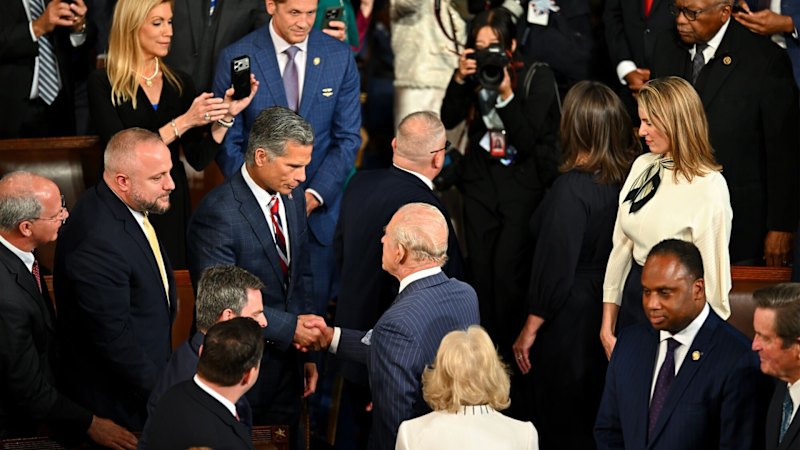
King Charles III stood before the United States Congress not as a mere visitor, but as a living symbol of a relationship that has transitioned from colonial struggle to indispensable alliance. This address represents a calculated maneuver in modern statecraft. By securing the podium of the House Chamber, the British Crown sought to solidify its relevance in a geopolitical environment that is increasingly skeptical of inherited power. The King aimed to align the UK’s soft power with American legislative muscle, focusing on shared environmental goals and the defense of democratic norms.
The significance of this moment cannot be overstated. While ceremonial in nature, the speech served as a bridge between the historical "Special Relationship" and the pragmatic requirements of the mid-2020s. Charles did not just recount old ties. He laid out a vision for how a constitutional monarchy can serve as a steadying force in an era of rapid political fragmentation.
The Strategy of Soft Power in a Hard World
Behind the gold braid and the carefully modulated delivery lies a sophisticated diplomatic machinery. The British Foreign, Commonwealth and Development Office viewed this address as a primary tool for post-Brexit influence. Without the weight of the European Union behind it, the United Kingdom must rely on its unique cultural assets to remain a top-tier global player. The King is the ultimate asset. He provides a level of access and pageantry that no elected politician can match, allowing the UK to punch above its weight in Washington’s crowded lobbying corridor.
This visit was designed to bypass the partisan gridlock that often defines American politics. The monarchy, by its very definition, is apolitical. This allows Charles to speak to both sides of the aisle about issues that are usually treated as political footballs. When he speaks on conservation or global security, he does so from a position of historical continuity rather than electoral ambition. It is a rare trick in modern governance.
Bridging the Environmental Divide
For decades, Charles was mocked for his outspoken views on organic farming and climate change. He was a man ahead of his time, or perhaps just a man with too much time on his hands. Today, those same views are the bedrock of international policy. His address to Congress focused heavily on the "green" economy, framing the transition to sustainable energy as an industrial necessity rather than a radical luxury.
He spoke to a room divided by energy interests. On one side, lawmakers from coal and oil states; on the other, advocates for a total overhaul of the American power grid. Charles navigated this by focusing on innovation. He highlighted the potential for British and American firms to dominate the next century of technology. This was not an activist’s plea. It was a businessman’s pitch delivered with a royal accent.
The Specter of Colonial History
One cannot ignore the irony of a British monarch standing in the heart of a republic born from a revolution against his ancestor. The King acknowledged this history with a dry wit that has become his trademark. However, the subtext was more serious. The world is currently witnessing a rise in authoritarianism, and Charles used his position to remind his audience that the "Great Experiment" of American democracy remains the world’s most vital bulwark against tyranny.
He drew a straight line from the Magna Carta to the US Constitution. This was a deliberate attempt to remind American lawmakers of their philosophical roots. In a time when internal divisions threaten the stability of the West, the King’s message was one of foundational unity. He was essentially telling Congress that if the Monarchy and the Republic can find common ground after 250 years, then perhaps the modern world can find a way to avoid its own collapse.
Security and the New Atlantic Charter
The defense of Ukraine and the stability of NATO were invisible guests at the podium. While the King cannot dictate military policy, his presence reinforced the defense pacts that bind London and Washington. The British government used this visit to signal that their commitment to European security remains absolute, regardless of which party holds the White House. This is a crucial message for an American public that is increasingly wary of foreign entanglements.
Charles emphasized the concept of "duty," a word that carries significant weight in both the military and the monarchy. By framing the defense of democratic allies as a moral duty, he appealed to the traditionalist wings of both the Republican and Democratic parties. It was a masterclass in using the prestige of the Crown to support the pragmatic goals of the Prime Minister.
The Modern Monarchy as a Global Brand
We often view the royals through the lens of tabloid drama or period television. That is a mistake. The House of Windsor is a multi-billion-dollar brand that exports British culture, values, and goods to every corner of the globe. This congressional address was a high-stakes marketing campaign for "Global Britain."
The King’s performance in Washington proves that the institution has successfully navigated the transition from Elizabeth II’s era of quiet mystery to Charles III’s era of active engagement. He is a more vocal monarch, willing to engage with the pressing issues of the day without violating the neutrality required of his office. This approach carries risks. If the King is seen as too political, he threatens the consensus that allows the monarchy to exist. If he is too silent, he risks irrelevance.
The Economic Reality of the Visit
While the speeches grab the headlines, the real work happens in the receptions and private meetings that surround the event. British trade delegations accompanied the royal party, using the doors opened by the King to discuss everything from financial services regulations to aerospace contracts. The address to Congress was the "anchor store" of a much larger trade mission.
The UK is currently the largest foreign investor in the United States, supporting millions of American jobs. Charles used his address to remind lawmakers of this economic reality. He didn't need to beg for a free trade agreement; he simply reminded them that the two nations are already so intertwined that their success is inseparable. It was a subtle, yet firm, assertion of British economic relevance.
Addressing the Commonwealth and the World
The eyes on Charles were not just American. Back in the UK and across the Commonwealth, the King’s performance was being scrutinized for signs of how he will lead a diverse group of 56 nations. By standing as an equal among the world's most powerful legislators, he signaled to the Commonwealth that Britain remains a central player on the world stage. This is vital for maintaining the cohesion of an organization that many critics believe is a relic of the past.
The King’s focus on "stewardship"—of the planet, of institutions, and of the law—served as a unifying theme. It is a concept that resonates in Nairobi as much as it does in New York. By choosing a word that implies caretaking rather than ruling, Charles is attempting to redefine the role of the King for a post-imperial age.
The Tension of the Moment
Not everyone in the chamber was cheering. A handful of lawmakers remained seated during the ovations, reflecting a growing segment of the American population that views monarchy as an outdated absurdity. Charles handled this with the poise of a man who has spent seventy years preparing for a job he only recently started. He did not seek to convert the skeptics; he sought to outwork them.
The success of the speech will not be measured by the length of the applause, but by the legislative cooperation that follows in the coming months. If British and American policies on carbon pricing or AI regulation begin to align more closely, the King’s visit will be deemed a triumph of quiet diplomacy.
The Future of the Special Relationship
The bond between the US and the UK is often described in sentimental terms, but its foundation is cold, hard utility. We share intelligence, technology, and capital. The King’s address was a reminder that these shared interests require a shared language of values. He provided that language by focusing on the long-term survival of the planet and the short-term defense of the international order.
As the King concluded his remarks, the focus shifted from the history of the 18th century to the challenges of the 21st. The monarchy has survived by being the ultimate survivor, adapting to every social and political shift for a millennium. By taking his message to the heart of the American Republic, Charles III proved that the Crown is not just a museum piece, but a functional tool of the British state.
The next time a major trade dispute or security crisis arises between these two nations, the memory of this address will serve as the diplomatic lubricant. It provided the high-level cover necessary for the bureaucrats and politicians to do their jobs. The King did his part by reminding the world that even in an age of digital disruption and political upheaval, there is still a place for the steadying hand of tradition.
Governments must now move beyond the ceremony and address the specific policy goals the King outlined. The transition to a sustainable economy will require more than royal speeches; it will require billions in capital and a massive shift in domestic policy for both nations.