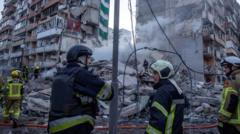
The air raid sirens in Kyiv no longer provoke the panicked rush to the subways they once did. Instead, they trigger a weary, practiced ritual of checking Telegram channels and moving away from windows. This normalization is exactly what the Russian Federation bankrolled as they launched another wave of coordinated missile and drone strikes against the Ukrainian capital. While initial reports often focus on the immediate debris and the smoke rising from residential districts, the strategic intent behind these strikes involves a sophisticated effort to bankrupt the Ukrainian defense budget and shatter the psychological endurance of its civilian population.
The most recent barrage followed a familiar, lethal pattern. At approximately 2:30 AM, Shahed loitering munitions began crossing the border, designed to loiter and force Ukrainian air defense teams to reveal their positions. These were followed by a mix of Kh-101 cruise missiles launched from Tu-95MS bombers and high-velocity ballistic missiles. The goal is simple. They want to saturate the sky so thoroughly that even the most advanced Western systems, like the Patriot or IRIS-T, reach a breaking point.
The Architecture of Attrition
The sheer cost of defending a city of three million people is staggering. We are witnessing an asymmetric economic war played out in the atmosphere. A single Iranian-designed drone might cost between $20,000 and $50,000 to produce. To intercept it, Ukraine often utilizes missiles that cost millions of dollars each. This is the math of a long war. Moscow isn't just trying to hit physical targets; they are trying to deplete the stockpile of interceptors faster than Western factories can replace them.
When a strike hits a residential building in an area like Solomyanskyi or Shevchenkivskyi, it is rarely a primary objective. More often, it is the result of a successful interception where the kinetic energy and remaining fuel of the missile carry it into a high-rise. For the families living there, the distinction between a direct hit and "falling debris" is meaningless. Their homes are gone. The city's infrastructure, particularly the energy grid, remains the true north for Russian targeting intelligence. By hitting thermal power plants and substations, the Kremlin intends to make Kyiv unlivable, forcing another wave of refugees toward the European borders.
The Failure of the Iron Veil
Despite the high interception rates often touted by the Ukrainian General Staff, no defense is impenetrable. In the recent strikes, several missiles bypassed the outer rings of the defense network. This happens because Russia has evolved its tactics. They now use "decoys" that mimic the radar signature of real missiles but carry no warhead. This forces the Ukrainian batteries to fire at ghosts, leaving them reloading and vulnerable when the actual lethal payloads arrive minutes later.
The logistics of this defense are grueling. Crews must remain mobile, constantly shifting their launchers to avoid being spotted by Russian Orlan-10 reconnaissance drones. If a Patriot battery stays in one place too long, it becomes the target rather than the protector. This cat-and-mouse game occurs every night, largely invisible to the civilians sleeping—or trying to sleep—in the apartments below.
The Psychological Frontline
Walk through the streets of Kyiv the morning after a major raid and you will see glass being swept. It is the rhythmic sound of the city's defiance. However, beneath that surface-level resilience lies a deepening exhaustion. Chronic sleep deprivation is now a collective medical condition in the capital. The Russian strategy relies on the "drip-feed" of terror—never enough to cause a total collapse of order, but always enough to ensure the population never feels truly safe.
There is a political dimension to these strikes that often gets overlooked in Western analysis. Every time a missile hits a target in Kyiv, it serves as a propaganda tool for the Kremlin to signal to its domestic audience that the "Special Military Operation" is proceeding with precision. Conversely, it puts immense pressure on the Ukrainian government to divert limited air defense assets from the front lines in the Donbas to protect the capital. By attacking Kyiv, Russia effectively thins out the defenses protecting the soldiers in the trenches.
The Limits of Western Aid
While the arrival of the Patriot and SAMP/T systems significantly altered the survival rate of the city, they are not a permanent solution. The supply chains for these interceptors are under immense strain. The United States and its European allies are operating at maximum production capacity, yet the consumption rate in Ukraine often exceeds the monthly output of these factories.
This creates a dangerous gap. If the West cannot find a way to lower the cost of interception—perhaps through the deployment of more Gepard anti-aircraft guns or laser-based systems—the current model of defending Kyiv is unsustainable over a multi-year horizon. The Kremlin is betting on Western fatigue. They believe that eventually, the political will to send multi-million dollar missiles to hunt fifty-thousand dollar drones will evaporate.
Targeting the Energy Heart
Beyond the human toll, the focus on the "energy heart" of the city is a calculated move to cripple the Ukrainian economy. Without stable power, businesses cannot operate, the banking system falters, and the cost of logistics skyrockets. The recent strikes have increasingly targeted the "control rooms" of the power grid—the specialized equipment that is much harder to replace than simple transformers.
Repair crews, the unsung heroes of this conflict, often arrive at the scene of a strike while the fires are still burning. They work in shifts to bypass damaged nodes and keep the lights on, but each subsequent strike makes the grid more brittle. We are seeing a gradual degradation of the system that no amount of emergency repair can fully reverse without a total cessation of hostilities.
The Intelligence Gap
A critical factor in the success or failure of these strikes is the role of ground-level informants. The SBU, Ukraine's security service, is in a constant battle to root out individuals who provide coordinates or "B-roll" footage of strike locations to Russian intelligence via encrypted apps. This real-time feedback allows the Russian military to adjust their targeting for the next wave, turning each attack into a learning exercise for their missile programmers.
The sophistication of the flight paths has also increased. Missiles now utilize terrain-following radar to fly low through river valleys, popping up at the last second to strike. This reduces the reaction time for Ukrainian radar operators to a matter of seconds. The "detect to engage" sequence is now so compressed that human decision-making is being replaced by automated fire-control systems.
A City Under Constant Siege
Kyiv is a city that lives in two realities. In the afternoon, the cafes are full and the parks are active. At night, the sky turns into a battlefield of tracers and explosions. This duality is the defining characteristic of the modern siege. It is not about surrounding the city with tanks; it is about surrounding its inhabitants with the constant threat of sudden, violent death from above.
The international community watches these events through the lens of a news cycle, but for the people of Kyiv, there is no "off" switch. The demand for more sophisticated long-range strike capabilities for Ukraine is driven by this reality. The military leadership in Kyiv argues that the only way to stop the strikes on their city is to destroy the bombers and missile launchers on their pads deep inside Russian territory. This remains the most contentious point of friction between Kyiv and its Western backers.
The current strategy of "passive defense"—intercepting missiles as they arrive—is a losing game in the long run. Without the ability to neutralize the source of the fire, Kyiv remains a target in a shooting gallery, dependent entirely on a finite supply of expensive interceptors and the iron will of its people to keep sweeping the glass. The air defense batteries are quiet for now, but the technicians are already prepping the next racks of missiles. They know the sirens will sound again before the week is out.
The war for Kyiv is no longer about territory; it is about the endurance of the social fabric under the weight of metal.