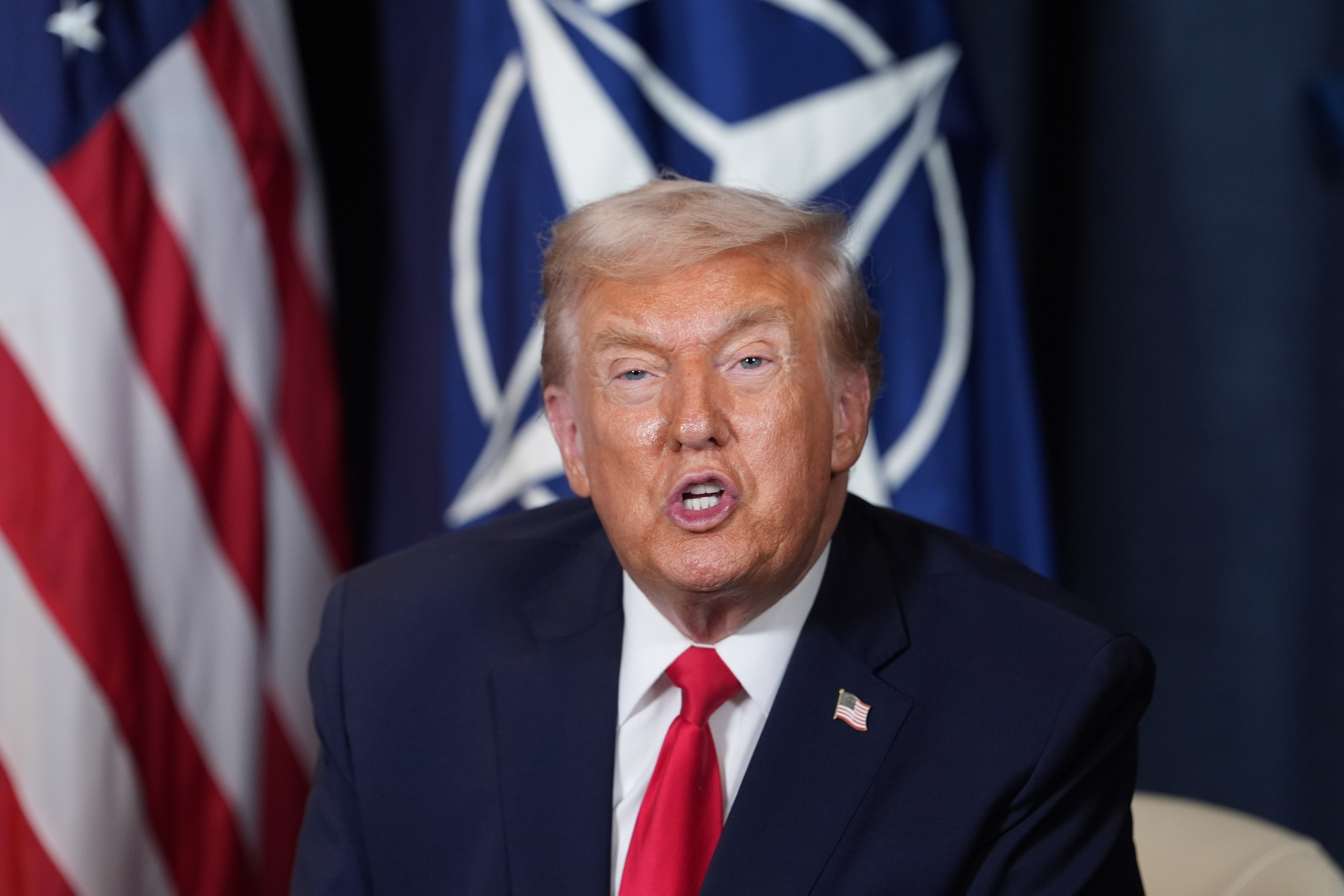
Donald Trump has officially labeled NATO a paper tiger, signaling a fundamental shift in American foreign policy that could dismantle the post-war security architecture. This isn't just campaign rhetoric or a bargaining tactic to increase defense spending. It is an ideological pivot toward a transactional "America First" doctrine that views 75 years of collective security as a bad business deal. If the United States exits, the North Atlantic Treaty Organization doesn't just shrink; it evaporates.
The shockwaves from these statements have rattled capitals from Tallinn to Paris. For decades, the alliance rested on a simple, terrifying promise: an attack on one is an attack on all. By casting doubt on Article 5, Trump is effectively nullifying the deterrent power of the American nuclear umbrella. Without that guarantee, the alliance loses its teeth.
The Transactional Trap
To understand why Trump sees a paper tiger where others see a shield, you have to look at the math he uses. He doesn't view NATO as a strategic geopolitical asset. He sees it as a protection racket where the lead enforcer isn't getting paid. His focus on the 2% GDP defense spending target is the lens through which he judges the entire value of the European continent.
Most European nations have historically failed to meet this threshold. While the Russian invasion of Ukraine spurred a massive uptick in spending, the legacy of "freeloading"—as Trump describes it—has soured the relationship. He is betting that the American public is tired of subsidizing the security of wealthy nations that then compete with the U.S. in global trade.
But this focus on ledger sheets ignores the "how" of American power. The U.S. doesn't station troops in Germany solely to protect Germans. It does so to project power into the Middle East, Africa, and Central Asia. Ramstein Air Base is a hub for global operations, not just a local police station. If the U.S. pulls out, it doesn't just save money; it loses the ability to respond to crises across half the globe.
A Continent Unprepared
Europe is currently in a state of quiet panic. For years, the "European pillar" of NATO was a theoretical concept discussed in academic circles. Now, it is a desperate necessity. The problem is that you cannot build a military-industrial complex overnight.
Europe lacks the heavy lift capabilities, satellite intelligence networks, and integrated command structures that the Americans provide. Even if Poland, Germany, and France doubled their budgets tomorrow, the hardware wouldn't arrive for a decade. The supply chains are brittle. The production lines for artillery shells and advanced missile systems are already strained by the war in Ukraine.
The Nuclear Gap
The most uncomfortable conversation involves the nuclear deterrent. If the U.S. departs, Europe is left with the United Kingdom and France. Together, their arsenals are a fraction of the size of Russia’s. More importantly, there is no framework for a "European nuclear umbrella." Would Paris sacrifice itself for Warsaw? That question was supposed to be answered by the U.S. presence. Without it, the "paper tiger" label becomes a self-fulfilling prophecy.
The Russian Calculus
In Moscow, this discord is viewed as a generational opportunity. Vladimir Putin’s long-term goal has always been the decoupling of the United States from European security. A fractured NATO allows Russia to deal with European nations individually rather than as a unified bloc. This is the "Salami Slicing" tactic: exerting pressure on the Baltics or the Balkans through hybrid warfare, cyberattacks, and political interference, knowing that a fractured West will hesitate to respond.
Trump’s rhetoric provides the Kremlin with exactly what it needs: uncertainty. Deterrence only works if it is absolute. If there is even a 5% chance that the U.S. won't show up to defend Riga or Tallinn, the deterrent has already failed.
The Burden of Proof
Critics of the "Paper Tiger" theory argue that Trump is merely using the threat of withdrawal to force Europe into a position of self-reliance. They point to the first Trump administration, where despite the rhetoric, U.S. troop levels in Europe actually increased. They argue that the bureaucracy of the Pentagon and the interests of the American defense industry act as a "deep state" brake on any radical moves.
However, this ignores the shift in the political personnel surrounding the former president. The "adults in the room" who tempered his impulses in the first term—generals like Mattis and Kelly—are gone. They have been replaced by loyalists who share his skepticism of multilateralism.
The Economic Fallout
A U.S. withdrawal from NATO would trigger more than just a military crisis; it would spark an economic earthquake. Global markets hate instability. The security of the North Atlantic is the foundation of the world’s most lucrative trade relationship. If the safety of the European market is no longer guaranteed by the world’s preeminent superpower, capital will flee.
The defense industry would be the only sector to see a boom, but even that would be chaotic. European nations would be forced to divert trillions from social programs, infrastructure, and green energy into frantic rearmament. This shift could lead to significant civil unrest in countries where the social safety net is a core part of the national identity.
Beyond the Article 5 Guarantee
What people often miss is that NATO is a massive interoperability machine. It ensures that a Dutch pilot can talk to a Turkish ground controller while flying a jet fueled by a Norwegian tanker. This technical integration is the result of seventy years of standardized protocols. If the U.S. leaves, this system breaks.
Europe would be left with a collection of national armies that use different ammunition, different radio frequencies, and different tactical doctrines. They would be a "paper tiger" not because they lack bravery, but because they lack a common language.
The American defense industry also stands to lose its primary captive market. European nations currently buy billions in F-35s, Abrams tanks, and Patriot missiles. If the U.S. is no longer their security partner, they will look to build their own alternatives or find new allies. This would hurt American manufacturing and reduce the "buy American" influence that has dominated global arms sales for decades.
The Looming Deadline
The timeline for this potential exit is shorter than many realize. While Congress recently passed legislation requiring a two-thirds Senate vote or an Act of Congress to leave NATO, a president can still effectively "leave" the alliance through executive action. They can stop attending summits, recall the Supreme Allied Commander, and cease sharing intelligence. A treaty is only as strong as the will of the person in the Oval Office to uphold it.
Europeans are already hedging their bets. We are seeing a flurry of bilateral security deals between individual nations. The UK and Germany recently signed a defense pact; France and Italy are deepening their cooperation. These are the frantic movements of people who realize the roof over their heads is about to be sold.
The reality is that NATO was never just about defense. It was the physical manifestation of the West's collective identity. If Trump pulls the plug, it confirms that the era of Western unity is over, replaced by a world of competing spheres of influence where might makes right and the highest bidder sets the rules.
Governments across the continent must now decide if they can afford to remain dependent on a partner that views their survival as a line item in a ledger. They are staring at a future where they must either arm themselves to the teeth or prepare to make terms with their neighbors to the East. The time for diplomatic niceties has passed. The tiger is only made of paper if the person holding the matches decides to strike a light.
Start building the manufacturing plants now.