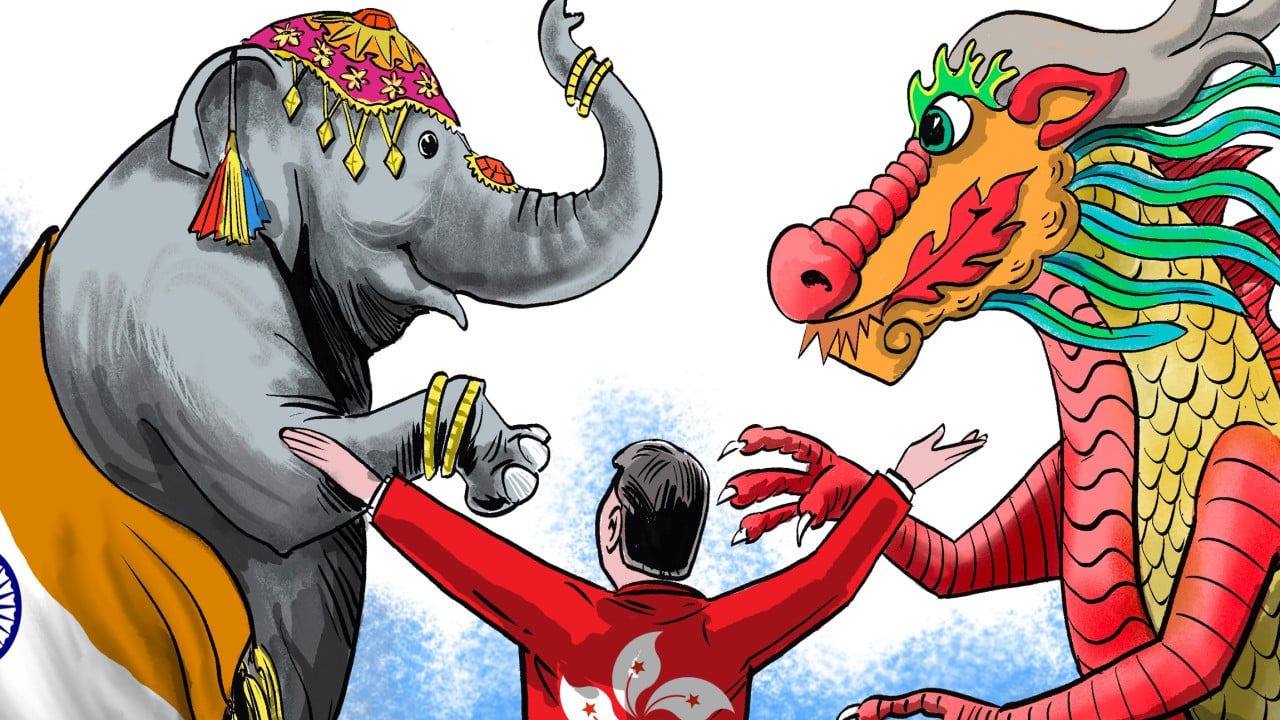
The prevailing narrative suggests that Chinese entrepreneurs are flocking to the Middle East as a defiant act of growth in the shadow of the 2025 Iran-Israel war. This is a half-truth that masks a much grimmer reality. While capital is indeed moving toward Riyadh and Dubai, it is not moving out of optimism. It is moving out of necessity. For many of China’s top private firms, the Middle East is no longer a choice; it is the only remaining lifeboat for businesses suffocating under domestic stagnation and the relentless tightening of Western sanctions.
The migration is a high-stakes gamble. As of March 2026, over 80% of surveyed Chinese enterprises in the region are operating across multiple jurisdictions, desperately trying to diversify their way out of a potential regional collapse. But the geography they have chosen is now a literal combat zone. Following the mid-2025 escalations and the subsequent U.S. strikes on Iranian nuclear facilities, the "safe haven" of the Gulf Cooperation Council (GCC) has begun to fray.
The Survivalist Migration
Domestically, the Chinese economy is trapped in a low-growth cycle, with the 2026 growth target hovering at a modest 4.5%. For high-tech sectors like AI, electric vehicles (EVs), and autonomous driving, the "Blue Ocean" of the Middle East is the only place left where their scale can be absorbed without immediate political blockades.
Meituan, Baidu, and WeRide have spent the last twelve months embedding themselves into the fabric of Abu Dhabi and Riyadh. However, the operational reality on the ground has shifted from expansion to survival. In early March 2026, Baidu was forced to halt its Apollo robotaxi testing in Dubai. Meituan, operating under the Keeta brand, has moved its entire regional workforce to remote status. This is the hidden cost of the pivot: companies are building billion-dollar infrastructures in cities that are increasingly within the flight path of retaliatory missile barrages.
The logic driving these entrepreneurs is brutal. They believe that if they can survive the current volatility, they will own the infrastructure of the future Middle East. But this assumes the region remains a cohesive market. The growing rift between Saudi Arabia and the UAE—exacerbated by disputes over Yemeni ports and competition for regional headquarters—is creating a fragmented environment where Chinese firms may soon be forced to pick sides.
The Sanctions Trap
The most significant risk facing Chinese capital in the Middle East is not a missile; it is a signature in Washington. As Beijing doubles down on its strategic partnership with Tehran, the threat of secondary U.S. sanctions has reached a breaking point.
Investors who previously viewed the Gulf as a neutral zone are finding that the walls are closing in. To win government contracts in Saudi Arabia, firms must now move their regional headquarters to Riyadh. Yet, doing so places them under a microscope. U.S. intelligence has intensified its scrutiny of any corporate ties to Iranian entities, especially as China expands its commercial footprint in Iranian ports and manufacturing zones.
Chinese legal experts at firms like King & Wood Mallesons are already warning clients of "extreme uncertainty." The threat of a Strait of Hormuz blockade is no longer a theoretical exercise in a boardroom; it is a live contingency plan. For a firm like Sinopec, which has anchored $4 billion into Saudi Aramco joint ventures, a total maritime shutdown would not just be a disruption—it would be a default-triggering event.
The Myth of Neutrality
Beijing’s attempt to play the role of the "balanced mediator" is failing under the weight of the Iran-Israel war. While China condemns strikes on Iranian sovereignty, it continues to be the second-largest trading partner for Israel. This dual-track diplomacy is becoming an impossible act.
On the ground, Chinese entrepreneurs are finding that their nationality is no longer a shield of neutrality. In the eyes of regional actors, Chinese tech is seen as an extension of Beijing’s geopolitical will. When Huawei builds the digital backbone of Egypt’s new energy grid or BYD sets up an EV plant in Turkey, they are not just selling products. They are exporting a Chinese-centric ecosystem that is increasingly at odds with the security architectures supported by the West.
The Strategic Shift to Localization
The veterans who have survived the last decade in the region know that the old "Belt and Road" model—bringing in Chinese labor and Chinese materials—is dead. To survive 2026, the strategy has shifted to radical localization.
- Data Sovereignty: Chinese cloud providers are moving toward cross-border data mirroring and local server redundancy to prevent total service blackouts if undersea cables are severed in the Red Sea.
- Personnel Mobility: The era of the "expat hub" is ending. Firms are aggressively hiring local talent to ensure operations can continue even when Chinese nationals are evacuated during escalations.
- Alternative Corridors: There is a quiet but frantic push to develop Central Asian land routes as a backup to the Persian Gulf. If the Strait of Hormuz closes, the value of the Trans-Caspian infrastructure will skyrocket, and those who haven't hedged their bets in Kazakhstan and Uzbekistan will be left stranded.
The Middle East is no longer a frontier for easy profit. It is a crucible. The entrepreneurs who remain are not doing so because they are fearless; they are doing so because they have nowhere else to go. The rewards are still massive—Saudi Arabia’s Vision 2030 remains the most ambitious capital project on the planet—but the entry price is now the potential loss of the entire enterprise.
This isn't an expansion. It is a siege.
Would you like me to analyze the specific sectors within the Middle East, such as fintech or renewable energy, where Chinese firms are facing the highest threat of secondary sanctions?