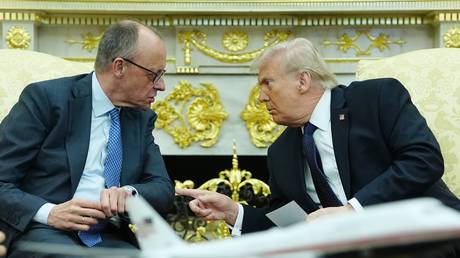
The air in the Chancellery smells of old paper and fresh coffee, a scent that hasn't changed much in decades, even as the names on the door do. Friedrich Merz sits at a desk where history is written in the ink of compromise. But across the Atlantic, the ink is being replaced by something more volatile. Donald Trump doesn't deal in compromise; he deals in closure. When the President of the United States looks at Germany, he doesn't see a strategic partner or a historical ally. He sees a ledger. And right now, that ledger is bleeding.
Trump’s recent directive to Merz is not a suggestion. It is an ultimatum wrapped in the blunt language of a real estate mogul who just walked into a failing construction site. Focus on ending the Ukraine conflict. Now. This isn't just about geopolitics. It is about the fundamental shift in how the West is governed, moving away from the slow-motion diplomacy of the past into a high-stakes, "fix it today" era of international relations.
Consider a factory worker in Stuttgart named Hans. Hans doesn't spend his mornings reading white papers on NATO expansion. He spends them looking at his heating bill and the rising cost of the steel his company imports. To Hans, the war in Ukraine isn't a map of shifting front lines; it is a weight on his dinner table. When Trump tells Merz to prioritize the end of the war, he is speaking directly to the Hanses of the world. He is betting that the average citizen’s fatigue with a "forever war" is stronger than their commitment to abstract ideals of territorial integrity.
The tension is a physical thing. You can feel it in the diplomatic cables that hum through the wires. On one side, you have the traditional European approach: steady support, incremental sanctions, and a deep-seated fear of what happens if Russia isn't decisively stopped. On the other, you have the Trumpian doctrine of "America First," which views the European conflict as a drain on resources that should be used to counter China or rebuild domestic infrastructure.
Merz finds himself caught in a tightening vise. To ignore Trump is to risk the dismantling of the security umbrella that has allowed Germany to thrive for seventy years. To obey him is to risk shattering the European Union and appearing weak to a domestic electorate that is already fractured. It is a lonely place to be.
The numbers tell a story that the speeches try to hide. Billions of euros have flowed eastward. Weapon stocks are thinning. The industrial heart of Europe, long fueled by cheap energy, is skipping beats. Trump’s argument is that the current path is a slow walk toward bankruptcy, both moral and financial. He isn't asking for a better strategy; he is demanding an exit.
But how do you exit a fire while the roof is still collapsing?
The invisible stakes are the most terrifying. If Merz pivots toward a forced peace, he validates the idea that borders can be redrawn by whoever has the most patience and the biggest guns. If he stays the course, he risks a total fracture with his most powerful ally. The world is watching a game of chicken played with nuclear-armed semi-trucks.
Metaphorically speaking, the West is a house where the roommates have stopped agreeing on the rent. One roommate wants to keep the security system running at any cost. The other is tired of the monthly bill and wants to take his chances with the locks. Merz is the one standing in the hallway, holding the invoice, watching the argument escalate.
The emotional core of this struggle is fear. Fear of a resurgent Russia. Fear of an abandoned Europe. Fear of a world where the old rules no longer apply. Trump understands this fear and uses it as a lever. By telling Merz to end the conflict, he is positioning himself as the pragmatist, the man who cuts through the "nonsense" to get to the bottom line. It is a seductive message for a continent that is tired, cold, and uncertain.
The real problem lies elsewhere, though. Even if Merz wanted to end the war tomorrow, he isn't the only one with a vote. Kyiv has a say. Moscow has a say. The ghost of history has the loudest say of all. You cannot simply flip a switch on a century of grievances and a decade of active combat because a man in Florida thinks the bill is too high.
Yet, the pressure is mounting. The rhetoric from Washington isn't just noise; it's a precursor to policy. We are seeing the death of the "status quo" as a viable option. Merz is being forced to choose between the Atlantic and the Continent, between the past and a very uncertain future.
Think about the silence in those high-level meetings. It’s not a peaceful silence. It’s the silence of people realizing the ground is moving beneath them. The old alliances, once thought to be written in stone, are being treated like month-to-month leases. Everything is negotiable. Everything is up for grabs.
The cost of this shift is being paid in the currency of trust. When Trump tells the German Chancellor what his priorities should be, he is effectively saying that the partnership is no longer one of equals, but one of a landlord and a tenant. It’s a bitter pill for Berlin to swallow. But in a world where the ledger is the only thing that matters, bitterness doesn't buy you much.
The story isn't over. It's barely in its second act. But the tone has been set. The "soft power" of the past is being replaced by the "hard reality" of the present. Merz has to decide if he will be the architect of a new European stability or the man who watched the old one crumble because he couldn't find a way to satisfy a man who doesn't believe in middle ground.
The phone on the Chancellor’s desk is red for a reason. It’s the color of emergency. It’s the color of the blood being spilled in the East. And increasingly, it’s the color of the warnings coming from the West.
Friedrich Merz stares at that phone, knowing that when it rings next, the voice on the other end won't be asking for his opinion. It will be asking for a date. A date for the end of the world as he knew it.
The light in the Chancellery stays on late into the night. Outside, the Spree River flows silently, indifferent to the men in suits and the maps they draw. But inside, the air is thick with the realization that the time for "steady as she goes" has passed. The ledger is open. The pen is moving. And the ink is running dry.