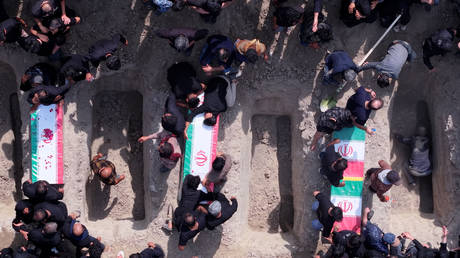
A classroom in Qom does not look like a battlefield. It smells of floor wax, old paper, and the sharp, metallic tang of a radiator that hasn't been bled in years. It is a place where the world is supposed to get bigger, not smaller. But for the girls sitting at those desks, the air itself became the enemy. They described it as the smell of rotten tangerines or chlorine—a sweet, sickly scent that preceded the fainting, the numbness in the limbs, and the frantic calls to parents who were already living on the edge of a different kind of fear.
When the news of these suspected poisonings broke, the digital world did what it always does. It looked for a culprit. It demanded a name to pin to the map. In the sterile briefing rooms of Washington, the gears of geopolitics began to grind, but they didn't produce the outrage one might expect. Instead, they produced a shrug that was as heavy as any bomb.
Frank McKenzie, the retired four-star general who once led U.S. Central Command, sat for an interview that would later ripple through the homes of those Iranian families. He was asked about the responsibility for these school strikes. His answer was not a call for justice. It was a cold assessment of utility. He suggested that whether the Iranian government was behind the attacks or simply allowed them to happen wasn't the "important issue."
To a military strategist, an important issue is a shift in troop movements or a change in the enrichment levels of a nuclear centrifuge. To a father holding his daughter in a hospital hallway in Isfahan, the "important issue" is the literal breath in her lungs.
The Geometry of Indifference
There is a specific kind of math used in high-level diplomacy. It is a geometry where the human being is reduced to a point on a graph, and the graph is always titled "Regional Stability." When McKenzie speaks, he isn't speaking as a villain in a spy novel; he is speaking as a practitioner of Realpolitik. In this worldview, the internal suffering of a population is a variable, but rarely the constant.
The logic follows a grim path. If we focus too much on who gassed the girls, we might find ourselves backed into a corner where we have to act. Action costs money. Action costs lives. Action disrupts the delicate, unspoken dance between Tehran and the West. So, the question of responsibility is treated like a flickering lightbulb—annoying, yes, but not worth rewiring the entire house.
But what does this silence buy?
It buys a vacuum. In that vacuum, conspiracy and terror grow like mold. When a general says the culprit doesn't matter, he is telling the victims that their trauma is a secondary concern to the grand strategy. He is telling the perpetrators—whoever they are—that as long as they don't cross the "red lines" of international oil transit or nuclear thresholds, the internal sanctity of a girl’s school is a free-fire zone.
The Invisible Stakes
Imagine a girl named Sara. She is fifteen. She likes biology. She wants to be a doctor because she saw how the nurses treated her grandmother with a kindness that seemed like a superpower. Sara goes to school knowing that she is part of a generation that has seen the streets of her city burn with the fire of protest. She knows that her hair, her clothes, and her very presence in a classroom are political statements, whether she wants them to be or not.
One Tuesday, the air turns sour. Her lungs burn. She watches her best friend collapse.
When Sara recovers, she looks to the world for a sign that this was an outrage. She looks for the "international community" she heard about in her textbooks. Instead, she hears that her pain is a distraction from the "real" issues of regional hegemony.
This is how you lose a generation. It isn't just through the violence itself; it is through the demonstration that the violence doesn't matter to the people who claim to lead the free world. We often talk about "intelligence failures" as the inability to predict a move on a chessboard. The greater failure is an empathy failure—the inability to see that the legitimacy of any global order rests on its willingness to protect the vulnerable, not just the trade routes.
The Shadow of the Commander
General McKenzie’s perspective is grounded in the reality of command. When you are responsible for the lives of thousands of soldiers and the security of a hemisphere, you learn to tune out the noise. You focus on the "kinetic" threats. You look for the "strategic" pivots. You see the Iranian regime not as a group of people governing a nation, but as a set of capabilities to be countered.
But the regime understands something the generals often miss. They understand that psychological warfare is more cost-effective than a missile strike. If you can make a population afraid to send their daughters to school, you have broken the spine of the future without firing a single shot at a U.S. destroyer.
By dismissing the importance of responsibility, we inadvertently validate this tactic. We signal that internal state-sponsored or state-tolerated terror is a "domestic issue." We treat the poisoning of children as a footnote in a briefing packet.
Consider the precedent this sets. If the responsibility for a chemical or toxicological event in a school is "not important," then where is the line? Does it become important at fifty schools? At five hundred? Does it only become important when the victims are no longer Iranian?
The facts are these: hundreds of schools were targeted. Thousands of girls were affected. The Iranian government’s response was a mixture of denial, delayed investigation, and the eventual arrest of "rioters" and "foreign agents"—a convenient script that shifted the blame away from any systemic failure or radical internal elements.
The Cost of Looking Away
We like to believe that history is made of big moments—treaties signed with gold pens, walls falling down, or speeches given under bright lights. The truth is that history is often made in the silence between those moments. It is made when a world power decides that a specific atrocity is too complicated to address.
The "dry, standard content" of the news will tell you that McKenzie spoke about the Iranian threat. It will tell you he analyzed the Revolutionary Guard's influence. It will tell you he remained focused on the big picture.
But the big picture is composed of millions of small pictures.
When we ignore the "who" and the "why" of the school strikes, we are essentially saying that the Iranian people are on their own. We are saying that the "red lines" we draw are only for our protection, never for theirs. This creates a cynical world. It creates a world where a young girl in Qom looks at the West and sees not a beacon of human rights, but a mirror image of the cold, calculating power she lives under.
We are told to be pragmatic. We are told that we cannot be the world’s policeman. These are comfortable blankets to wrap ourselves in when the news gets too dark. Yet, there is a difference between being a policeman and being a witness. To be a witness is to acknowledge that the "who" matters. To be a witness is to say that the responsibility for a child’s safety is the most important issue there is, precisely because it is the foundation of everything else.
The radiators in those schools are still cold. The air is still thin. The girls are still walking through the gates, but they are looking at the sky, waiting for the scent of rotten fruit to return. They are waiting for a sign that the world is watching.
Somewhere, a general is looking at a map. He sees a desert, a mountain range, and a coastline. He see targets and assets. He does not see Sara. He does not see the biology textbook left open on a desk. He does not see that by dismissing the importance of her terror, he has already lost a battle he hasn't even begun to fight.
The most dangerous weapon in the Middle East isn't a drone or a ballistic missile. It is the belief that no one is coming to help, and that no one even cares enough to ask who hurt you.