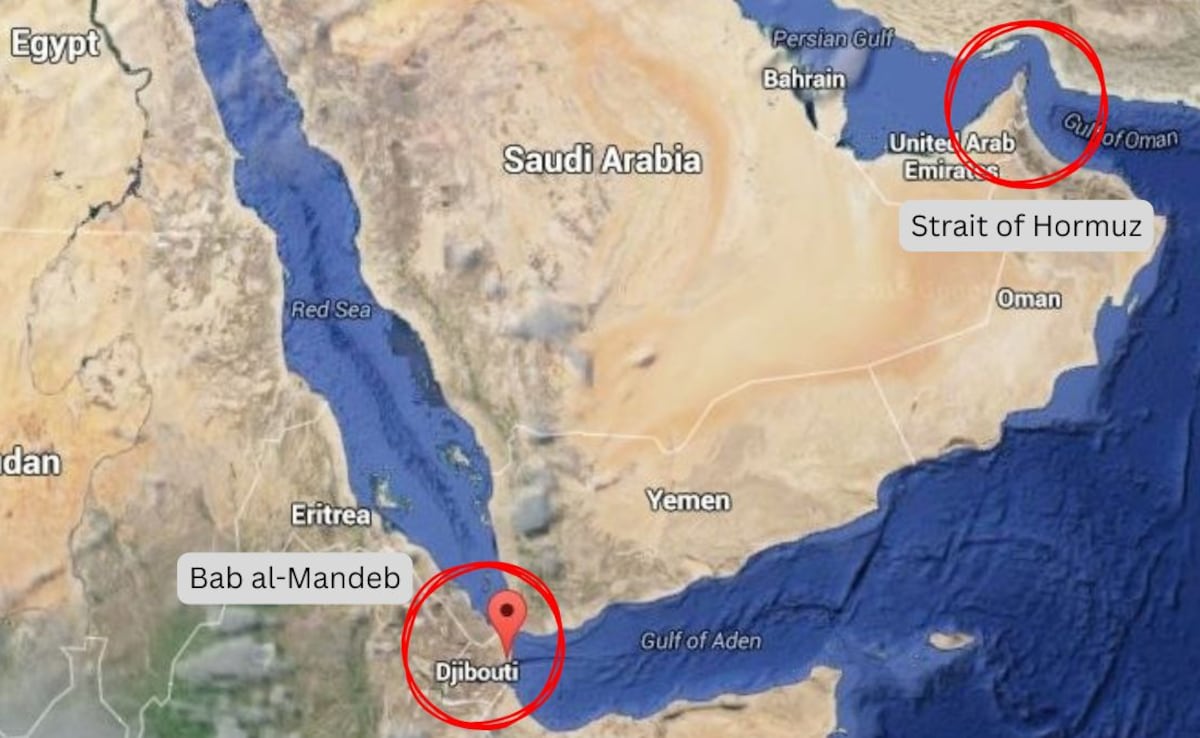
The headlines are predictable. Iran whispers about the Strait of Hormuz, and the West collectively hyperventilates. Now, the narrative has shifted to the Bab el-Mandeb and the latest "strategic" threat to global shipping. The consensus is lazy: if a hostile power closes a narrow strip of water, the global economy collapses.
It is a beautiful, terrifying story. It sells newspapers. It justifies bloated naval budgets. It is also fundamentally wrong.
The "Strait-jacket" theory of global trade assumes we are still living in 1974. It ignores the reality of modern logistics, the sheer physics of blockades, and the brutal economic suicide pact that actually occurs when a nation tries to "turn off" the ocean. If you are making investment decisions based on the fear of a permanent maritime blackout, you are being played.
The Myth of the "Off" Switch
Everyone talks about the Strait of Hormuz as if it has a literal gate. Analysts love to point out that 20% of the world's petroleum passes through that 21-mile-wide gap. The logic follows that if Iran sinks a few tankers, the lights go out in London and Tokyo.
I have spent twenty years watching these "shocks" play out from the inside of commodity trading floors and logistics hubs. Here is what actually happens: the "blockade" lasts forty-eight hours, insurance premiums spike, and then the world finds a way around.
Blocking a strait isn't like closing a highway; it’s like trying to stop a flood with a screen door. You can impede it, you can make it messy, but the volume of global capital is too high to be contained by a handful of shore-to-ship missiles.
To actually "block" a strait, you need to maintain persistent, 24/7 denial of the surface. In the age of satellite intelligence and carrier strike groups, no mid-tier power can do this for more than a few days without their entire coastal infrastructure being turned into a smoking parking lot. The "threat" is the weapon. The actual "act" is a death sentence for the aggressor.
The Suez Diversion Proved the Fear-Mongers Wrong
Look at the recent Red Sea disruptions. The Houthis launched drones. Shipping giants like Maersk and MSC diverted around the Cape of Good Hope. The "experts" predicted a global inflationary spiral that would dwarf the 1970s.
What happened? The supply chain flexed.
Yes, it takes 10 to 14 days longer to go around Africa. Yes, it costs more in fuel. But the "unavoidable strategic chokepoint" turned out to be... avoidable. We discovered that the global economy is not a fragile glass sculpture. It is a massive, self-healing organism. The extra cost of shipping a container around the Cape is a rounding error compared to the cost of a total economic shutdown.
The competitor's article wants you to believe that the Bab el-Mandeb is a singular point of failure. It isn’t. It’s an efficiency. Losing it is an inconvenience, not a catastrophe. We’ve spent forty years building a "just-in-time" world, and we’re now discovering that "just-in-case" logistics—while more expensive—are perfectly functional.
The Energy Weapon is a Blunderbuss
The loudest argument for chokepoint anxiety is energy security. "Iran will starve the world of oil!"
This assumes the world is a passive victim. It ignores the reality of the Global Integrated Grid.
- The Pipeline Pivot: Saudi Arabia and the UAE haven't been sitting on their hands. The East-West Pipeline (Petroline) in Saudi Arabia can move 5 million barrels per day to the Red Sea, bypassing Hormuz entirely.
- The Strategic Petroleum Reserve (SPR): The US and its allies hold enough oil to blunt any 30-day disruption.
- The Demand Destruction Paradox: If oil hits $200 because of a blockade, the first thing that happens is a global recession. A recession kills demand. If there is no demand, the "weapon" loses its edge.
When a country like Iran threatens to block a strait, they are threatening their own best customers. China, which buys the lion's share of Iranian crude, is not going to sit quietly while its energy supply is used as a geopolitical football. The "insider" truth is that the biggest deterrent to blocking a strait isn't the US Navy—it's the Chinese Ministry of Commerce.
The Insurance Grift
If the physical threat is overstated, why is the panic so consistent? Follow the money.
When a "strategic strait" is threatened, the Joint War Committee (JWC) in London expands the "listed areas." Suddenly, every ship passing through the region has to pay "war risk" premiums. These premiums can jump from 0.01% of the hull value to 1% in a single week.
On a $200 million LNG carrier, that is a $2 million surcharge for a single transit.
The industry thrives on this volatility. Tanker owners love it because spot rates skyrocket. Defense contractors love it because it justifies the next generation of littoral combat ships. Even the "hostile" powers love it because it gives them leverage they haven't actually earned.
The only person who loses is the consumer who believes the narrative that the world is ending.
The Real Chokepoints Are Digital and Financial
While we are obsessing over 19th-century naval geography, we are missing the actual vulnerabilities. You want to see a real chokepoint? Look at the SWIFT payment system. Look at the TSMC fabrication plants in Taiwan. Look at the Malacca Strait, not because of missiles, but because of the sheer density of undersea fiber optic cables that carry the world’s data.
If you sever a cable, you don't just delay a shipment of sneakers; you decouple the global financial system. But that doesn't make for a good "war at sea" infographic, so we keep talking about Hormuz.
The obsession with physical straits is a distraction. It's "Maginot Line" thinking. We are preparing to defend a trench while the enemy is already behind us, hacking the server.
Logic Over Logistics
Let's do a thought experiment. Imagine Iran actually manages to sink three VLCCs (Very Large Crude Carriers) in the narrowest part of the shipping lane. They use mines, drones, and shore-based batteries.
The strait is "closed."
Within 24 hours:
- Global insurance for the Persian Gulf hits "unquoteable" status.
- Crude spikes to $150.
- The US Fifth Fleet initiates "Operation Praying Mantis 2.0."
Within 72 hours:
- Every Iranian naval asset is at the bottom of the Gulf.
- The Iranian air force is non-existent.
- Satellite-guided salvage operations begin.
Within 10 days:
- A cleared channel is established.
- The "blockade" is over.
The cost to the world: A two-week supply chain hiccup.
The cost to the aggressor: Total military and economic annihilation.
This isn't a "strategic threat." It's a suicide vest. And people with suicide vests don't usually use them unless they have absolutely nothing left to lose. As long as the regime in Tehran likes being in power, the "blockade" will remain a rhetorical flourish, not a reality.
Stop Asking if the Strait is Safe
The question isn't "Will they block the strait?"
The question is "Why do we keep falling for the threat?"
We fall for it because it’s easier to point at a map than to understand the complexities of global trade resilience. We fall for it because fear is a more potent motivator than math.
If you are a business leader, stop rerouting your entire strategy every time a drone flies near a tanker. The "chokepoint" is a ghost. The actual risk is your own inability to distinguish between a temporary price spike and a structural shift in the world order.
The world is too big to be stopped by a narrow neck of water. We have outgrown the geography of the past. The ocean is wide, the Cape is always there, and the tankers will keep moving. The only thing truly "blocked" is the vision of anyone still reading the competitor's fear-mongering headlines.
Buy the dip. Ignore the "strategic" noise. The ships aren't stopping.