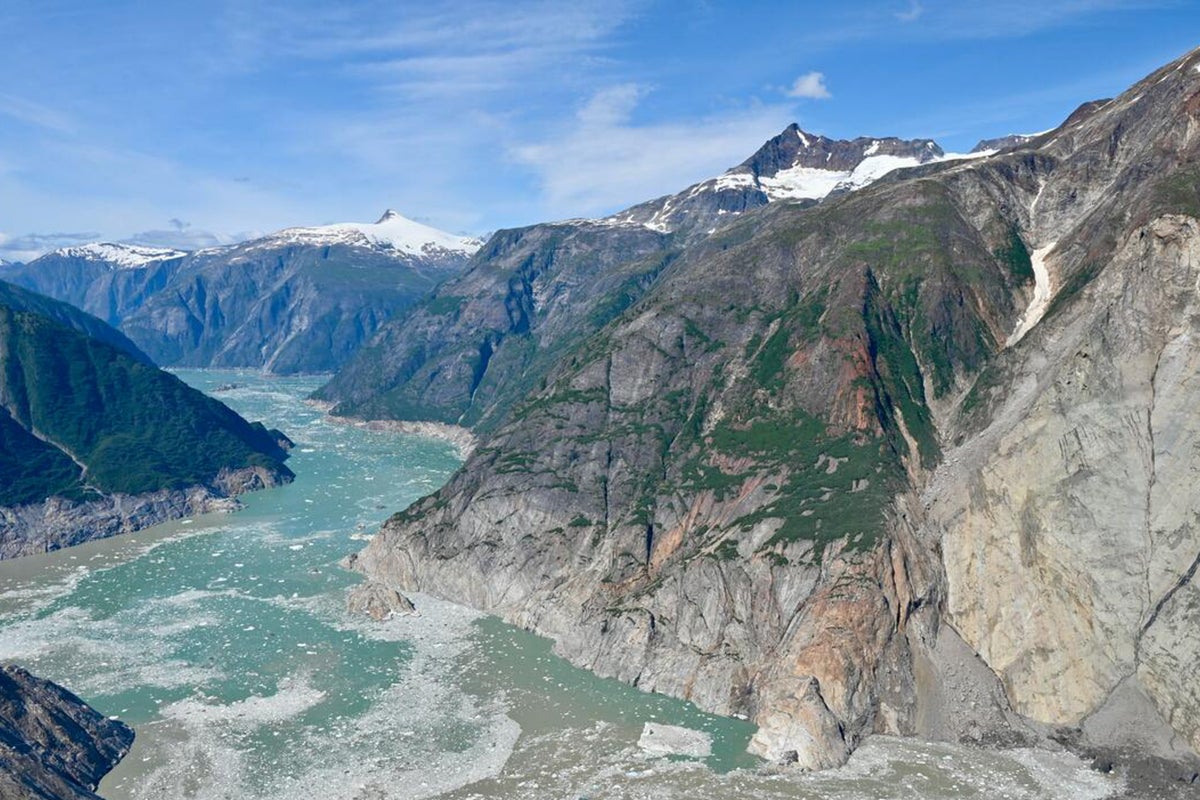
In 2015, a wall of water towering 1,578 feet surged through Alaska’s Taan Fiord. It was the second-largest tsunami ever recorded on Earth, triggered by a massive landslide of 200 million metric tons of rock falling into a narrow glacial bay. The sheer height of the wave dwarf almost every skyscraper on the planet. Yet, because it occurred in an uninhabited, glacially carved wilderness, the event passed largely unnoticed by the public until scientists analyzing seismic data reconstructed the disaster.
The Taan Fiord megatsunami represents a stark warning about a rapidly warming planet. As glaciers retreat at unprecedented speeds, they leave behind unstable mountain slopes that are increasingly prone to catastrophic collapse.
The Anatomy of a Megatsunami
To understand how a wave can reach nearly 1,600 feet, one must abandon the traditional concept of an earthquake-induced ocean tsunami.
Oceanic tsunamis are generated by the sudden displacement of the seafloor, creating waves that are only a few feet high in the deep ocean but grow as they reach shallow coastal waters. A megatsunami is entirely different. It is a localized, high-energy event caused by a massive displacement of water within a confined space.
When the unstable mountainside above Taan Fiord collapsed, a colossal volume of rock plummeted directly into the deep, narrow waters of the glacial bay. The water had nowhere to go but up.
The force of the impact pushed a massive wedge of water up the opposite slope of the fiord, stripping away mature forests and soil down to the bedrock. Scientists measuring the "run-up"—the maximum height the wave reached on land—found evidence of destruction up to 1,578 feet above sea level.
Historically, this is surpassed only by the legendary 1958 Lituya Bay megatsunami, also in Alaska, which reached an astonishing run-up height of 1,720 feet under similar conditions.
Why Glacier Retreat is Unlocking the Mountains
The fundamental driver behind the Taan Fiord collapse is a geological process called paraglacial slope failure.
Glaciers are massive rivers of ice that exert immense pressure against valley walls. For thousands of years, the Tyndall Glacier in Taan Fiord acted as a giant buttress, physically supporting the steep rock faces bordering it. As the glacier thinned and retreated—shrinking by over ten miles between 1961 and 2015—that physical support vanished.
[Glacial Buttress Peak] ----> [Glacier Retreals] ----> [Unsupported Rock Wall] ----> [Catastrophic Collapse]
Without the ice to hold them back, these steep, fractured slopes are left exposed to gravity.
The problem is compounded by the degradation of mountain permafrost. Deep within the rock, ice acts as a natural cement, binding fractured geological formations together. When temperatures rise, this subterranean ice melts. Water fills the newly opened joints and fractures, building up immense hydrostatic pressure that pushes the rock layers apart.
Eventually, a tipping point is reached. A heavy rainfall event, a minor earthquake, or simply the relentless pull of gravity causes the entire mountainside to fail.
The Hidden Danger of Alaska’s Unmonitored Fiords
The Taan Fiord disaster was not an isolated incident. Across the sub-Arctic and Arctic regions, hundreds of steep, glaciated slopes are currently destabilizing.
Perhaps the most pressing modern threat is Barry Arm, another deep fiord located in Prince William Sound, Alaska. Scientists have identified a massive, slowly moving landslide on the slopes above the water. If this slope fails catastrophically, it could generate a megatsunami capable of threatening nearby towns, commercial fishing vessels, and cruise ships carrying thousands of tourists.
Unlike Taan Fiord, which is isolated, Barry Arm lies within sixty miles of Anchorage and is actively navigated by recreational and commercial watercraft.
| Location | Peak Wave/Run-up Height | Primary Cause | Year |
|---|---|---|---|
| Lituya Bay, Alaska | 1,720 feet | Landslide triggered by 7.8 earthquake | 1958 |
| Taan Fiord, Alaska | 1,578 feet | Paraglacial landslide due to ice retreat | 2015 |
| Vaiont Dam, Italy | 820 feet | Landslide into reservoir | 1963 |
| Karrat Fjord, Greenland | 300 feet | Landslide from unstable mountain wall | 2017 |
The hazard is not confined to North America. In 2017, a landslide-induced megatsunami in Karrat Fjord, Greenland, swept through the remote fishing village of Nuugaatsiaq, destroying homes and leaving four people dead. The event forced the permanent evacuation of the settlement.
The Technological Challenge of Predicting Chaos
Predicting when a mountain slope will collapse into a fiord is an extraordinarily difficult scientific endeavor.
Geologists use satellite-based radar (InSAR) to detect microscopic movements in mountainsides over time. If a slope is creeping downward by a few inches a year, it indicates active instability. However, translating this movement into an accurate prediction of a sudden collapse remains elusive.
A slope can creep slowly for decades without failing, or it can give way with almost no warning.
Furthermore, monitoring these remote locations requires significant funding and infrastructure. Seismometers, tide gauges, and real-time GPS monitoring stations must be installed in some of the most hostile terrain on Earth.
When a collapse does occur, the window for warning is measured in seconds, not hours. For anyone in the immediate vicinity of a narrow fiord, there is simply no time to receive an alert. Survival depends entirely on understanding the landscape and recognizing the immediate warning signs, such as a sudden drop in water level or a low, rumbling sound emanating from the head of the bay.
Redefining Natural Hazards in a Warming World
For decades, natural hazard assessments focused primarily on earthquakes, volcanic eruptions, and predictable weather events. The emerging reality of paraglacial landslides and megatsunamis forces a radical reassessment of risk in northern latitudes.
Industrial activities, including shipping, mining, and high-end ecotourism, are expanding deeper into high-latitude waters. Cruise ships routinely navigate narrow fiords to give passengers close-up views of calving glaciers.
These vessels are sailing directly into the run-out zones of potential megatsunamis.
The shipping industry and maritime regulators have been slow to adapt to this shifting hazard landscape. Current marine charts detail underwater hazards like shoals and reefs, but they do not flag unstable mountains towering thousands of feet above the shipping lanes.
Integrating terrestrial geological hazards into maritime safety protocols is no longer optional. It is a critical necessity.
The Cost of Inaction
The physical footprint of the Taan Fiord wave is a permanent scar on the Alaskan wilderness, visible from space. It serves as a monument to the colossal forces unleashed when high-altitude ice disappears.
As warming accelerates, the frequency of these mountain failures will inevitably increase. The geological stability we took for granted in northern regions is melting away, leaving behind a fragile, volatile landscape where the next giant wave is already taking shape on a fracturing mountainside.