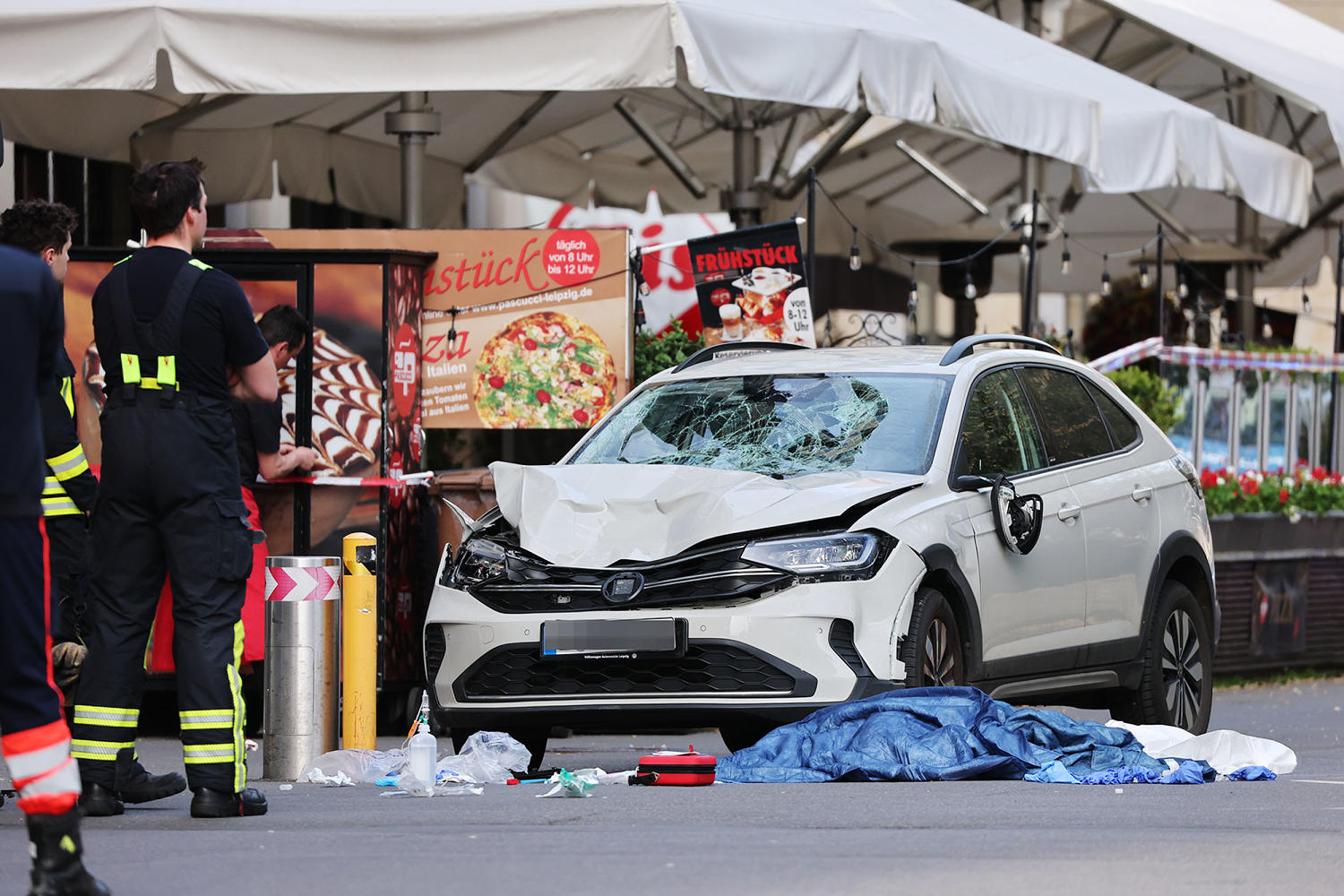
A standard morning at the Großen Ried in Leipzig ended in a tangle of metal and screams when a vehicle plowed into a crowd of pedestrians. While early reports from local outlets focused on the immediate chaos, the incident serves as a grim entry in a growing ledger of European urban transit failures. This was not a random act of nature. It was the predictable collision of aging infrastructure, driver health oversight gaps, and the inherent risks of mixing high-speed machinery with foot traffic in a city trying to reinvent its spatial logic.
The incident, which occurred near a busy transit hub, left several people with life-altering injuries. Emergency services arrived within minutes, but the physical damage was already done. Investigators quickly moved to cordoned off the area, shifting their focus from the victims to the man behind the wheel. The driver, a 50-year-old local, reportedly lost control of his vehicle before veering onto the sidewalk. While the word "accident" is often used as a shield, the mechanics of this event suggest a deeper systemic rot in how Germany manages its public safety and driver licensing for aging populations.
The Physical Mechanics of the Leipzig Crash
Eyewitness accounts describe a vehicle that did not brake. It accelerated. This suggests a total failure of either the mechanical systems or, more likely, the human element. In modern automotive forensics, we look for "pedal misapplication," a phenomenon where a driver, often in a state of medical distress or panic, slams the accelerator thinking it is the brake.
Leipzig’s urban design in this specific district hasn't caught up to its population density. The sidewalks are narrow. The bollards are decorative rather than structural. When two tons of steel leaves the asphalt, there is nothing standing between a commuter and a catastrophic impact. We are building cities for 2026 while relying on safety standards from 1998.
Medical Emergencies at the Wheel
Police sources indicate that a "medical episode" is the leading theory behind the loss of control. This isn't just a stroke of bad luck. It is a policy failure. Germany, like much of the EU, has a relatively hands-off approach to medical re-evaluations for licensed drivers. Once you have a license, you effectively keep it until a tragedy occurs or a doctor makes the difficult, often litigious, decision to report you.
The data is clear. As the population ages, the frequency of "unintended acceleration" incidents rises. We are seeing a surge in incidents where cardiovascular events or sudden neurological lapses turn a daily commute into a crime scene. Leipzig is just the latest data point in a trend that authorities are desperate to ignore because the alternative—restricting the mobility of millions—is a political third rail.
The Infrastructure Blind Spot
Urban planners often talk about "shared spaces," a high-minded concept where cars and people coexist in a peaceful, low-speed harmony. It’s a fantasy. In reality, these spaces create ambiguity. Ambiguity leads to hesitation, and in a high-traffic environment, hesitation kills.
The area surrounding the crash site is a bottleneck. It is a place where high-volume transit lines meet narrow vehicular lanes. If you look at the curb heights and the lack of reinforced barriers, it becomes obvious that the city prioritized aesthetics over kinetic protection. A simple row of K-rated bollards—the kind used to protect government buildings from truck bombs—would have stopped that car in its tracks. Instead, the pedestrians were the only "soft" barriers available.
Why Safety Bollards Aren't Everywhere
The excuse is always the budget. Or historical preservation. Or the "vibe" of the neighborhood. But the cost of a single life-flight helicopter and a week of intensive care for five victims far outweighs the cost of stainless-steel reinforced posts.
Leipzig has been undergoing a massive "Verkehrswende" or transport transition. They want fewer cars. They want more bikes. They want more walking. But they are trying to force this transition by simply narrowing lanes without providing the physical protection needed to separate the remaining cars from the people. It is a half-measure that creates a deadly environment for the very people the city claims to be protecting.
The Psychological Aftermath for the City
A car driving into a crowd in Germany carries a heavy psychological weight. Given the history of vehicle-ramming attacks across Europe—from Berlin to Nice—the immediate reaction is terror. This puts an immense strain on the local police force, who must balance a forensic investigation with a counter-terrorism sweep.
The panic in Leipzig was palpable. For hours, social media was flooded with speculation. Was it intentional? Was it terror? The official line moved toward "accident" quickly, but the damage to the collective psyche of the city’s pedestrians is harder to repair. People no longer stand at the edge of the curb. They look over their shoulders. This loss of public trust in the safety of the street is a hidden cost of these incidents that no insurance policy covers.
The Problem with the Term Accident
We need to stop calling these events accidents. An accident is a lightning strike. A car veering into a sidewalk due to a predictable medical lapse or a lack of physical barriers is a failure of systems. When we call it an accident, we absolve the city planners, the licensing boards, and the automotive manufacturers of their responsibility to prevent the next one.
The car involved was a late-model vehicle equipped with numerous "safety features." Where was the Autonomous Emergency Braking (AEB)? Why didn't the car's sensors detect a crowd of humans directly in its path and kill the engine? The industry has promised us that smart cars would solve human error. Leipzig proves that the tech is still failing in the most critical moments.
The European Licensing Crisis
The conversation nobody wants to have in the Bundestag is the mandatory re-testing of drivers. In some neighboring countries, vision and cognitive tests are required every few years after a certain age. In Germany, the driver’s license is seen almost as a fundamental right, one that is rarely questioned until a car is sitting in the middle of a pedestrian zone.
The privacy laws in Germany also make it difficult for doctors to communicate with licensing authorities. A physician might know their patient is no longer fit to drive, but HIPAA-like protections often prevent them from taking proactive steps. This "privacy" comes at the cost of public safety. We are protecting the rights of the individual to drive at the expense of the right of the public to walk without being crushed.
Technical Failures in Detection
Modern cars are supposed to be rolling computers. They have cameras, radar, and LIDAR. Yet, in high-intensity urban environments, these systems often suffer from "sensory overload." They struggle to distinguish between a pedestrian on the sidewalk and one about to be hit. The software is optimized for highways, where the variables are limited. In the messy, chaotic streets of Leipzig, the software often defaults to doing nothing to avoid "false positives."
This means that as a driver, you are effectively on your own the moment you leave the autobahn. The safety net is a marketing myth. If the driver loses consciousness, the car becomes a mindless projectile, regardless of how many "assistance" badges are on the trunk.
The Immediate Response and Beyond
The victims in Leipzig are currently facing a long road to recovery. Some will never walk the same way again. The driver is facing a battery of tests and a likely criminal inquiry for negligent bodily harm. But the real trial should be for the city’s infrastructure department.
If you walk the streets of Leipzig tomorrow, you will see the same vulnerabilities. You will see the same low curbs. You will see the same unprotected bus stops. The city will issue a statement of sympathy, the police will finish their report, and the world will move on until the next "accident" occurs in a different neighborhood.
The reality of urban life in the mid-2020s is that we are living in a transition period. We have the technology to make streets safe, but we lack the political will to implement it. We have the data to identify high-risk drivers, but we lack the courage to take their keys. Until these two factors change, the sidewalks of our major cities will remain a high-stakes gamble for everyone on foot.
Install the bollards. Re-test the drivers. Stop calling it an accident.


