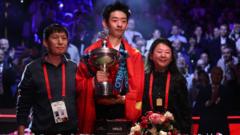
The air in the training hall usually smells of stale sweat and floor wax. It is a sterile, unforgiving scent. For Wu, the newly minted world champion, that smell was the backdrop of a decade. But behind the flashbulbs and the heavy weight of a gold medal lies a different kind of scent—the smell of home-cooked meals she rarely ate and the faint, metallic tang of coins being scraped together in a kitchen thousands of miles away.
We often talk about champions as if they were forged in a vacuum. We see the muscle, the focus, and the final score. We celebrate the individual will. Yet, if you pull back the curtain on any podium finish, you don't just find an athlete. You find a family that decided to gamble their entire existence on a dream that wasn't even theirs.
The silent kitchen
Think about a small apartment on the outskirts of a bustling city. There is a table with three chairs, but only two are occupied. The third belongs to a daughter who hasn't lived at home since she was ten years old.
Wu’s parents didn't set out to be martyrs. They were ordinary people with ordinary jobs. But when talent reveals itself in a child, it creates a gravitational pull that rearranges everything in its orbit. The "sacrifices" we read about in headlines—the long hours, the second jobs, the missed vacations—are often sanitized versions of a much grittier reality.
For Wu’s father, it meant working double shifts until his hands shook with fatigue. For her mother, it meant wearing the same coat for six winters so the daughter could have the latest equipment. These aren't just choices; they are a slow, steady erosion of personal comfort. It is the act of disappearing so that someone else can shine.
The weight of the long distance call
Every Sunday, the ritual was the same. A phone call. A screen filled with a face that looked older every time it appeared.
Wu would talk about her training, the bruises on her shins, and the coach's harsh critiques. Her parents would talk about the weather or the neighbors. They never mentioned the debt. They never mentioned the fact that the refrigerator was half-empty or that the roof was leaking.
This is the invisible burden of the elite athlete. Every time Wu stepped onto the mat, she wasn't just fighting for herself. She was fighting to justify the empty chairs at home. She was fighting to make the six-year-old coat worth it.
Imagine the pressure of knowing that if you lose, the sacrifice remains just that—a loss. A wasted investment. A hole in a family’s history that can never be filled. Most of us work for a paycheck. Wu worked to repay a debt of love that she never asked for but felt entirely responsible for.
The mathematics of a dream
Success in sports is often framed as a matter of "heart." That’s a beautiful sentiment, but it’s a lie. Success is also a matter of cold, hard math.
To reach the world-class level, an athlete needs roughly 10,000 hours of deliberate practice. In those hours, they aren't earning money; they are consuming it. Coaching fees. Travel expenses. Nutritional supplements. Physical therapy.
In Wu’s case, the numbers were staggering. The cost of her training exceeded her parents’ combined annual income by nearly thirty percent. How does a family bridge that gap? They borrow. They sell. They go without.
But the math doesn't just apply to money. It applies to time. While other families were spending weekends at the park, Wu’s family was driving six hours to a tournament. While other parents were planning for retirement, Wu’s parents were wondering if they could afford the next flight to a qualifying match. They traded their future for her present.
The isolation of the pinnacle
When the gold medal was finally placed around her neck, the world saw a triumph. The anthem played, and the flags rose.
Wu looked at the cameras, but her eyes were searching for two specific faces in the crowd. When she found them, she didn't see fans. She saw the architects of her bones. She saw the people who had quite literally poured their lives into her so that she could stand four inches higher than everyone else on that podium.
The isolation of being a champion is that no one truly understands what it took to get there—except the people who weren't allowed to go with you. The coaches see the technique. The fans see the glory. Only the family sees the cost of the years spent apart.
There is a specific kind of grief in winning. It is the realization that the childhood you lost can never be recovered, even by a world title. Wu is a champion now, yes. But she is also a woman who realized that her parents’ youth was the fuel for her fire.
The myth of the self-made hero
We love the story of the lone wolf. We want to believe in the "self-made" man or woman because it suggests that we are the masters of our own destiny. If we just work hard enough, we can win.
But Wu’s story proves that "hard work" is a collaborative effort. It is a communal sacrifice.
Every time we watch a sports highlight or cheer for a national hero, we should look closer. Look at the people in the shadows. Look at the siblings who stayed home so the "talented one" could travel. Look at the parents who retired a decade late.
The glory belongs to the athlete, but the foundation belongs to the family.
Wu stands on the podium today, but she is standing on a mountain of unsaid "I love yous" and unspent "I wants." She is the visible tip of an iceberg of collective will.
As the stadium lights dim and the crowds head home, Wu sits in the locker room. The gold medal is heavy. It is cool against her skin. She picks up her phone and makes the call. There is no talk of technique or scores this time.
"I'm coming home," she says.
On the other end of the line, in a small apartment that still smells like the same old meals, two people finally sit down in their chairs and breathe. The debt isn't gone—it will never be gone—but for the first time in a decade, the balance feels right.