If you've never sat in a Eurovision press centre, you probably think it's a sterile room full of serious journalists typing furiously in suits. It's not. It's a high-camp, chaotic ecosystem where seasoned reporters wear full sequins, wave miniature flags, and scream at massive television monitors.
The press room doesn't do polite golf claps. They either ignore you, ironise you, or collectively lose their minds.
When Delta Goodrem's performance of "Eclipse" flashed across the screens in Vienna during the second semi-final, the room didn't just clap. They erupted. A rapturous, standing ovation delivered entirely to a digital display. For an artist who has spent over two decades navigating the brutal peaks and troughs of the Australian music industry, this moment wasn't just a successful qualification. It was a complete shift in the 2026 leaderboard momentum.
Before taking the stage, the bookies had Goodrem floating around fourth or fifth place. Reasonable, but not a threat to the top tier. The second the cameras cut away from her crystal-encrusted staging, her odds skyrocketed straight to second favourite, sitting directly behind Finland's runaway favourite.
The Illusion of Effortless Pop Mastery
What the international press witnessed in Vienna wasn't a lucky breaks or a catchy hook. It was the result of a terrifyingly precise level of professionalism that you can't fake.
Eurovision co-commentator Danny Estrin, who lived the madness himself with Voyager in 2023, pointed out that the magic came down to total preparation. When you've been performing live since you were a teenager, the stage becomes your natural habitat. Goodrem didn't look like a nervous contestant fighting for votes. She had a cheeky, self-assured smirk that essentially told the audience, I do this every single day of my life.
Courtney Act summarized the performance backstage as a masterclass in effortless pop staging. It had the signature hair flicks, the flawless upper-range vocals, and a dramatic lift into the sky.
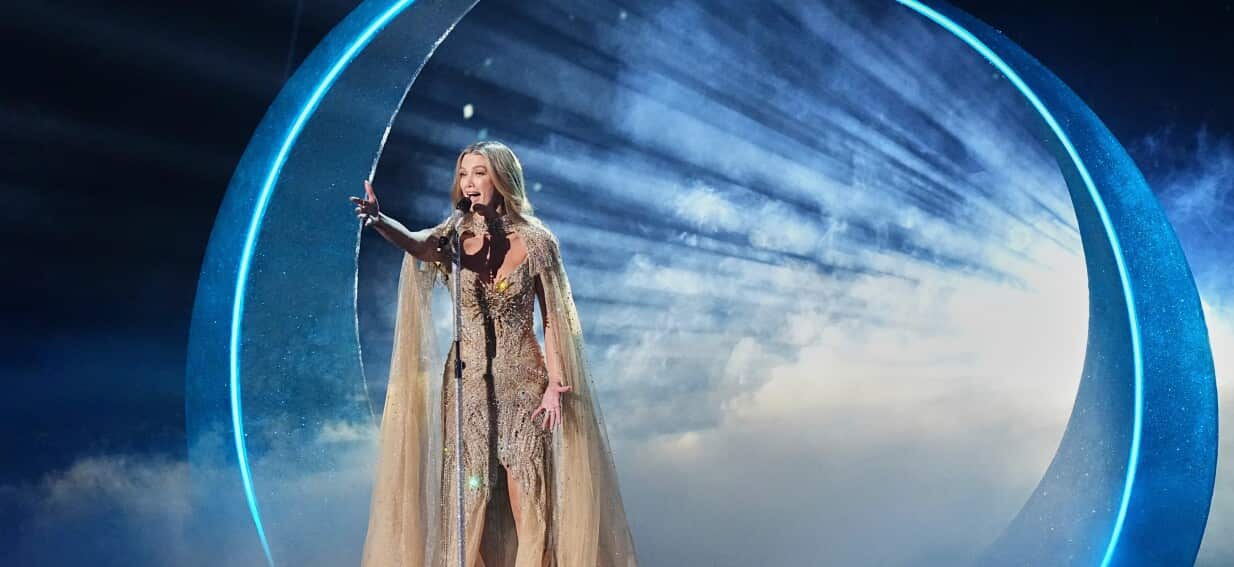
The staging itself avoided the classic Eurovision trap of relying on massive, clunky props or hyperactive background dancers. Instead, it relied on lighting, atmosphere, and sheer vocal power. Goodrem stood before a glistening crescent moon wearing a custom gown by Australian label Velani by Nicky. The dress took over 500 hours to hand-embellish with roughly 7,000 Swarovski crystals. At her chest sat a central crystal piece by House of Emmanuele, designed to act as both a striking visual ornament and a symbolic shield.
Then came the climax. Goodrem moved to her gold, bedazzled piano. As the song reached its emotional peak and the inevitable key change hit, she didn't just stand up. A hidden platform inside the piano propelled her straight up into the air amidst a flurry of wind and pyrotechnic fire.
Backstage, she laughed about the sheer logistics of the stunt, admitting that when you aren't actively singing, you suddenly realize exactly how high up you are. But under the lights, the transition was seamless.
Breaking the Two Year Qualification Drought
Australia's relationship with Eurovision has been rocky lately. After a couple of disappointing years failing to make the grand final cuts, the pressure on the 2026 entry was immense.
The European Broadcasting Union didn't invite Australia into the fold back in 2015 out of pure charity. It was a calculated business move driven by the fact that SBS had pulled massive, dedicated viewing figures since 1983. Dr. Jess Carniel, an expert on the cultural impact of the contest, notes that Australia's fandom isn't just about European nostalgia. It connects deeply with multicultural communities, including Asian Australians who grow up with a love for massive, theatrical televised song competitions.
When you look at the landscape of this year's contest, standing out is incredibly difficult. Out of 35 competing countries, 15 are represented by solo female vocalists. "Eclipse" is an incredibly well-engineered power ballad, but on paper, it runs the risk of blending into a crowded field of high-energy pop.
Goodrem won the room because she didn't try to out-weird the competition. While Finland's entry features a live violin performance that leans heavily into the bizarre, traditional camp style that voters love, Goodrem went for undeniable, old-school star power. She stepped into the role of Olivia Newton-John 2.0, delivering a note-perfect vocal performance that left even the most cynical critics gasping. Even the UK's notoriously tough commentator Graham Norton admitted the Australian delegation completely knocked it out of the park, labeling her the one to beat.
Going Independent and the Road to Vienna
The narrative surrounding this Eurovision run runs deeper than just a single song. This performance marks Goodrem's grand introduction as a completely independent artist.
After a massive 20-year partnership with Sony Music Australia, she parted ways with the major label to take complete creative control of her career. "Eclipse" serves as the lead single for her upcoming seventh studio album, Pure.
Choosing to enter the Eurovision machine as an independent artist is an incredibly ballsy move. It means funding your own vision, managing your own creative team, and carrying the entire weight of your brand on your own shoulders. When the universe aligned during a trip to London last year—where a casual response to a newspaper journalist sparked a massive media rumor mills—she decided to leap.
That independence shows in the final product. There's no corporate committee thinning out the rough edges of her performance. It's unapologetically dramatic, unashamedly grand, and completely aligned with what she wants to project as an artist.
How to Watch the Grand Final This Weekend
The momentum is real, the press room is converted, and the betting odds suggest Australia has its best shot at a historic win since Dami Im took second place back in 2016.
If you want to watch the history unfold live, you need to prepare for the brutal southern hemisphere time zone realities. The Grand Final broadcasts live across Australia on Sunday morning.
- Set your alarms: The live broadcast kicks off at exactly 5:00 AM AEST on SBS and SBS On Demand.
- Skip the standard breakfast: Take Goodrem's personal advice from her post-semi-final press conference. Ditch the standard toast, lean into heavy pastry vibes, and get the mimosas ready to pour the second the coverage starts.
- Watch the betting shifts: Keep an eye on live track updates during the voting blocks. The gap between Finland and Australia is closing rapidly, and jury votes will heavily favor Goodrem’s flawless live vocal delivery over the more chaotic acts.