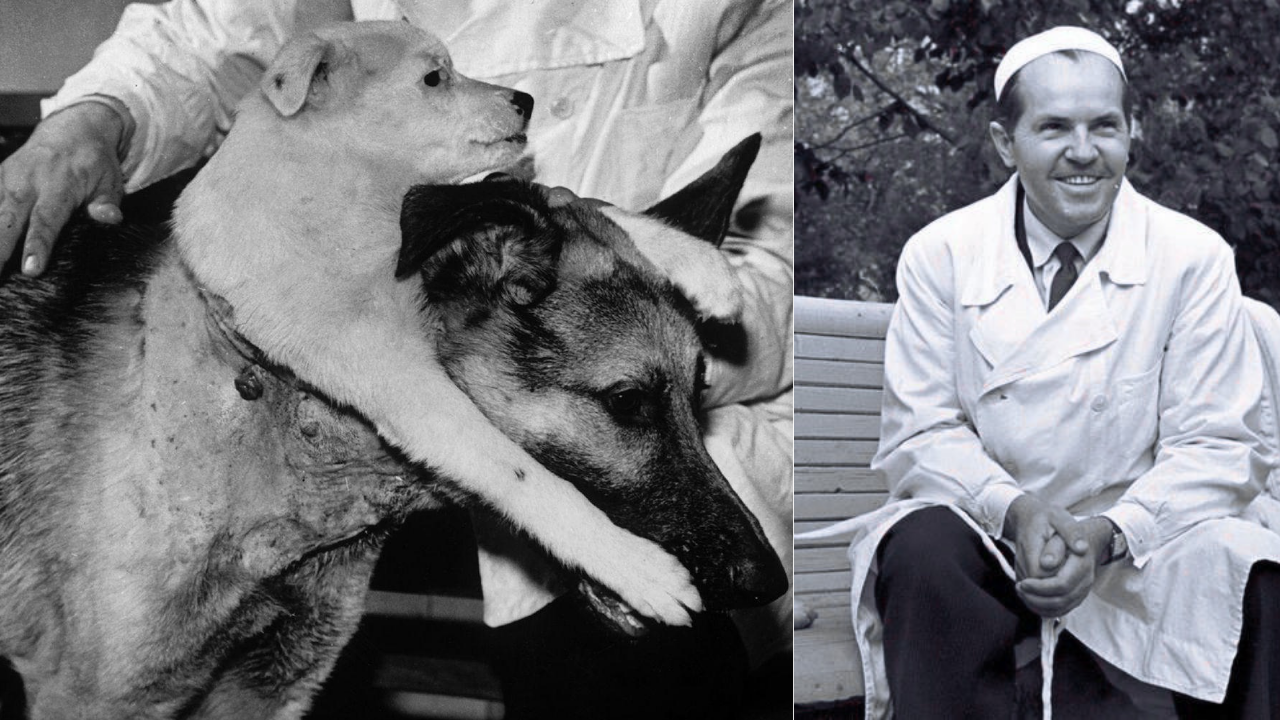
Vladimir Demikhov was not a "mad scientist," nor was he the misunderstood father of modern transplantology. Those are the two tired tropes history uses to avoid looking at the uncomfortable reality. One side paints him as a Frankenstein-esque horror show, while the academic side tries to sanitize his legacy by claiming every modern heart transplant is a direct descendant of his two-headed dogs.
Both sides are wrong.
Demikhov was a master of vascular suturing who mistook mechanical connectivity for biological viability. He solved the plumbing problems of surgery while completely ignoring the cellular warfare of the immune system. To call him the "creator" of modern transplantation is like calling the guy who first bolted two bicycle frames together the inventor of the supercar. He proved the pipes could be connected; he had no idea why the house kept burning down afterward.
The Plumbing Fallacy
The mainstream narrative obsesses over the visual shock of a small dog’s head and forelegs grafted onto the neck of a larger German Shepherd. It’s a grisly image designed for 1950s Soviet propaganda and modern clickbait. But look past the gore.
Demikhov’s obsession was "organ pairing." He believed that by creating a shared circulatory system, he could bypass the need for complex understanding of organ failure. He wasn't trying to replace a heart; he was trying to add a "spare." This fundamental misunderstanding of biological load and systemic rejection is where the "genius" label falls apart.
In modern medicine, we understand that the body is not a Lego set. You don't just click pieces together. The true barrier to transplantation wasn't the sewing—it was the rejection. Demikhov’s subjects died, often within days, not because the stitches failed, but because the body’s internal security system identified the new tissue as a lethal invader and tore it apart at the molecular level.
The Immunological Blind Spot
While Demikhov was busy with his needle and thread in Moscow, the real revolution was happening in laboratories he largely ignored. Sir Peter Medawar was winning a Nobel Prize for discovering acquired immunological tolerance. Medawar understood that the "skin-graft problem" was a genetic and chemical war.
Demikhov, meanwhile, was doubling down on surgical speed. He boasted about how fast he could perform a transplant, as if velocity could outrun the leukocyte response. This is the "Industry Insider" truth: surgeons often suffer from a "God Complex" where they believe if the blood flows, the patient lives.
We see this same arrogance today in the hype surrounding "head transplants" or certain high-risk xenotransplantation startups. They focus on the surgical theater—the robots, the specialized clamps, the glue—while the real battle is fought in the quiet, invisible realm of immunosuppression. Demikhov’s work was a dead end because it offered no solution to the one thing that actually kills transplant patients: the host.
Propaganda as Peer Review
You have to understand the era. The Soviet Union needed a scientific superstar to rival Western achievements in physics and space. Demikhov was useful. His experiments were visual, visceral, and easily photographed. They screamed "Soviet Superiority" in a way that a boring paper on T-cell suppression never could.
If you look at his 1960 monograph, Experimental Transplantation of Vital Organs, you see a man obsessed with the mechanics. He pioneered the use of stapling devices for blood vessels, which was genuinely useful. But the two-headed dog? That was a circus act. It served no clinical purpose. There is no medical scenario where a patient needs a second, parasitic head grafted to their shoulder.
By framing these experiments as "pioneering," we give a pass to unethical, scientifically redundant cruelty. I’ve seen modern biotech firms burn through Series A funding by chasing similar "spectacle science"—building flashy tech that looks great in a pitch deck but ignores the underlying biological hurdles. Demikhov was the original "vaporware" salesman, only his product was made of flesh and blood.
The Myth of the Heart Transplant Pioneer
Christiaan Barnard, the man who performed the first human-to-human heart transplant in 1967, famously credited Demikhov. History buffs love this quote. It adds a layer of "student surpassing the master" drama.
But let’s be brutal: Barnard’s success didn't come from Demikhov’s dog experiments. It came from the development of the heart-lung machine by John Gibbon and the refinement of bypass techniques. It came from the understanding of brain death and the ethics of harvesting. Most importantly, it came from the pharmacological ability to keep the patient’s immune system from murdering the new heart.
Demikhov’s contribution was a footnote in technique, not a blueprint for success. He was a gifted technician with a narrow vision. To credit him with the heart transplant is like crediting the person who invented the needle with the success of the first open-heart surgery. It’s a technical necessity, but it’s not the breakthrough.
The Cost of the "Maverick" Narrative
Why does the "misunderstood genius" story persist? Because it’s comfortable. We want to believe that progress requires these lone wolves who break all the rules and "do what others won't." It justifies the "move fast and break things" mentality.
In medicine, "breaking things" usually means unnecessary suffering for no data gain. Demikhov performed twenty-four of these two-headed dog experiments. By the third one, he knew they wouldn't survive long-term. By the tenth, he knew why. The remaining fourteen weren't for science; they were for the camera.
When we celebrate Demikhov without the "but," we encourage a culture where the visual "wow" factor outweighs the boring, incremental, and actually life-saving work of pathology and pharmacology.
Stop Asking the Wrong Questions
People often ask, "What can we learn from Demikhov's bravery?" That is the wrong question. Bravery is irrelevant when it’s someone else’s life (or an animal’s) on the line for a flawed hypothesis.
The right question is: "How do we identify when a scientific 'breakthrough' is actually just a high-budget stunt?"
The answer lies in the longevity of the results. Demikhov’s "masterpieces" were transient. They were biological ghosts that vanished as soon as the anesthesia wore off. If your "disruptive" medical tech can't survive the body's natural defenses for more than a week, you haven't invented a cure; you've staged a performance.
The Demikhov Lesson for Modern Tech
Today, we see "Demikhovs" everywhere in the longevity and bio-hacking spaces. We see people promising to "re-code" the human body or "swap out" failing components as if we are hardware. They use the same language of mechanical inevitability that Demikhov used in the fifties.
They are making the same mistake.
The body is a complex, adaptive, and highly aggressive system of systems. It is not a machine. It is a sovereign nation that does not take kindly to foreign intervention. Demikhov's failure wasn't a lack of tools; it was a lack of humility in the face of biology.
Stop romanticizing the two-headed dog. It wasn't a step toward the future. It was a gruesome detour fueled by ego and political necessity. The real pioneers were the ones in the lab coats staring at petri dishes, figuring out how to make two different sets of DNA coexist without a war. They are the ones who changed medicine. Demikhov just proved you could sew.
Stop looking for "mavericks" and start looking for the people who actually understand the system they are trying to disrupt.
The stitches aren't the surgery. The plumbing isn't the life.