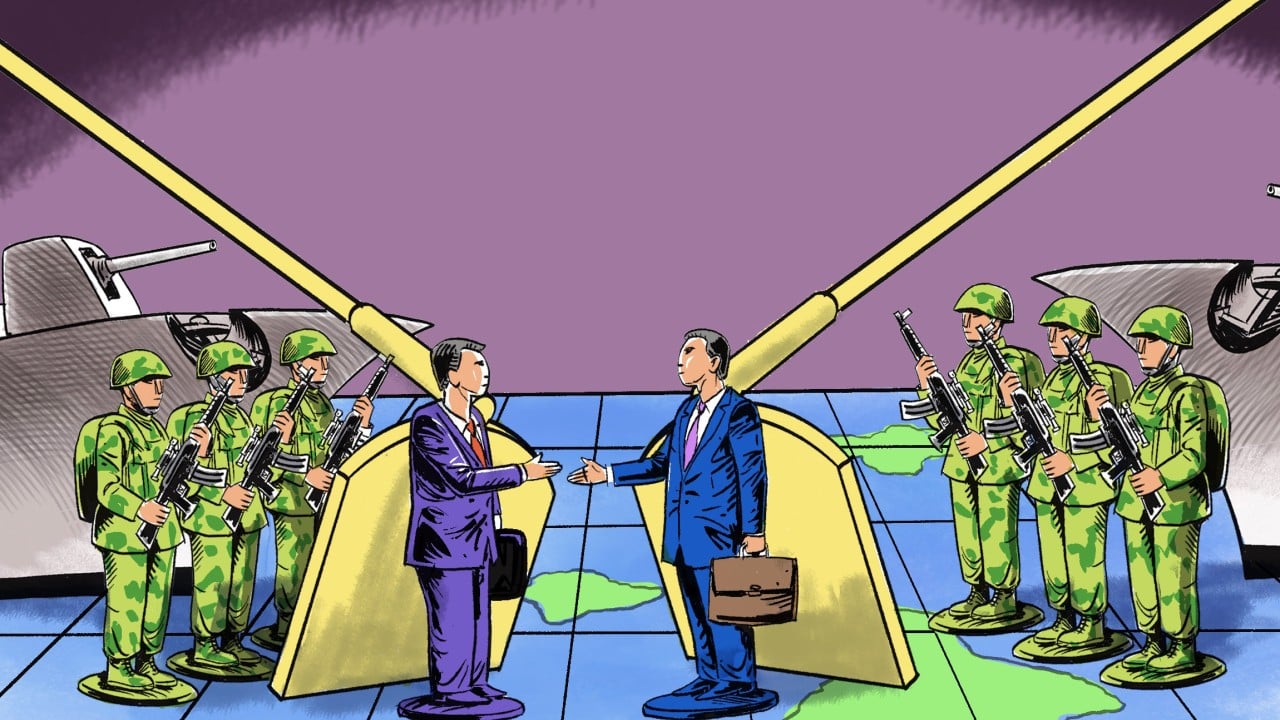
Deterrence is the current buzzword in every capital from Washington to Tokyo. The logic seems simple enough. If you build enough missiles, park enough aircraft carriers in the South China Sea, and sign enough defense pacts, your opponent will think twice before making a move. It’s the classic "peace through strength" argument. But there's a massive, dangerous flaw in how this is being applied in Asia today. If you only focus on the threat of force without giving your opponent a clear, credible path to avoid that force, you aren't deterring a war. You’re just scheduling one.
Right now, the West and its partners are leaning so hard into the military side of the equation that they’ve forgotten how to talk. We’re seeing a massive buildup of hardware—AUKUS submarines, expanded bases in the Philippines, and new missile batteries in Japan—without any corresponding diplomatic "off-ramps." This approach ignores a basic rule of human psychology and international relations. When a nation feels backed into a corner with no hope of a peaceful resolution, it doesn't always surrender. Sometimes, it lashes out because it feels it has nothing left to lose.
The trap of one sided pressure
Deterrence isn't just about making someone afraid to fight. It’s also about making them feel safe enough not to fight. Think about it. If I tell you I’ll punch you if you move, but I also look like I’m going to punch you even if you stay perfectly still, what’s your incentive to stay still? You might as well swing first and try to get the advantage.
This is exactly where we are with China and the various flashpoints in Asia, from the Taiwan Strait to the Second Thomas Shoal. The United States and its allies are successfully increasing the costs of Chinese aggression. That’s the "deterrence" part. But they aren't successfully communicating what China gets if it chooses restraint. If Beijing perceives that the ultimate goal of the West is to permanently contain their economy or eventually force a regime change, then the military buildup looks less like a shield and more like a sword.
We saw this dynamic play out during the Cold War. The most dangerous moments, like the Cuban Missile Crisis, weren't solved by just having more nukes. They were solved because both sides found a way to let the other guy save face and withdraw without feeling like they’d invited their own destruction. Today, that diplomatic nuance is almost entirely absent from the conversation.
Military hardware won't fix political problems
You can't use a Tomahawk missile to solve a sovereignty dispute. These are deeply rooted historical and political issues that require actual negotiation. Look at the situation in the South China Sea. China’s "nine-dash line" claims are illegal under international law, as the 2016 Permanent Court of Arbitration ruling made clear. But simply sailing destroyers through those waters doesn't change the reality on the ground or the political pressure within Beijing to defend what they call their "ancestral property."
The heavy lifting has to happen in the boring, unsexy rooms where diplomats sit. It happens in the ASEAN summits and the bilateral "hotlines" that currently go unanswered during crises. The problem is that diplomacy has become a dirty word in many political circles. It’s seen as "appeasement" or weakness. In reality, diplomacy is a tool of national power just as much as an F-35 is.
When we stop talking, we stop understanding the red lines of the other side. This leads to miscalculation. One captain of a coast guard vessel gets too aggressive, one pilot makes a mistake, and suddenly you have a shooting war that neither side actually wanted but neither side knows how to stop.
The cost of ignoring the off ramp
We’re seeing a literal arms race. Japan is doubling its defense spending. Australia is spending hundreds of billions on nuclear-powered subs. China is expanding its nuclear arsenal at a rate we haven't seen in decades. This is "deterrence" on steroids. But every time one side adds a new capability, the other side feels less secure. It's a classic security dilemma.
The result is a region that’s bristling with weapons but feels less stable than it did ten years ago. The missing piece is reassurance. To make deterrence work, you have to convince your adversary of two things simultaneously:
- If you attack, it will hurt more than you can bear.
- If you don't attack, your core interests won't be threatened by us.
Most of our current strategy is 100% focused on the first point. We’re failing miserably at the second. By failing to offer credible reassurances—like stating clearly that the goal is status quo, not total containment—we’re making the "deterrence" part feel like an existential threat to the other side.
How we actually get back to stability
Fixing this doesn't mean being soft. It doesn't mean stopping the military build-up or abandoning allies. It means balancing the scales. We need to stop treating diplomacy as a reward for good behavior and start using it as a way to prevent bad behavior.
First, the U.S. and China need functional, high-level military-to-military communications that don't get shut down every time there’s a political spat. These shouldn't be optional. They’re the safety valves on a pressure cooker. When a Chinese jet buzzes a U.S. plane, the commanders need to be able to talk immediately to de-escalate.
Second, the region needs a clear framework for what "peaceful coexistence" actually looks like. This sounds fluffy, but it’s practical. It means defining the boundaries of competition. We can compete on chips, on trade, and on influence without it turning into a kinetic conflict. But that requires explicit agreements and a return to some of the "strategic ambiguity" that kept the peace for decades.
Finally, allies in the region like Australia, Japan, and South Korea need to play a bigger role in the talking, not just the buying of weapons. They’re the ones on the front lines. They have the most to lose if deterrence fails. They should be leading the charge for regional code-of-conduct agreements in the South China Sea that have real teeth.
Stop thinking of diplomacy as the opposite of strength. It’s the steering wheel that tells the strength where to go. Without it, you’re just a heavy truck barreling down a mountain with no brakes and no map. You’re going to crash; it’s just a matter of when.
The next step for anyone watching this space is to look past the headlines about new missile contracts. Start looking at the state of the diplomatic corps. Look at whether the "red phones" are actually connected. If the weapons are piling up but the talking has stopped, it’s time to be very, very worried. We need to demand that our leaders spend as much intellectual energy on de-escalation as they do on target acquisition. Peace isn't the absence of conflict; it's the management of it.