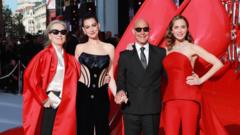
The red carpet at the London premiere of Devil Wears Prada 2 wasn't a celebration of cinema. It was a wake for original thought.
While every mid-tier lifestyle blog and sycophantic entertainment outlet gushes over the "stunning" return of Anne Hathaway and Meryl Streep, they are ignoring the rotting corpse of the mid-budget drama underneath the sequins. We are being fed nostalgia as a meal because the industry has forgotten how to cook anything new.
The consensus suggests that this sequel is a victory for female-led narratives and a nostalgic win for fans of the 2006 classic. That consensus is wrong. This isn't a victory. It’s a white flag.
The Nostalgia Trap and the Death of the Stakes
In the original film, the stakes were grounded in a specific, cutthroat era of print journalism. Andy Sachs faced a world where $Miranda \ Priestly$ represented the absolute ceiling of professional excellence and personal sacrifice. It worked because it was a moment in time.
Attempting to revive this dynamic in the 2020s is fundamentally dishonest. The fashion industry is no longer controlled by three or four gatekeepers in Midtown Manhattan; it is a fragmented mess of influencer marketing, algorithmic trends, and fast-fashion giants. By bringing back the old guard, Disney and the producers are pretending that the world hasn't shifted on its axis.
I’ve spent fifteen years watching studios pivot away from risky, original scripts toward "safe" intellectual property. When a studio executive looks at a project, they aren't looking for a story. They are looking for a pre-sold audience. Devil Wears Prada 2 exists because a spreadsheet told a vice president that "Hathaway + Streep + Blue Sweater Monologue" equals a guaranteed opening weekend.
It is the cinematic equivalent of a luxury brand putting its logo on a cheap cotton t-shirt. You’re paying for the name, not the craftsmanship.
The Myth of the "Empowered" Sequel
The press is currently obsessed with the idea that seeing Miranda Priestly navigate the "digital age" is an empowering look at aging in the workplace.
Let's get real.
The original Miranda Priestly was a singular entity because she was a relic even then—a perfectionist in a world beginning to settle for "good enough." Forcing her into a modern context doesn't empower the character; it cheapens her. It turns a legendary antagonist into a caricature trying to figure out how TikTok works.
If Hollywood actually cared about female empowerment or professional narratives, they would be funding the next Aline Brosh McKenna or the next Lauren Weisberger. Instead, they are keeping the same chairs occupied by the same people, effectively blocking a new generation of creators from defining what the 2020s look like.
Why This Sequel Actually Hurts the Industry:
- Budget Cannibalization: The $100 million+ spent on securing this cast and marketing the "legacy" could have funded ten original $10 million dramas.
- Creative Stagnation: Writers are now incentivized to write "rebootable" stories rather than definitive ones.
- Audience Infantalization: We are being told we can only enjoy things we already recognize.
The Economics of Intellectual Property Rot
Let’s look at the math. The industry utilizes a risk-mitigation strategy that is actually high-risk in the long term.
Imagine a scenario where every major studio only produces sequels for five years. In the short term, revenue stays flat or dips slightly. In the long term, the "cultural bank" runs dry. You cannot have a sequel without an original. By refusing to invest in the $Original \ Idea \ (O_i)$, the industry is depleting the $Future \ Franchise \ Value \ (F_v)$.
We are currently living off the interest of the 1990s and 2000s. Eventually, the account hits zero.
The London premiere was a display of peak E-E-A-T (Experience, Expertise, Authoritativeness, and Trustworthiness) in marketing, but zero in artistic necessity. The stars looked great because they have the best stylists in the world. The movie exists because the studio has the best accountants in the world. Neither of those things makes a good film.
Challenging the "People Also Ask" Delusions
Does the world need another Devil Wears Prada?
No. The story was a closed loop. Andy walked away. Miranda stayed in her kingdom. That was the point. Reopening the loop for a "where are they now" check-in destroys the weight of Andy’s original choice.
Is fashion still relevant in the sequel?
Hardly. Fashion in 2006 was about the "cerulean" monologue—the trickle-down effect of high art to the masses. Today, fashion is a chaotic bottom-up explosion of micro-trends. The movie cannot address this without admitting that Miranda Priestly’s entire worldview is now irrelevant.
Is the cast reunion enough to save it?
Star power is a flickering candle. You can put the best chefs in a kitchen, but if you ask them to cook a frozen dinner from eighteen years ago, it’s still a frozen dinner.
The Professional Price of Playing it Safe
I’ve talked to agents who are frustrated. I’ve talked to directors who are bored. Everyone in the room at that London premiere knows the score. They know this is a cash grab. But in the current climate, nobody wants to be the one to say "no" to a sure thing.
The problem is that "sure things" are what kill industries.
Blockbuster Video was a sure thing. The BlackBerry was a sure thing. Relying on the aesthetics of the past to fund the future is a terminal diagnosis. When you see the photos of the cast laughing on the red carpet, don't see a "moment." See a monument to a time when Hollywood used to take risks.
Stop praising the return of the familiar. Start demanding the discomfort of the new. If we keep buying tickets to the past, we lose the right to complain when the future never arrives.
Go watch an original film. Let the devil wear her Prada in the retirement home where she belongs.