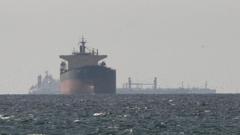
The headlines are bleeding with the same old tired narratives. On one side, we have Keir Starmer supposedly ready to "send drones to the Gulf" to secure shipping lanes. On the other, the British public is being told to "panic at the pumps" because of supply chain fragility.
It is the classic pincer movement of mid-wit journalism: fear-mongering about the Middle East paired with domestic hysteria. Both stories miss the point so spectacularly that it borders on negligence.
The media wants you to believe that "sending drones" is a sign of British strength and that fuel shortages are an inevitable byproduct of global chaos. The reality is far more damning. These aren't signs of a proactive government or a volatile market. They are the death rattles of a strategic framework that hasn't been updated since the 1990s.
The Drone Delusion: Sovereignty via Remote Control
Let’s start with the Gulf. The narrative suggests that deploying British-made drones is a bold move to protect the free flow of trade. I have spent years watching defense budgets vanish into the "miracle cure" of unmanned aerial vehicles (UAVs). Everyone thinks drones are a shortcut to relevance. They aren't.
Deploying drones to the Gulf is not a projection of power; it is an admission of exhaustion. We are trying to maintain the appearance of a "Global Britain" on a budget that barely covers a coastal patrol. When you send drones instead of carrier strike groups or sustained diplomatic presence, you aren't deterring adversaries. You are telling them exactly how much skin you are willing to put in the game: zero.
In military theory, deterrence requires two things: capability and credibility. We have the technical capability. We have zero credibility. Our adversaries know that a downed drone results in a strongly worded letter, while a downed manned aircraft results in a war. By opting for the "safe" robotic route, Starmer is effectively signaling that the Gulf shipping lanes are important, but not important enough to actually fight for.
The "lazy consensus" here is that technology replaces presence. It doesn't. If you want to protect oil tankers from Houthi rebels or Iranian interference, you need boots on decks and hulls in the water. Drones are observation tools being mis-sold as enforcers. It is the geopolitical equivalent of putting a "Beware of the Dog" sign on your gate when you don't even own a cat.
The Fuel Panic: A Self-Fulfilling Prophecy of Competence
While the government plays toy soldiers in the desert, the domestic press is busy lighting fires at the petrol station. "Panic hits the pumps" is the headline that sells papers and destroys economies.
I’ve seen this movie before. In 2021, and again during various strikes, the shortage was never about the literal volume of fuel under the ground. It was about the "Just-in-Time" (JIT) delivery model meeting a psychological breakdown.
The UK’s fuel infrastructure is a fragile web of outsourced logistics and razor-thin margins. When the media whispers "shortage," they create a feedback loop.
- The media reports a "potential" issue.
- The "top-up" effect kicks in (people who usually wait until their tank is 10% full rush to fill up at 70%).
- Demand spikes by 500% in a single afternoon.
- The JIT delivery system, designed for steady-state demand, collapses.
The industry calls this the "Bullwhip Effect." A small fluctuation in consumer behavior creates massive, unmanageable swings further up the supply chain.
The mistake everyone makes is blaming the "panic buyers." Don't blame the people; blame a system that is so optimized for cost-cutting that it has zero resilience. We have traded security for efficiency. We have no strategic fuel reserve at the retail level because storage costs money, and money spent on "just in case" doesn't look good on a quarterly earnings report.
The Energy Independence Lie
The common question asked is: "How do we stop the pumps from running dry?"
The wrong answer is "better logistics." The right answer is "destroying the dependency."
Both the Gulf drone deployment and the pump panic are tied to the same umbilical cord: fossil fuel dependency. The UK likes to pretend it is a leader in green energy while its entire national security posture is still dictated by the price of Brent Crude and the stability of the Strait of Hormuz.
If we were actually serious about "securing our future," we wouldn't be worried about sending drones to watch tankers. We would be aggressively decoupling our transport network from international oil markets. Every headline about the Gulf is a reminder that our sovereignty is leased from some of the most unstable regions on earth.
We are told that moving away from oil is "too expensive" or "too slow." Tell that to the person sitting in a two-hour queue for £2-a-litre diesel. The hidden cost of our current energy "stability" includes the billions spent on defense deployments, the economic loss of transport strikes, and the massive inflation spikes caused by regional wars. When you add those up, the "expensive" transition looks like a bargain.
The Counter-Intuitive Truth: We Need More Crisis, Not Less
Here is the take that will get me kicked out of the room: We need these panics.
We need the system to fail occasionally to remind us how pathetic our "resilience" actually is. Stability breeds complacency. As Nassim Taleb argues in Antifragile, systems that are protected from small shocks eventually succumb to massive, terminal ones.
The "Panic at the Pumps" is a small shock. It’s an annoying reminder that our logistics are brittle. If the government "fixes" it by just subsidizing fuel or begging hauliers to work harder, they are just kicking the can down the road. They are masking the symptoms while the cancer of dependency grows.
Similarly, "Drone Diplomacy" is a sedative. It makes the public feel like "something is being done" without the political cost of actual military engagement. It’s security theater. We are watching a live-streamed retreat from global responsibility and calling it "technological advancement."
Stop Asking the Wrong Questions
People also ask: "Will drone strikes in the Gulf lower my fuel prices?"
No. They won't. Even if Starmer sends a thousand drones, he can't control the global market price of oil. He can't control the insurance premiums for tankers. He can't control the internal politics of OPEC.
The question you should be asking is: "Why is my ability to get to work dependent on a drone's ability to loiter over a desert 3,000 miles away?"
We are living in an era of "Synthetic Security." We use synthetic military presence (drones) and synthetic economic stability (market interventions) to hide the fact that we have lost control.
True authority doesn't come from a remote-control joystick in a trailer in Lincolnshire. It comes from having a domestic energy base that isn't susceptible to a tweet from a Middle Eastern dictator or a viral video of a queue in Kent.
The downsides to my approach? It’s painful. It involves admitting that the UK is currently a secondary power trying to maintain a primary power’s lifestyle. It involves massive upfront investment in nuclear and renewables that won't show a "profit" for a decade. It involves telling the public that the "cheap" fuel of the last thirty years was a subsidized illusion.
But the alternative is what you see in the papers today: a cycle of perpetual anxiety, hollow military gestures, and a slow slide into irrelevance.
If you’re waiting for the government to "solve" the pump crisis or "secure" the Gulf, you’ve already lost. They are managing the decline, not stopping it.
Stop looking at the drones. Look at the tether.
Cut it.