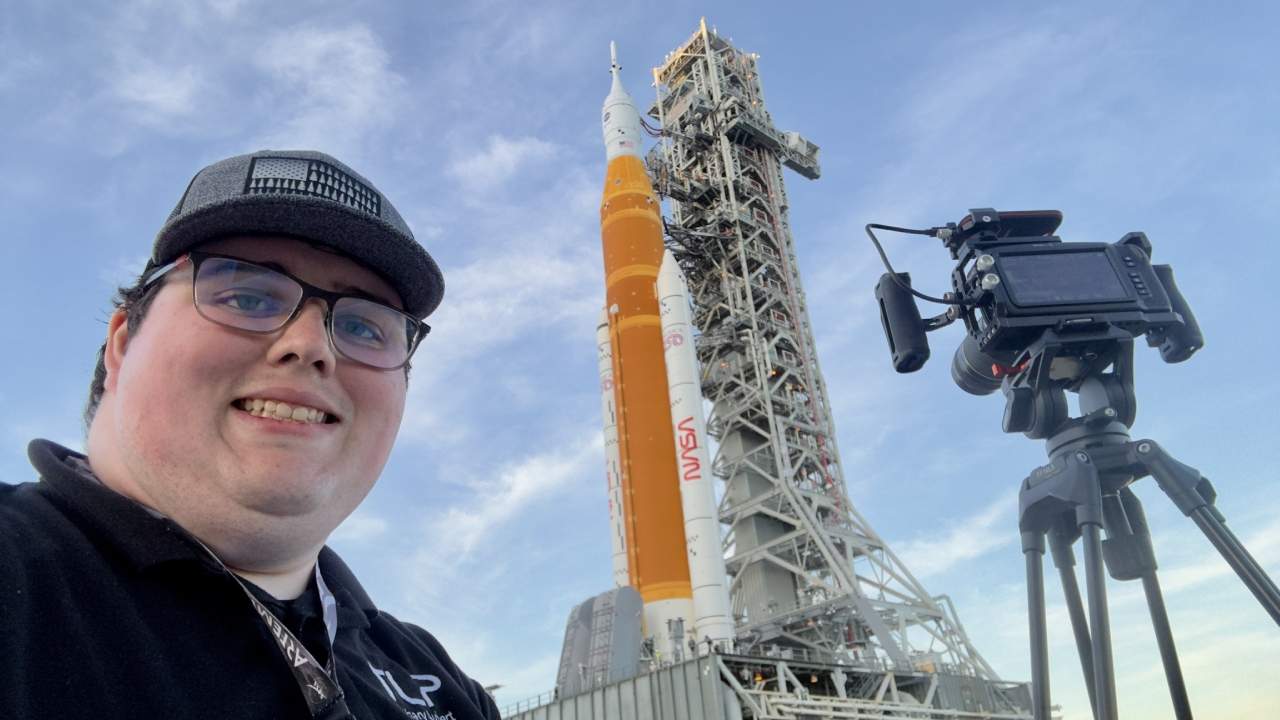
The ground shakes. You don’t just hear a moon rocket; you feel it in your bone marrow. For most of us, space is something we see on a grainy YouTube stream or a polished Netflix documentary. But for a dedicated group of Canadians, including one very loud space enthusiast from Edmonton, the Artemis II launch wasn't just a news story. It was a pilgrimage.
Going to Florida to watch a heavy-lift rocket leave the planet isn't about the three seconds of fire. It’s about being part of the moment when humanity stops spinning its wheels in low Earth orbit and finally looks back at the lunar surface. Artemis II is the first time in over fifty years that humans are heading toward the moon. This isn't a test flight for robots. There are people inside that capsule. One of them, Jeremy Hansen, is carrying the hopes of every Canadian who ever looked at the Avro Arrow or the Canadarm and wondered why we weren't out there too.
The Edmonton connection to the lunar gateway
You might wonder why someone from the prairies cares this much about a launch pad in Cape Canaveral. It’s simple. Alberta has a weirdly deep connection to the stars. From the University of Alberta’s work on satellite sensors to the local astronomy clubs that brave -40°C nights to catch a glimpse of the aurora, the "space bug" bites hard here.
When that Edmonton enthusiast stood on the Florida coast, they weren't just a tourist. They represented a community that understands the technical grit required to survive in harsh environments. Space is just the ultimate version of a northern winter. Everything wants to break, the heating is expensive, and if you go outside without the right gear, you’re dead.
Seeing a Canadian astronaut’s name on the manifest changes the math. For decades, we were the helpful sidekicks. We built the arms that caught the shuttles. Now, we’re in the driver’s seat. That shift in status is why people are flying thousands of miles to stand in a swampy marshland just to see a streak of light.
Why Artemis II is the mission that actually matters
Everyone talks about Mars. Mars is flashy. Mars is the "someday" goal that keeps billionaires busy. But Artemis II is the "right now" reality. It’s the mission that proves the Orion spacecraft and the Space Launch System (SLS) can actually keep four humans alive while they sling around the backside of the moon.
Think about the sheer ballsy nature of this flight path. The crew isn't landing—not yet. They’re performing a hybrid free-return trajectory. They’ll use the moon’s gravity like a cosmic slingshot to whip them back toward Earth. If the engines don't fire exactly right, or if the heat shield has a microscopic flaw, that’s it.
Breaking down the hardware
The SLS is a beast. It generates 8.8 million pounds of thrust. That’s about 15 percent more power than the Saturn V. When you’re standing a few miles away, the sound waves literally compress the air in your lungs. It’s a physical assault.
- The Orion Capsule: This is the most advanced crewed spacecraft ever built. It has to handle re-entry speeds of 25,000 mph.
- The European Service Module: This provides the air, water, and power. It’s a global effort.
- The Heat Shield: It’s five meters wide and has to survive temperatures half as hot as the sun’s surface.
The long wait for a Canadian in deep space
Jeremy Hansen isn't just another pilot. He’s a veteran colonel in the Royal Canadian Air Force, but more importantly, he’s been waiting for this seat for years. Watching him represent Canada on this mission feels like a payoff for every kid who went to the Telus World of Science and dreamed of more than just a planetarium show.
The atmosphere at the launch site was electric, but also tense. There’s a specific kind of silence that happens right before the countdown hits zero. You can hear the insects in the Florida grass, and then, suddenly, you can’t hear anything but the roar. Our Edmonton observer described it as "truly incredible," but even that feels like an understatement. It’s a spiritual experience for the technically minded.
Forget the critics who say it costs too much
You’ll always hear people grumbling about the price tag. "Why spend billions on space when we have problems on Earth?" It’s a tired argument. We don't throw the money into a black hole. We spend it here. We spend it on engineers in Ontario, technicians in Quebec, and researchers in Alberta.
Space exploration drives the kind of innovation that eventually trickles down to your smartphone and your hospital's MRI machine. But beyond the gadgets, it’s about the "what if." If we stop looking up, we stop growing. That’s the real reason an Edmonton space nut spends their savings to stand in the humidity and watch a rocket go up. It’s a reminder that we’re capable of doing things that aren't just about survival or quarterly profits.
How to follow the mission like a pro
If you couldn't make it to the Florida coast, you don't have to miss out. The mission lasts about ten days, and the data coming back will be a goldmine. You should be looking at the live telemetry feeds provided by NASA and the Canadian Space Agency.
Don't just watch the highlights. Look for the "Earthrise" photos the crew will take. Seeing our planet from the perspective of the lunar far side is a perspective shift we haven't had in high resolution since 1972. It makes everything back home—the politics, the traffic, the weather—seem pretty small.
Keep an eye on the splashdown. The recovery of the Orion capsule in the Pacific Ocean is just as dangerous as the launch. It’s a high-speed hit into the water that tests every bolt and weld on that ship. Once that capsule is back and the crew is out, Canada officially becomes a deep-space nation.
Follow the mission updates through the official CSA Twitter and NASA’s Artemis blog. If you’re in Edmonton, head down to the local observatory. Talk to the people there. They’ve been waiting for this moment since the last Apollo mission left the moon. The excitement isn't just hype; it's the start of a new era. Grab a telescope, find the moon on a clear night, and realize there are people up there again.