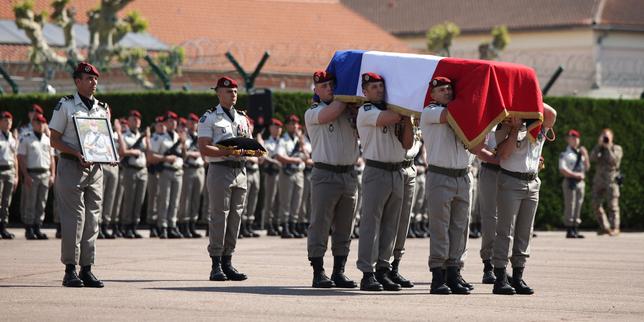
The wind in Montauban carries a specific chill in April. It is the kind of cold that doesn't just bite the skin; it settles into the marrow, especially when the rhythm of a military town is broken by the heavy, rhythmic thud of a funeral march. On the grounds of the 17th Parachute Engineer Regiment, the silence was absolute. Thousands of boots stood motionless. In the center of the courtyard, draped in the tricolor of a nation that asks much of its sons, lay Staff Sergeant Florian Montorio.
He was thirty-one.
To the spreadsheets of a ministry, he is a statistic in the ledger of Operation Daman. To the geopoliticians, he is a data point in the volatile friction of the Blue Line in Lebanon. But to the men who jumped out of planes with him, Florian was the guy who knew how to fix a broken spirit with a well-timed joke and how to navigate a minefield with the steady hands of a surgeon.
The world sees the uniform. The family sees the man who isn't coming home for dinner.
The mission in Lebanon is often described in the press as a peacekeeping effort, a phrase so sanitized it masks the grinding reality of the terrain. Since 1978, UNIFIL forces have stood in the gap between ancient grievances and modern artillery. It is a land of white dust, olive trees, and sudden, jarring violence. Florian wasn't a stranger to the stakes. He had already seen the dust of Mali and the complexities of other theaters. He knew that in the Levant, peace isn't a state of being; it is a fragile, hourly negotiation.
Consider the mechanics of a military life. It is built on the mundane—the cleaning of a rifle, the folding of a beret, the repetitive drills that make movement instinctive. These routines are the scaffolding of a soldier's sanity. When a soldier like Montorio dies, the scaffolding doesn't just collapse; it leaves a hole in the sky.
The official ceremony was led by Sébastien Lecornu, the Minister of the Armed Forces. There were medals. The Médaille Militaire and the Croix de la Valeur Militaire with a bronze star were pinned to the velvet cushions. These are heavy pieces of metal. They carry the weight of a life ended prematurely. But as the Minister spoke of "the price of commitment," one couldn't help but look at the faces of the 17th RGP. Their eyes weren't on the medals. They were staring at the void where a friend used to be.
Soldiers don't fight for grand abstractions. They fight for the person to their left and the person to their right.
Imagine a humid evening in a temporary camp near the Lebanese border. The air is thick with the scent of diesel and dry earth. Florian is there, perhaps sharing a cigarette or a story about home. These are the "invisible stakes." We talk about national interests and border integrity, but the real currency of the military is trust. You trust that the man next to you has checked the perimeter. You trust that he will keep his head when the world turns into fire. Florian was that trust personified.
His death was the result of a traffic accident during a high-stakes mission. In the civilian world, we call it a tragedy. In the military, it is a "death in the line of duty." The distinction is subtle but vital. It means that every kilometer driven on those winding, treacherous roads is an act of service. There are no safe zones. There is only the mission and the constant, low-thrumming awareness that the environment is as much an enemy as any insurgent.
The grief in Montauban was not loud. It was the quiet, crushing weight of a community that knows the cost of its profession. Montauban is a "garrison town," a place where the sound of bugles is as common as the sound of church bells. Yet, you never get used to the sight of a coffin. You never get used to the "Marseillaise" sounding like a lament instead of an anthem.
When a paratrooper dies, the regiment feels the phantom limb. The 17th RGP is a specialized unit—the "Sapeurs Parachutistes." They are the ones who go in first to clear the way. They find the traps. They build the bridges. They are the architects of safety in chaotic places. To lose one of their best is to lose a piece of their collective intuition.
The Minister’s eulogy touched on the "shining example" Florian set. It is a standard rhetorical move, but it rings true in the barracks. Young recruits look at a Staff Sergeant like Montorio and see the blueprint of who they want to become. They see the discipline. They see the scars. They see a man who walked the talk until his very last breath.
But what about the morning after the ceremony?
The dignitaries leave. The black sedans drive away. The flags are returned to their poles. That is when the true mourning begins. It happens in the mess hall, where a specific chair remains empty. It happens in the mail call when a letter arrives that can no longer be delivered. It happens in the homes of his loved ones, where the silence is now a permanent resident.
We often treat the news of a soldier's death like a weather report—something distant that happens to other people. We read the headline, feel a fleeting moment of pity, and move on to the sports scores or the stock market. But to forget the human behind the rank is a second death. It is a failure of the society that sent him there in the first place.
Florian Montorio was more than a sergent-chef. He was a son of France who believed that some things were worth the risk of everything. He didn't die for a headline. He died because he believed in the person standing next to him. He died because he accepted the burden of our collective security so we wouldn't have to think about it.
The real tragedy of the Blue Line isn't just the geopolitical stalemate; it's that the world's most beautiful landscapes are so often stained by the blood of people who just wanted to make them safe.
As the sun set over the Place de l'Hôtel de Ville in Montauban, the shadows of the paratroopers grew long. They stood tall, shoulders back, faces like flint. They will go back to Lebanon. They will go back to the dust and the heat. They will continue the work because that is what Florian would have done.
The medal on the cushion is cold. The memory of the man, however, is a flame that the wind of Montauban cannot blow out. It burns in the stories told in low voices after lights out. It burns in the resolve of a regiment that has lost a brother but found a legend.
In the end, we are not defined by the length of our lives, but by the depth of the shadows we leave behind. Staff Sergeant Montorio’s shadow is vast, stretching from the Tarn to the mountains of Lebanon, a silent reminder that peace is never free, and its guardians are never truly gone as long as their names are spoken with honor.
The bugle call ended. The regiment turned. The empty seat remained.