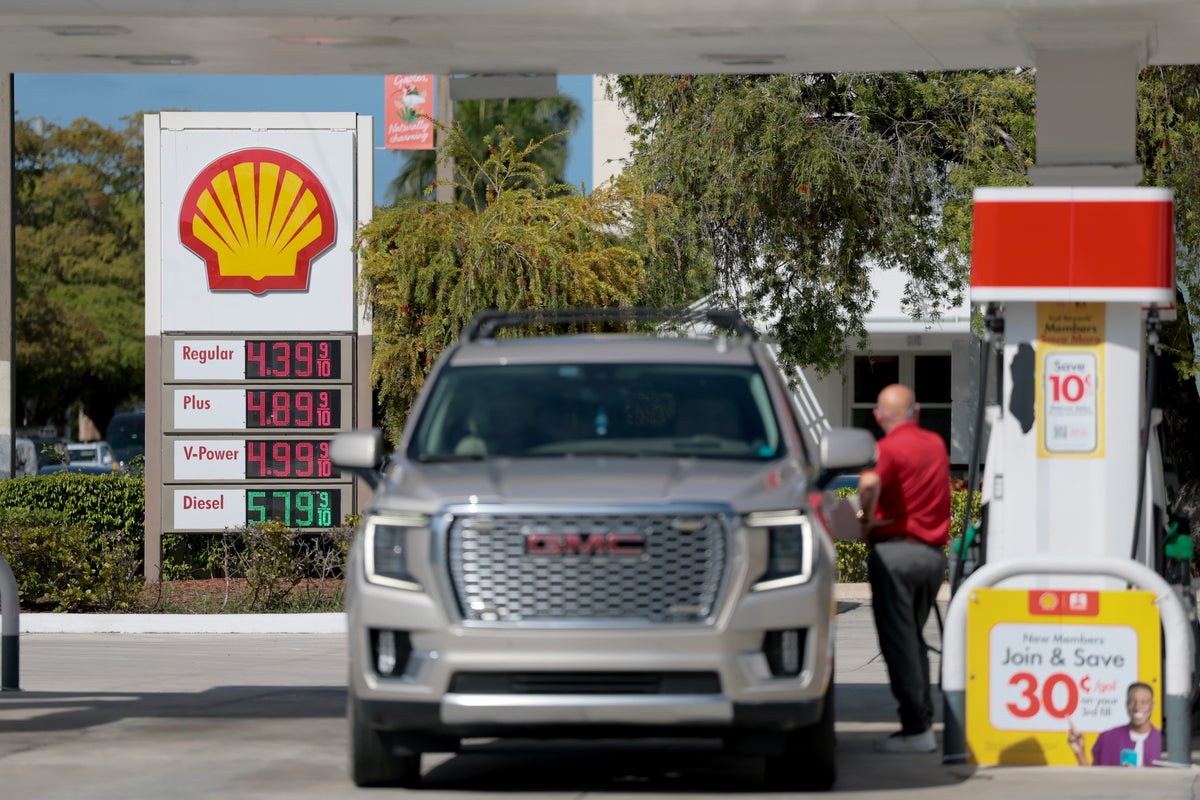
The persistent failure of political leadership to accurately forecast gasoline price movements stems from a fundamental misclassification of the energy market as a controllable domestic system rather than a chaotic global commodity network. When an Energy Secretary suggests a seasonal decline in fuel costs that fails to materialize, the error is rarely a lack of data; it is a failure to account for the Beta-Coefficient of Geopolitical Friction. Gasoline prices are not set by legislative intent but by the intersection of global crude benchmarks, regional refining utilization rates, and the inventory buffers held by private midstream actors.
To understand why price predictions often collapse, we must deconstruct the fuel cost stack into three distinct variables that operate on different time scales and with varying degrees of sensitivity to executive action.
The Triad of Price Elasticity
The retail price of gasoline is the output of a multi-variable equation where the inputs are frequently decoupled from one another.
- Global Crude Feedstock (60%–70% of cost): This is the most volatile component, governed by OPEC+ production quotas, Brent/WTI spreads, and the threat of maritime chokepoint closures. Domestic policy has a multi-year lag on this variable, meaning any shift in drilling permits today has zero mathematical impact on the price at the pump next month.
- Refining Spread or "Crack Spread" (15%–20% of cost): This represents the margin between the cost of crude and the value of the finished product. US refining capacity has faced a structural bottleneck since 2019. The system operates at near-peak utilization (often above 90%), leaving no margin for error during unplanned maintenance or extreme weather events.
- Logistics and State-Level Taxation (10%–15% of cost): These are the most stable variables but are subject to regional supply disruptions. A pipeline outage in the Colonial system, for instance, can decouple East Coast prices from global trends instantly.
Predicting a "fall by summer" ignores the Seasonality of Refining Complexity. Every spring, US refineries must switch from winter-blend to summer-blend gasoline. Summer-grade fuel requires lower Reid Vapor Pressure (RVP) to reduce evaporative emissions, making it more expensive to produce. This transition creates a predictable upward pressure on prices that usually offsets any modest gains in crude production.
The Disconnect Between Production and Pricing
A common analytical error is the assumption that increased domestic oil production leads to a linear decrease in domestic gasoline prices. This logic fails because oil is a fungible global commodity. US-produced light sweet crude is often exported to maximize value on the global market, while US refineries—many of which are configured for heavier sour crudes from overseas—continue to import feedstock.
The Refinery Utilization Trap
Even if the United States reaches record crude production, the price of gasoline remains tethered to Nameplate Capacity. The US hasn't built a major "grassroots" refinery with significant capacity since 1977. Instead, the industry has relied on "bracket creep"—incremental expansions of existing facilities.
When an Energy Secretary predicts lower prices, they are betting on a "perfect run" in the refining sector. However, the probability of a perfect run decreases as the infrastructure ages. Structural risks include:
- Unscheduled Turnarounds: As refineries push for 95% utilization to meet demand, the rate of mechanical failure increases.
- Climate-Induced Latency: Gulf Coast refineries are increasingly susceptible to "Rapid Intensification" hurricanes, which can take 10%–15% of national capacity offline in a 48-hour window.
- Regulatory Uncertainty: The transition toward Electric Vehicles (EVs) creates a "sunset industry" mentality. Refiners are hesitant to invest the $5 billion to $10 billion required for new capacity if they anticipate a permanent demand destruction by 2035.
The Strategic Petroleum Reserve as a Blunt Instrument
The Strategic Petroleum Reserve (SPR) is frequently used as a psychological tool to signal "action" to the voting public. From a data-driven perspective, however, SPR releases are often insufficient to alter the long-term price trajectory.
The total volume of an SPR release is usually measured in millions of barrels, but global consumption is roughly 100 million barrels per day. A release of 15 million barrels over a month represents a drop of less than 0.5% of global supply. While this can dampen short-term "fear premiums" in the futures market, it does nothing to address the Refining Bottleneck. Releasing crude into a system where refineries are already at 94% capacity is akin to adding water to a funnel that is already overflowing; the bottleneck isn't the volume of liquid, but the diameter of the neck.
Macroeconomic Headwinds and the Dollar Index
The relationship between the US Dollar (USD) and oil prices creates a secondary layer of predictive difficulty. Oil is priced globally in dollars. When the USD is strong, it effectively raises the price of oil for international buyers, which can suppress global demand and eventually lead to lower prices. Conversely, if the Federal Reserve shifts toward a more dovish monetary policy, a weakening dollar can drive crude prices higher even if supply-demand fundamentals remain steady.
Political forecasts rarely integrate Currency Cross-Correlation. An Energy Secretary might look at domestic supply numbers and see a surplus, but if the dollar is devaluing against a basket of currencies, the nominal price at the pump will stay high. This is a "Nominal vs. Real" value trap that captures many political analysts.
The Inventory Lag and the Bullwhip Effect
Gasoline pricing at the retail level suffers from "Asymmetric Price Transmission," popularly known as "Rockets and Feathers." When crude prices spike, retail prices rise like rockets. When crude prices fall, retail prices drift down like feathers.
This is not necessarily evidence of price gouging, but a reflection of Inventory Replacement Cost. A gas station owner buys a shipment of fuel at a specific price. If the market price drops the next day, the owner cannot lower their price without taking a net loss on the existing inventory. They must wait until that inventory is depleted and replaced with cheaper fuel. In a period of high volatility, the "feather" effect becomes more pronounced as retailers bake in a risk premium to protect themselves from the next sudden spike.
The Logical Failure of "Not So Sure"
When the Secretary shifts from certainty to "not so sure," it indicates a shift from a Deterministic Model to a Probabilistic Model. The deterministic model assumed that increased domestic drilling would dictate price. The probabilistic model acknowledges that a single drone strike in the Middle East or a refinery fire in Louisiana can negate six months of production gains.
The analytical mistake is not the failure to predict the future, but the initial claim that the future was predictable at all. In a complex system, the "Range of Outcomes" is more important than the "Point Estimate."
Strategic Framework for Evaluating Energy Claims
To bypass political rhetoric, observers must evaluate energy statements through a three-stage filter:
- Feedstock Origin vs. Pricing Mechanism: Does the claim acknowledge that US oil is sold at global prices, not a domestic discount?
- Downstream Capacity: Does the claim address refining constraints, or only upstream extraction?
- Global Buffer Capacity: What is the current "Spare Capacity" of OPEC? If spare capacity is low (under 2 million barrels per day), the market is in a "fragile" state where any minor disruption causes a non-linear price spike.
The current state of the global energy market suggests that volatility is the baseline, not the exception. The transition to renewable energy sources has created a "dead zone" for capital investment in fossil fuel infrastructure. While demand remains high, the incentive to build the infrastructure required to lower prices is at an all-time low.
The Immediate Strategic Play
Institutional investors and corporate fleet managers should ignore price "targets" issued by political entities and instead focus on Mean Reversion of the Crack Spread. When the margin between crude and gasoline exceeds historical norms (typically $20–$30 per barrel), a correction is inevitable, but it usually comes through demand destruction—consumers driving less—rather than a sudden surge in supply.
Risk mitigation requires hedging against the Infrastructure Failure Premium. If you are exposed to fuel costs, your strategy should assume a 15% volatility buffer regardless of the "official" forecast. The "fall by summer" narrative was a failure of structural analysis; the reality is that gasoline prices are now a permanent function of global geopolitical stability and domestic mechanical endurance. Monitor the refinery utilization rates in the PADD 3 (Gulf Coast) region; if they remain above 92%, any price relief will be temporary and easily erased by the first storm of the season.