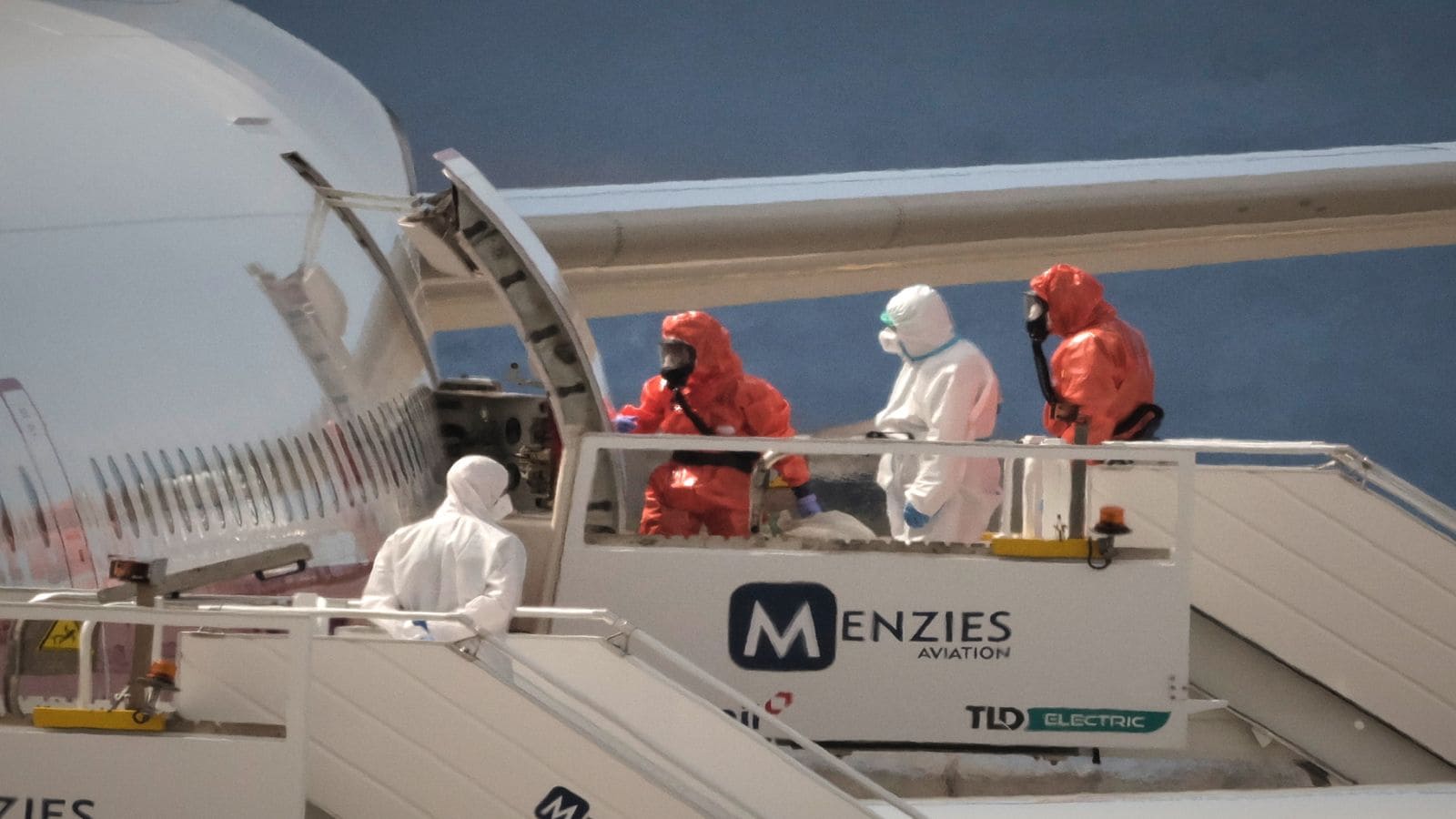
The conflation of the 2020 SARS-CoV-2 pandemic with localized viral outbreaks creates a false equivalence that distorts public health risk assessments and operational responses. While "outbreak" remains a high-variance term in public discourse, the structural mechanics of Hantavirus Pulmonary Syndrome (HPS) and its counterparts in the Bunyaviridae family operate on a transmission logic fundamentally different from respiratory aerosols. To manage the current cruise ship scenario, one must decouple the psychological trauma of global lockdowns from the biological reality of rodent-borne pathogens. The failure to distinguish between $R_0$ (the basic reproduction number) and environmental exposure rates leads to either catastrophic under-reaction or economically ruinous over-correction.
The Transmission Bottleneck: Why $R_0$ Approaches Zero
The primary driver of the COVID-19 pandemic was sustained human-to-human transmission via respiratory droplets and aerosols. Hantaviruses, specifically those found in the Americas such as the Sin Nombre virus, are characterized by a "dead-end host" profile in humans.
Pathogen Transfer Dynamics
Hantavirus transmission requires the inhalation of aerosolized virus particles from the excreta (urine, feces, saliva) of infected rodents, typically of the Sigmodontinae subfamily. Unlike the high viral shedding observed in the upper respiratory tracts of COVID-19 patients, Hantavirus primary infection occurs deep in the pulmonary endothelium. The virus targets the capillaries rather than the mucosal surfaces of the throat or nose.
Because the virus is not typically present in the upper airway of an infected human, the mechanical action of coughing or speaking does not facilitate secondary transmission. The rare exception is the Andes virus in South America, which has shown limited human-to-human capacity, but this remains an epidemiological outlier. On a cruise ship—a closed environment—the risk is not a "superspreader" passenger, but a localized "point-source" environmental contamination.
The Three Pillars of Cruise Ship Biosafety
Managing an outbreak in a maritime environment requires a shift from contact tracing (human-centric) to environmental forensics (vector-centric). The strategy must be anchored in three specific domains of intervention.
1. Vector Mapping and Exclusion
The presence of Hantavirus on a vessel indicates a breach in the Integrated Pest Management (IPM) system. Rodents do not spontaneously appear; they enter through supply chains or port-side moorings. The analytical focus must shift from the sick bay to the ship’s "hot zones":
- Dry Provision Storage: High-density food sources that attract rodents.
- HVAC Plenums: Air handling units can distribute aerosolized particles if nesting occurs within the ductwork.
- Void Spaces: The interstitial areas between bulkheads where rodent pathways are established.
2. Environmental Degradation of Viral Load
Hantaviruses are enveloped viruses. This structural reality makes them highly susceptible to environmental stressors. They are lipid-bilayer dependent; once that envelope is disrupted, the virus loses infectivity.
- UV-C Exposure: Effective for surface sterilization in common areas.
- Oxidizing Agents: Chlorine-based solutions or hydrogen peroxide vapors are necessary for deep-cleaning void spaces.
- Humidity Control: Low-humidity environments can increase the rate of particle aerosolization, whereas high-humidity environments may accelerate the degradation of the viral envelope under certain temperature profiles.
3. Clinical Triage and the Pulmonary Gap
The clinical challenge lies in the "prodromal phase." Early Hantavirus symptoms—fever, myalgia, and headache—are indistinguishable from common influenza or even seasickness. However, the progression to Hantavirus Pulmonary Syndrome (HPS) is rapid, often occurring within 24 to 48 hours of initial symptoms.
The diagnostic delta between a standard viral infection and HPS is the sudden onset of pulmonary edema and myocardial depression. Ships must utilize on-board lactate monitoring and pulse oximetry to identify early-stage capillary leak syndrome before the patient requires mechanical ventilation, which is often unavailable in standard shipboard medical facilities.
Quantifying the Risk: Environmental vs. Biological
The risk function of Hantavirus is a product of exposure duration and particle density ($R = D \times P$). In a cruise ship setting, $D$ is limited by the duration of the voyage, but $P$ can be high if a nesting site is disturbed near a ventilation intake.
The Mortality Rate Distortion
Public anxiety is often fueled by the high Case Fatality Rate (CFR) of Hantavirus, which can exceed 35%. While this figure is significantly higher than the 1-3% CFR seen in various waves of COVID-19, the absolute risk remains lower because the probability of infection ($P_i$) is tied to specific rodent contact rather than general proximity to other humans.
A data-driven response acknowledges that while the individual outcome of an infection is severe, the population-level risk on the ship is contained to those who accessed the specific contaminated zone. Mass quarantine of passengers in their cabins—a hallmark of early 2020 responses—is an irrational strategy for a non-contagious pathogen. It provides zero reduction in risk if the source of the virus is the ship’s internal ventilation system.
Structural Failures in Maritime Supply Chains
The root cause of such an outbreak is rarely a failure of medical screening; it is a failure of logistics. The maritime industry operates on a Just-In-Time (JIT) provisioning model. When ships take on thousands of pounds of fresh produce and dry goods in diverse global ports, the risk of "hitchhiking" vectors increases.
Hardening the Perimeter
- Palletized Inspection: Implementing thermal imaging or rodent-sniffing sensors at the point of loading.
- Sonic Deterrents: Utilizing high-frequency acoustic barriers at gangways and mooring lines to prevent rodent ingress from piers.
- CO2 Monitoring in Storage: Elevated carbon dioxide levels in sealed storage areas can indicate the presence of mammalian pests.
The Economic Cost of Miscommunication
The cruise industry is hyper-sensitive to "outbreak" headlines. The standard PR move—urging calm—often fails because it lacks the technical depth to reassure a sophisticated public. Transparency regarding the specific strain and the localized nature of the threat is the only way to prevent a total collapse in bookings.
When health officials state "this is not COVID," they must provide the structural "why." Explaining the lack of human-to-human transmission and the specific requirements for viral aerosolization shifts the narrative from a "plague ship" to a "maintenance failure." The former is a terrifying, uncontrollable force; the latter is a solvable engineering and sanitation problem.
Strategic Operational Protocol
The immediate response for the vessel operator involves a three-stage escalation:
- Isolate the Plenum: Identify the air-handling unit (AHU) serving the area where the infected individual spent the most time. Shutdown and disinfect the filters and coils using a 10% bleach solution or an equivalent EPA-registered disinfectant.
- Vector Forensic Audit: Deploy non-toxic tracking powders to map rodent movement patterns within the ship’s infrastructure. This identifies the "nexus" of the infestation rather than just killing individual pests.
- Serum Surveillance: While human-to-human transmission is unlikely, conducting rapid-response serological testing on "high-contact" crew members (housekeeping and maintenance) serves as a sentinel system to ensure the exposure was limited to the index case.
The final strategic pivot must be the integration of epidemiological surveillance into the ship’s existing Safety Management System (SMS). Rather than treating Hantavirus as a "black swan" event, it must be categorized as a high-consequence, low-probability failure of the environmental containment system. Future vessel designs should move toward seamless bulkhead construction and centralized, HEPA-filtered HVAC systems that can be isolated by zone to prevent the distribution of any aerosolized biological agent, regardless of its source.