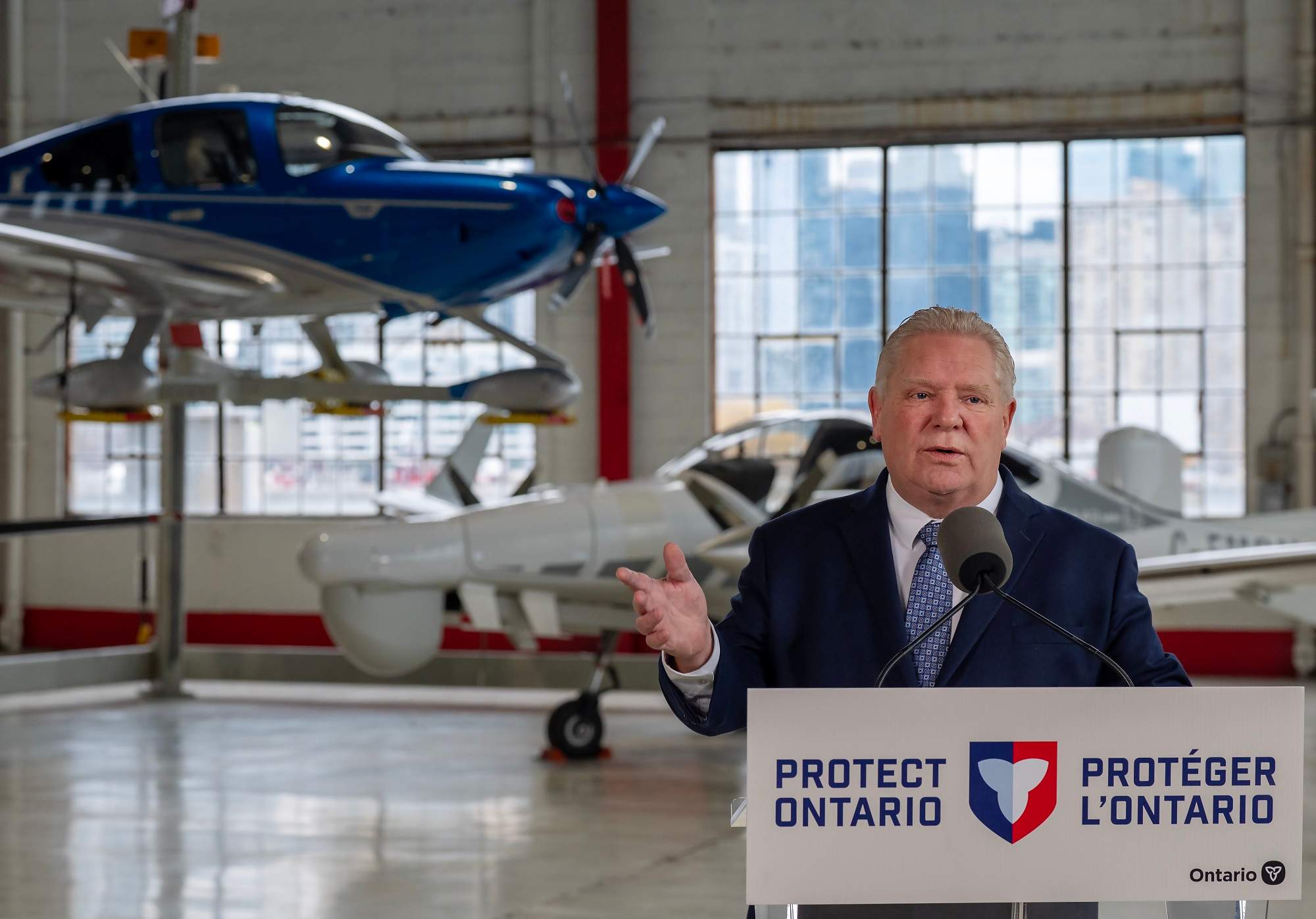
The procurement of private aviation for government officials represents a classic friction point between operational efficiency and political optics. When evaluating the $200,000 in incremental costs associated with Premier Doug Ford’s use of private jet travel, the debate often collapses into a binary argument regarding taxpayer entitlement versus security requirements. This reductionist view ignores the underlying logic of high-stakes logistics. To understand why these costs occur, one must apply a rigorous framework to the trade-offs between government-owned assets, commercial logistics, and the specific cost-drivers of private aviation chartering.
The Triple Constraint of Executive Transit
Executive mobility is governed by three competing variables: security, speed, and cost. In the context of the Ontario Premier’s travel, the $200,000 expenditure is not a single line item but the output of a specific "Cost Function of Availability."
- Security and Continuity of Operations: Commercial aviation introduces uncontrollable variables, including public exposure and reliance on third-party schedules. In a government context, "dead time"—hours spent in security lines or waiting for delayed commercial flights—represents an opportunity cost of executive leadership.
- Geographic Reach: Ontario’s landmass presents a unique logistical challenge. The efficacy of a centralized government depends on its ability to project presence in remote or underserved regions where commercial routes are either non-existent or infrequent.
- Emergency Readiness: Private assets allow for immediate redirection. If a crisis emerges mid-transit, a chartered vessel can be diverted; a commercial vessel cannot.
The $200,000 in "extra" costs identifies a premium paid for the elimination of these variables. However, the controversy persists because the government failed to justify this premium using a standardized ROI model for executive time.
The Mechanics of Private Aviation Cost Structures
Critics often frame the $200,000 as "waste," but from a procurement perspective, it is more accurately described as a "spot-market premium." Private aviation costs are generally broken down into three tiers:
- Fixed Costs: Hangarage, insurance, and crew salaries. These exist regardless of whether the plane flies.
- Variable Operational Costs: Fuel, landing fees, and catering.
- Positioning Fees (Deadhead Miles): This is the primary driver of unexpected costs. If a jet is chartered to fly the Premier from Toronto to a northern community, the government must often pay for the aircraft to return to its base empty, or for a separate aircraft to fly to the destination to pick him up.
When the government lacks its own fleet—or when the existing fleet (such as the Ornge medevac planes or the provincial King Airs) is diverted to primary missions—they enter the private charter market. The private market is subject to dynamic pricing. High demand, fuel surcharges, and short-notice bookings create a "surge" effect. The $200,000 figure suggests a pattern of short-term, reactive procurement rather than a long-term, leased-hour strategy.
The Opportunity Cost Fallacy
A frequent criticism is that the Premier could have flown "for a fraction of the cost" on a commercial airline. This argument relies on the assumption that an executive’s time is valued at zero.
If we model the Premier’s role as the CEO of a $200 billion "corporation" (the Province of Ontario), we can calculate a Shadow Price of Time ($S_t$). If commercial travel adds 6 hours of transit time per trip due to layovers and security, and the executive makes 20 such trips a year, the government loses 120 hours of peak-level decision-making capacity. In a corporate environment, if $S_t$ exceeds the hourly cost of a charter, the charter is the rational choice.
The political failure here is not the expenditure itself, but the lack of a transparent Time-Value Metric. Without a public-facing framework that explains how much the Premier's hour is worth, any expenditure above the price of an economy-class ticket appears as an indulgence rather than an optimization.
Structural Inefficiencies in Provincial Fleet Management
The reliance on $200,000 in third-party charters points to a mismatch between the province’s current aviation assets and its operational needs. Ontario maintains a fleet for natural resources and medical emergencies, but these assets are specialized.
- Mission Creep: Using medevac-configured planes for executive transport is politically risky and operationally inefficient due to the need for reconfiguration.
- Maintenance Windows: As government fleets age, their "Down-Time Ratio" increases. When a provincial plane is grounded for maintenance, the government is forced into the spot market, where they have zero bargaining power.
- Lack of Fractional Ownership: Many large organizations mitigate the cost of private travel through fractional ownership or "jet cards," which lock in hourly rates. The current data suggests the Ontario government is paying "retail" prices for a "wholesale" need.
The Agency Problem in Public Spending
The "Agency Problem" occurs when an agent (a politician) makes decisions on behalf of a principal (the taxpayer). Because the agent does not bear the cost of the decision personally, there is an inherent risk of over-consumption.
In this specific case, the $200,000 becomes a symbol of "lifestyle inflation" because there is no clear boundary for when private travel is mandatory versus when it is a preference. A rigorous strategy for government travel would require a Decision Matrix for Aviation Procurement:
- Distance Threshold: Is the destination more than 400km away?
- Commercial Availability: Are there more than three commercial flights per day to the destination?
- Party Size: Does the cost-per-seat of a charter drop below 2x commercial rates when the full staff is included?
- Security Threat Level: Does the mission involve sensitive briefings that cannot occur in a public cabin?
The absence of such a matrix allows critics to fill the vacuum with narratives of elitism.
The Governance Gap: Reporting and Oversight
The standard for reporting executive travel in Ontario is currently focused on the amount spent rather than the utility gained. This is a fundamental flaw in public accounting. To move beyond the cycle of "lambasting" and "defending," the reporting structure must change.
The $200,000 in question is a trailing indicator. The leading indicator is the Logistical Efficiency Ratio (LER). This ratio would compare the total cost of a trip (including staff time and travel expenses) against the alternative of commercial travel. If the LER is documented and justified before the flight, the political "scandal" is neutralized by data.
Instead, the current system relies on retroactive disclosure, which invites scrutiny only after the money is gone. This creates a permanent state of defensive communication.
Re-Engineering the Executive Mobility Strategy
To resolve the tension between fiscal responsibility and executive necessity, the provincial government must pivot from a reactive procurement model to a structured aviation strategy.
- Establish a Shadow Price for Executive Time: Define the hourly value of the Premier and Cabinet members to justify the use of private assets.
- Standardize the Fleet Strategy: Conduct a "Make vs. Buy" analysis. Is it more cost-effective to maintain a dedicated executive transport aircraft with lower operational costs (like a PC-12), or to continue paying spot-market premiums for private jets?
- Implement a Public-Facing "Necessity Audit": Every non-commercial flight should be accompanied by a brief justifying the choice based on the Decision Matrix mentioned above.
The current controversy over $200,000 is not actually about the money; it is about the perception of a breakdown in the social contract. By failing to provide a rigorous, data-driven defense of these expenditures, the administration allows a necessary tool of modern governance to be characterized as a luxury. The strategic move is not to stop flying private, but to start treating government aviation as a logistics problem to be solved rather than a secret to be kept.
Identify the current average cost-per-hour for private charters in the Great Lakes region and compare this against the total cost of ownership (TCO) for a small-cabin turboprop. Transition the Premier's travel to a high-efficiency, low-optics platform like a Pilatus or a Beechcraft King Air. These aircraft provide the necessary geographic reach and security while significantly lowering the fuel burn and landing fees compared to the mid-sized jets that typically trigger $200,000 overages. Documentation of this shift, framed as "The Mobility Efficiency Initiative," would convert a liability into a demonstration of operational discipline.

:max_bytes(150000):strip_icc():focal(819x186:821x188)/Murdaugh-Family-e90854a716884d608fb6fd925e18d840.jpg)
