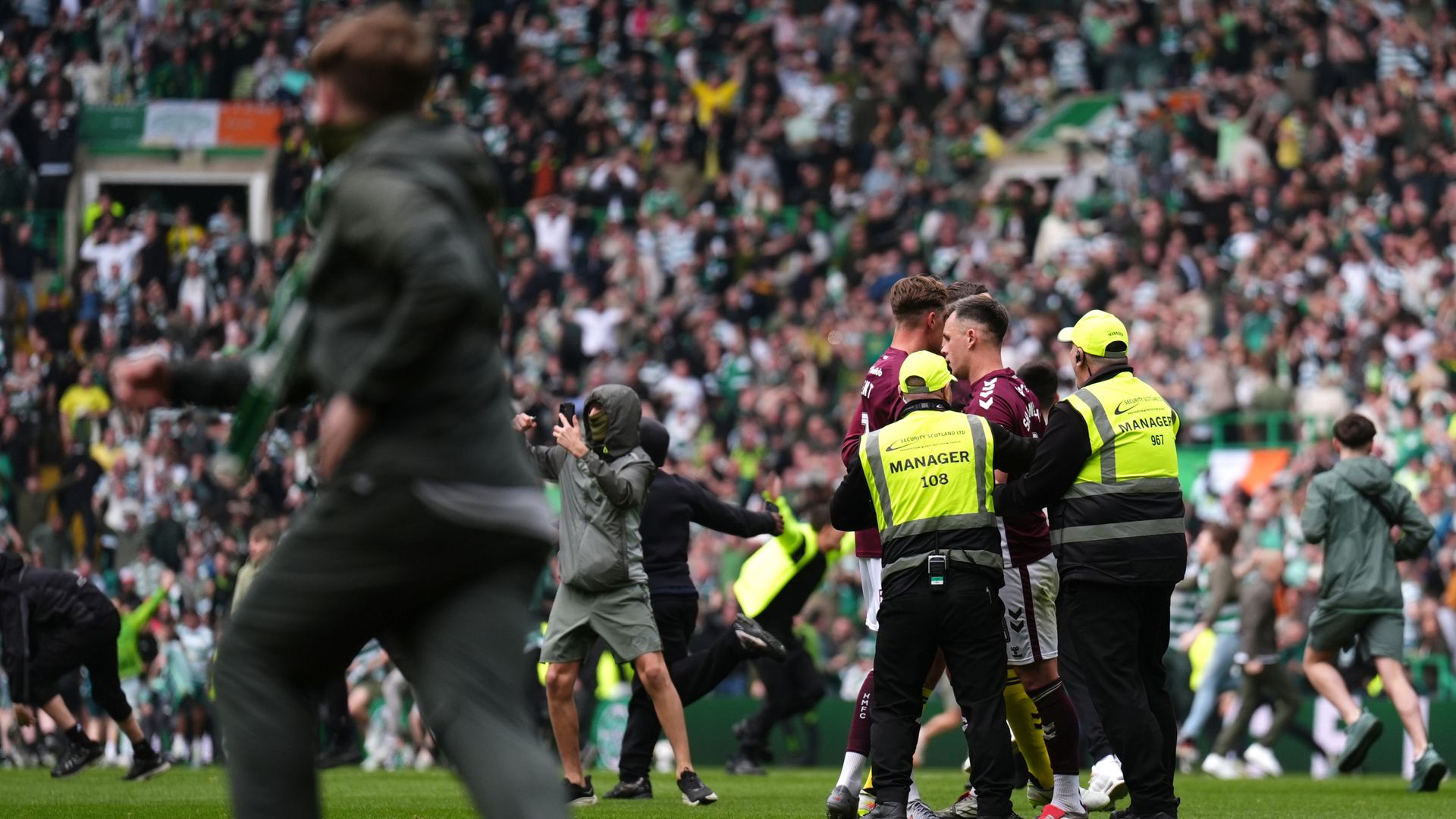
The grass of a football pitch is supposed to be sacred. For ninety minutes, it is a stage where theater unfolds, bounded by white lines that act as a barrier between ordinary life and athletic myth. But when the final whistle blew at a recent Celtic match, those lines dissolved.
Imagine standing in the shoes of a stadium steward. You are wearing a high-vis jacket that offers zero physical protection. You are paid just above minimum wage to stand with your back to the game, watching a wall of thousands of roaring faces. Suddenly, the air changes. A collective surge overpowers the metal barriers. The roar shifts from a celebration of sport to a chaotic rumble of moving bodies.
Feet pound the turf. Flares ignite, choking the air with thick, acrid green smoke. In the blur, a steward is knocked to the ground. A player, moments ago a hero, is suddenly surrounded by frantic strangers grabbing at his jersey, his eyes scanning for an exit route.
This isn't just fandom overflowing. It is a flashpoint. And it has pushed Scotland’s political leadership to the brink of changing the game forever.
The Breaking Point of the Beautiful Game
For decades, the pitch invasion was viewed with a sort of nostalgic leniency. It was the ultimate expression of raw joy—the spontaneous eruption of a fanbase capturing a title or surviving relegation. We all remember the grainy footage from the twentieth century: fans carrying players on their shoulders, a sea of smiles, a harmless tradition.
But tradition has curdled into something volatile.
The recent disorder involving Celtic supporters has forced a cold, hard reassessment of what happens when the crowd claims the pitch. It wasn't just a celebratory jog; it was a chaotic breach that left safety officials compromised, stadium property damaged, and the thin veneer of matchday security completely shredded.
Consider the sheer physics of a crowd surge. When hundreds of people move as a single, pressurized wave toward a single point, human agency vanishes. If you trip, you don't get back up. If you are a player caught in the center, you are entirely at the mercy of the crowd's collective mood, which can turn from ecstatic to aggressive in a heartbeat.
Scotland's First Minister has looked at this escalating risk and signaled that the government’s patience has finally run out. The message is clear: the current system of fines for clubs and stadium bans for individuals is no longer working as a deterrent. The state is preparing to step in with the heaviest hammer it possesses.
The Looming Threat of the Criminal Record
Right now, running onto a football pitch in Scotland can get you ejected, banned by the club, or charged under general breach of the peace or public order laws. But the government is now openly considering the creation of a specific, standalone criminal offense for pitch invasions.
To understand what that means, look past the immediate drama of the stadium lights and consider the morning after.
Let us look at a hypothetical fan. Call him Craig. Craig is twenty-two, works an entry-level job in logistics, and holds a season ticket he inherited from his father. In a moment of pure, adrenaline-fueled euphoria after a late winner, Craig mimics the people around him. He leaps the advertising boards. He runs twenty yards onto the pitch, slides on his knees, and gets dragged away by security. He didn't hurt anyone. He didn't throw a flare. He just wanted to touch the grass.
Under a strict new legislative framework, Craig doesn't just get a stern lecture and a twelve-month ban from the stadium. He gets handcuffs. He gets a day in court. He gets a criminal record.
Suddenly, Craig’s life trajectory alters over a five-second rush of blood to the head. That logistics job? Gone, because his employer requires a clean background check. That summer trip to the United States he was saving for? Denied at the visa border. The coaching license he wanted to get to train his nephew’s local youth team? Blocked.
The First Minister’s openness to criminalization is a direct attempt to force fans to make this exact mental calculation before their boots hit the turf. The state wants the penalty to be so severe that the risk becomes unthinkable. But it raises a deeper, more unsettling question: are we using a sledgehammer to fix a problem that requires a scalpel?
The Invisible Burden on the Clubs
When a pitch invasion happens, the public immediate looks at the fans who crossed the line. But the financial and operational fallout lands squarely on the shoulders of the football clubs themselves.
The football ecosystem relies on a delicate balance of trust between local authorities, the police, and the clubs. When disorder spikes, that trust fractures.
- Skyrocketing Policing Costs: When a fixture is deemed high-risk due to past crowd behavior, local police forces demand a much higher presence inside and outside the ground. The clubs must foot this bill. For smaller clubs in the league, a massive spike in policing costs can wipe out the matchday profit margin entirely.
- The Threat of Closed-Door Matches: If standard penalties fail, football governing bodies possess the nuclear option: forcing clubs to play behind closed doors. An empty stadium means zero ticket revenue, zero hospitality sales, and a hollowed-out spectacle that damages television broadcast value.
- Structural Retrofitting: To prevent fans from breaching the pitch, clubs are faced with the grim prospect of altering their stadiums. This means higher fences, netting, or deeper security moats. It transforms a place of community into something resembling a low-security correctional facility.
The clubs find themselves trapped in an impossible vice. They are desperate to maintain the vibrant, passionate atmosphere that makes British football a global product, yet they are legally responsible for the safety of every soul inside the concrete walls. They cannot control the individual impulses of 60,000 people, yet they are the ones who will pay the ultimate price if the government decides the sport cannot police itself.
The Human Cost Behind the High-Vis
We often talk about football violence in the abstract, analyzing it through the lens of governance, politics, and team rivalries. We forget the people who actually occupy the space between the stands and the pitch.
Talk to the paramedics who sit in the tunnels, waiting for the worst to happen. Talk to the stewards, many of whom are university students or retirees looking for a bit of extra income. They do not sign up to be human shields against a stampede.
When a pitch invasion occurs, the immediate reaction of the television cameras is often to pan away, cutting to a wide shot of the stadium or going to a commercial break to avoid glorifying the behavior. But on the ground, the reality is a chaotic mess of sensory overload. The smell of sulfur from pyrotechnics blocks out the cold night air. The sound is deafening—a mix of sirens, shouting, and the metallic clatter of overturned barriers.
The psychological toll on stadium staff is real. When a workplace can transform into a riot zone within thirty seconds, the nature of the job changes. Turnstiles become anxiety triggers. The joy of working within the sport fades, replaced by a cynical, exhausting vigilance.
If the government moves forward with criminalization, it isn't to protect the billionaires who own the clubs or the pristine condition of the hybrid grass. It is to protect the person standing on the touchline with a radio clipped to their belt, wondering if they will get home to their family without an injury.
The Soul of the Terrace
There is a unique tragedy to this entire debate. The very thing that makes football the most popular sport on earth is its capacity for unbridled, overwhelming emotion. It is a secular religion where the ordinary rules of emotional restraint are temporarily suspended. You are allowed to scream, cry, and embrace strangers in a way that society forbids anywhere else.
But that intensity is a double-edged sword.
When the First Minister talks about criminalizing the act of stepping onto the pitch, there is a palpable fear among traditional matchgoers that the sport is being sanitized beyond recognition. They see it as another step toward a sterile, corporate environment where fans are treated as consumers to be managed rather than the lifeblood of the institution.
The tension is real, and the solution is far from simple. If the law changes, the defining image of a historic victory will no longer be a joyous pitch invasion celebrating a historic treble or a miraculous escape from relegation. Instead, it will be the sight of police officers lining the touchline, handcuffs ready, waiting for anyone brave—or foolish—enough to cross the white line.
The white lines on the pitch used to be a boundary for the players. Now, they are becoming a frontier for a legal battlefield that could redefine the matchday experience for generations to come. The game is changing, and the price of admission might soon include your freedom.
:max_bytes(150000):strip_icc():focal(749x0:751x2)/king-charles-coronation-portraits-050823-1-cee933616cd042eab8c220c3ab689cef.jpg)