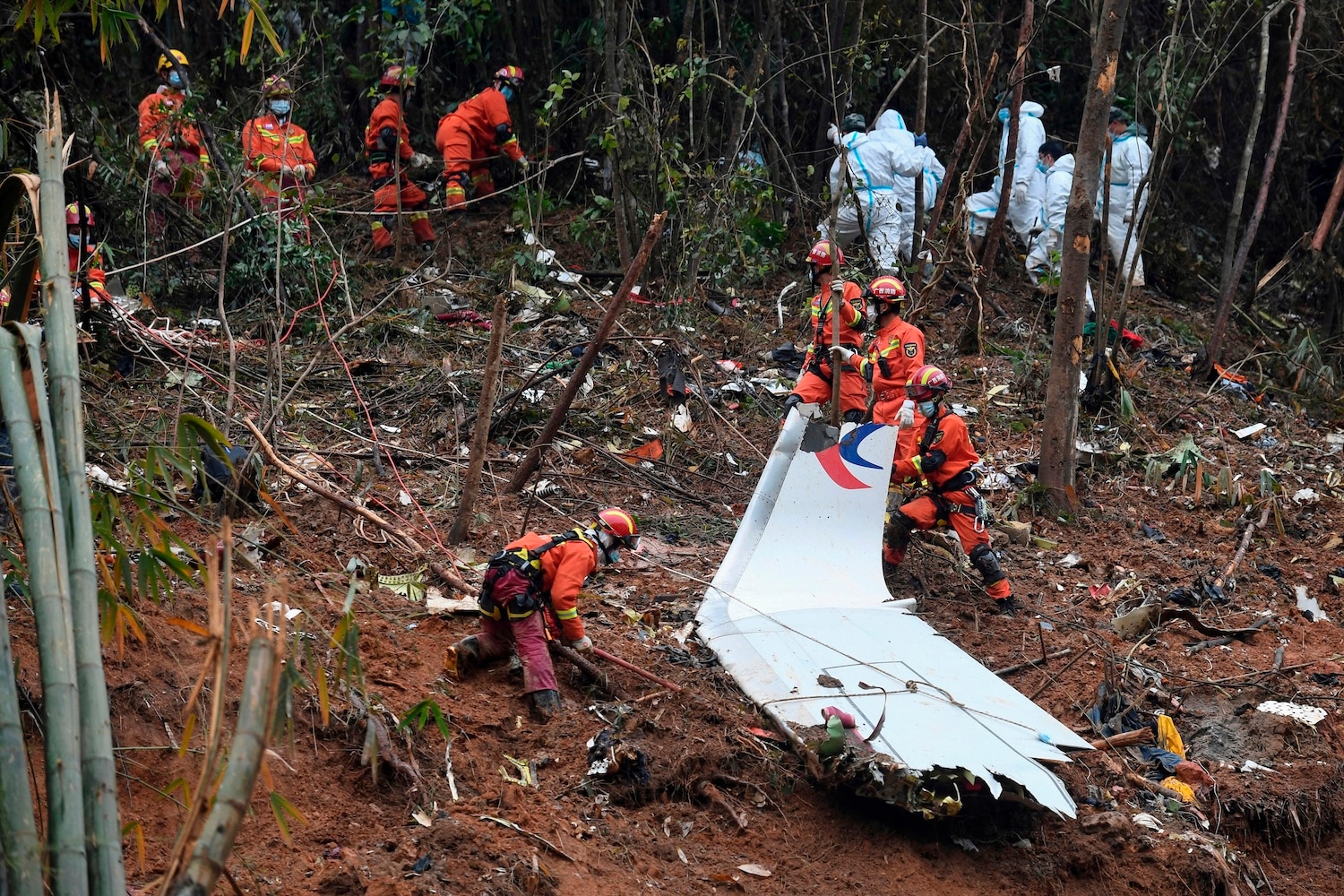
The black boxes found in the wreckage of China Eastern Airlines Flight MU5735 didn't just record the final moments of 132 lives. They recorded the death of a comfortable industry lie.
Media outlets scrambled to report on a "cockpit struggle" or "intentional input." They painted a cinematic picture of a hero fighting a villain for control of a Boeing 737-800. It’s a neat, digestible narrative. It’s also largely a fantasy that ignores how modern flight decks actually function.
When a plane pointed its nose toward the earth and accelerated into a near-vertical dive from 29,000 feet, the "struggle" wasn't necessarily a physical wrestling match over a yoke. It was the terminal failure of a system that assumes the person in the seat wants to live.
The Flaw in the Dual-Control Logic
Aviation safety is built on the bedrock of redundancy. Two engines. Three hydraulic systems. Two pilots. But there is a massive, unspoken vulnerability in the Boeing 737 architecture: the interconnected control columns.
Unlike Airbus, which uses "side-sticks" that can operate independently (and provide an audible "dual input" warning when both pilots move them), the 737 uses a mechanical yoke system. If one pilot pushes forward and the other pulls back, they feel each other’s force. The "struggle" isn't a data point; it’s a physical reality of the hardware.
The industry consensus is that "more data" from the flight recorders will clarify the intent. That’s a mistake. Intent is a psychological state; the data only shows the mechanical result. If the flight recorders show conflicting inputs, the media calls it a fight. In reality, it represents the total collapse of the Crew Resource Management (CRM) philosophy.
CRM was designed to stop "God-complex" captains from flying planes into mountains while junior officers watched in silence. It wasn't designed for a scenario where the controls themselves are used as weapons. We have spent forty years perfecting how pilots talk to each other. We have spent zero years designing a system that can effectively lock out a rogue actor in the cockpit.
The Intentionality Trap
Let’s look at the physics of the MU5735 crash. The aircraft was cruising at 29,000 feet. It didn't drift down. It didn't stall. It didn't break apart in mid-air due to a structural flaw. It transitioned from level flight to a vertical dive.
Gravity doesn't do that to a stable aircraft. Aerodynamics actively fight that movement. To keep a Boeing 737 in a vertical dive, you have to hold it there. You have to fight the plane's natural urge to level its wings and pull its nose up.
The "lazy consensus" suggests we need better mental health screening for pilots. This is a band-aid on a bullet wound. Screening is a snapshot in time; human psychology is a fluid, high-pressure environment. I’ve sat in rooms with safety investigators who admit, off the record, that the "human factor" is the one variable they cannot engineer out, yet the industry refuses to discuss the logical conclusion: total automation or remote override.
Why Remote Override is the Taboo We Need
Mention "remote control" to a commercial pilot and they will tell you it's a security nightmare. They’ll talk about hacking, signal jamming, and the "sanctity of the cockpit."
They are wrong.
We already trust fly-by-wire systems to interpret pilot inputs through a computer filter. We already trust automated landing systems in zero-visibility conditions. The technology to take control of an aircraft from the ground—to force it into a "protected" flight mode that prevents steep dives or excessive speeds—already exists. It’s used in high-end military drones and experimental safety craft.
The reason we don't have it on a 737 or an A320 isn't because of technical limitations. It’s because of the liability. If a ground-based pilot overrides a plane and it still crashes, who pays? If an AI prevents a pilot from making a necessary, non-standard maneuver, who is at fault?
The industry would rather accept the statistical anomaly of a "cockpit struggle" every few years than open the legal Pandora's box of remote intervention. They are trading lives for predictable insurance premiums.
The Myth of the "Inexplicable"
News reports often use the word "inexplicable" when discussing the 2022 China Eastern crash. This is a linguistic shield. It implies that without a suicide note or a clear manifesto, we can't know what happened.
We know exactly what happened. The kinetic energy required to vaporize an aircraft into a 65-foot deep hole in a mountainside requires sustained, deliberate force.
The Boeing 737-800 is a "Generation 3" aircraft. It is one of the safest machines ever built by human hands. It does not simply "fall." When the data shows a brief recovery—a momentary pull-up before the final plunge—people want to believe it was a struggle for the soul of the aircraft.
Imagine a scenario where that recovery wasn't a struggle at all, but a momentary hesitation by a single actor, or a mechanical reaction to extreme speeds. By framing every tragedy as a "mystery" or a "struggle," we avoid the terrifying truth: the cockpit is a room where two people have absolute power over hundreds, and we have built no digital "nanny" to stop them from using it.
The Failure of Transparency
The CAAC (Civil Aviation Administration of China) has been criticized for its "slow" reporting. But more reports won't change the outcome. The preliminary data already pointed to the truth. The flight path was an anomaly that no mechanical failure could replicate.
When an engine fails, you glide. When a rudder jams, you roll. When you dive vertically at Mach 1, you are being driven.
The aviation industry’s obsession with "finding the cause" is often a distraction from "fixing the vulnerability." If the cause is "human intent," the industry sighs with relief because it means the planes aren't broken. It’s the ultimate "not my department" defense.
But if the human is part of the system, and the human fails, the system is broken.
Stop Asking "Why" and Start Asking "How"
People ask: "Why would a pilot do this?"
That is a question for a therapist. It is useless for safety.
The real question is: "How was the aircraft allowed to execute the command?"
Modern cars have lane-assist that vibrates the wheel if you drift. They have automatic emergency braking if you're about to hit a wall. Yet, a $100 million jet will happily allow a human to fly it directly into the ground at 600 miles per hour without the software saying "No."
The "cockpit struggle" in China wasn't just between two or three people in a small room. It was a struggle between an antiquated 20th-century philosophy of "pilot in command" and the 21st-century reality that humans are the most unreliable component in the machine.
We don't need more "data points" from Flight MU5735. We need to stop pretending that a pilot’s authority should be absolute. Until the plane itself has the power to reject a suicidal command, the black boxes will keep recording the same "inexplicable" tragedies.
The struggle didn't happen because one pilot was "bad." The struggle happened because the airplane was too "obedient."
Get the human out of the loop or give the loop a way to bypass the human. Everything else is just noise for the evening news.
The 132 people on that flight didn't die because of a mystery. They died because we haven't yet found the courage to tell pilots that we no longer trust them implicitly. We are still flying with a 1950s mentality in a world of 2020s risks.
Stop looking for a fight in the cockpit and start looking for the "off" switch for human error. It’s there. We’re just too afraid to flip it.