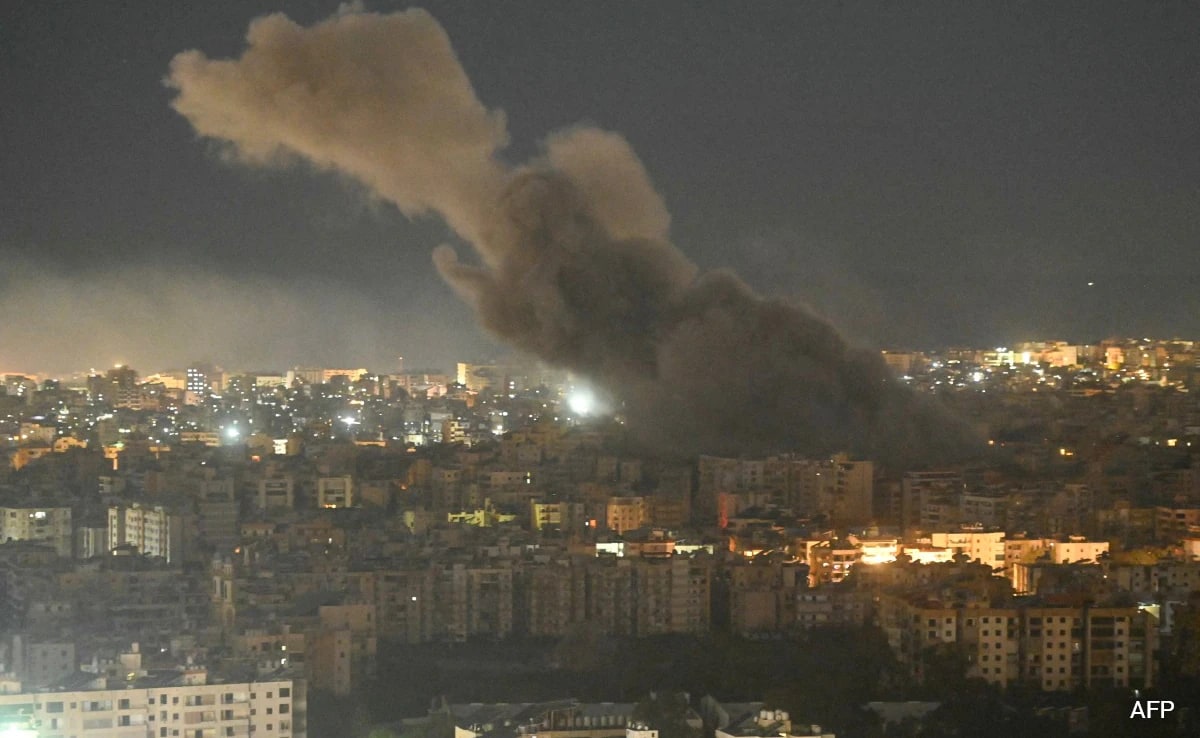
The silence in Beirut does not sound like peace. It sounds like a held breath.
For months, the rhythm of daily life in the Levant has been dictated by the sky. You learn to listen for the specific, metallic drone of unmanned aircraft. You learn to calculate the distance of a thud by the rattle of your kitchen windows. But on a Tuesday afternoon, a different kind of noise rippled through the cafes of Hamra and the concrete corridors of Tyre. It was the sound of phones buzzing simultaneously, carrying a message from Washington that translated roughly to this: you have forty-five more days to live outside the shadow of total ruin. For a different perspective, check out: this related article.
The United States government confirmed the extension of the ceasefire between Israel and Lebanon. Forty-five days. To a diplomat in a tailored suit sitting in a climate-controlled room in D.C., forty-five days is a standard bureaucratic increment, a neat line item on a regional stability report.
To a mother in southern Lebanon looking at the skeletal remains of her olive grove, or a family in northern Israel wondering if they can finally unpack the suitcases that have sat by their front door for a year, forty-five days is an eternity. And it is nothing at all. Related insight on the subject has been provided by Al Jazeera.
This is the human math of a modern truce. It is a fragile, conditional grace period bought with backchannel memos and frantic late-night phone calls, dropped onto a landscape where trust was buried decades ago.
The Anatomy of an Added Month
To understand how we arrived at this temporary reprieve, we have to look past the sterile language of official press releases. When the initial cessation of hostilities was brokered, critics called it a band-aid on an open artery. They were right. But sometimes a band-aid is the only thing keeping a patient from bleeding out before they reach the operating table.
Consider a hypothetical shopkeeper in Nabatieh named Hadi. Hadi does not exist as a single person, but he represents thousands of merchants across the borderlands. For the past year, his business was a gamble against physics. Will a mortar hit the roof today? Will the supply trucks from the north make it through the mountain passes? When the first ceasefire was announced, Hadi did not celebrate. He simply walked to his storefront, wiped the grey dust off his remaining inventory, and opened the doors.
Now, with forty-five more days guaranteed, Hadi faces a strange, psychological dilemma. Do you reinvest? Do you buy the extra crates of produce, the expensive imported goods that take weeks to sell?
This is where geopolitical policy meets the kitchen table. The extension provides what economists call artificial stability. It allows the Lebanese army to continue its precarious deployment southward, attempting to establish a presence in areas long dominated by armed factions. It gives international observers time to calibrate their radar systems and write reports.
But for the people on the ground, it creates a cruel form of suspended animation. You cannot rebuild a house in forty-five days. You can only patch the roof with blue tarp and hope the wind does not pick up.
The Invisible Strings of Washington
The machinery behind this extension is fueled by a desperate kind of leverage. The American diplomatic corps has been working under the assumption that if you can keep the guns quiet long enough, the sheer exhaustion of war will do the heavy lifting.
It is a high-stakes gamble. The region is a web of interconnected tripwires. A single misfire by a nervous conscript on the border, a lone rocket launched by a rogue cell, or a political assassination in a neighboring capital can vaporize forty-five days of diplomacy in forty-five seconds.
We often view these conflicts through the lens of grand strategy—as a chess match between Washington, Jerusalem, Beirut, and Tehran. We talk about deterrence capabilities, security corridors, and sovereign mandates. But this macro-perspective obscures the gritty reality of enforcement.
Right now, Lebanese soldiers are moving into towns they haven't controlled effectively in a generation. They are driving vehicles paid for by foreign aid, eating rations supplied by international partners, and trying to project the authority of a state that is financially insolvent.
Across the blue line, Israeli communities remain ghost towns. The schools are empty. The fields are untended. The government in Tel Aviv faces immense internal pressure to ensure that the threat from the north is not just paused, but permanently neutralized. For them, forty-five days is not a victory; it is an agonizingly slow countdown during which the enemy might be rearming just beyond the hills.
The Weight of Uncertainty
Living inside a timed ceasefire changes the way the human brain processes time itself.
When you live in a stable society, time is linear. You plan for the next quarter, the next school year, the next vacation. When your life is governed by a forty-five-day extension, time becomes circular and frantic. You start prioritizing the immediate. You visit relatives you haven't seen because who knows where the roads will be next month. You buy non-perishable food not out of habit, but because the memory of empty shelves is still fresh in your throat.
It is an exhausting way to exist. The psychological toll of an uncertain peace can be weirder than the trauma of active conflict. In war, the adrenaline takes over. Survival is a series of binary choices: hide or run, stay or go. In a temporary peace, you are forced to navigate the agonizing grey zone of normalization. You watch children play in streets that were targeted a month ago, their laughter sounding unnervingly loud against the backdrop of quiet ruins.
The international community praises these extensions as monumental achievements. They point to the reduction in civilian casualties and the resumption of basic commercial transport. They are not wrong to do so. Every day without an airstrike is a day a child does not die. That matters. It is the only thing that matters.
But we must be honest about what this extension actually is. It is not peace. It is the absence of active slaughter. It is an agreement to delay the inevitable or a frantic scramble to prevent it, with no clear consensus on what the final destination looks like.
The Horizon at the End of the Clock
As the days begin to tick down from forty-five, the tension will inevitably rise again. The diplomatic cables will grow hotter. The rhetoric from political leaders on both sides will sharpen as they attempt to position themselves for whatever happens when the clock hits zero.
The true test of this period is not whether the silence holds today or tomorrow. The test is whether the diplomats can use this borrowed time to build something heavier than a paper promise. They need to construct a framework that addresses the core grievances that have turned this border into a generational slaughterhouse: the sovereignty of the Lebanese state, the security of Israeli citizens, and the disarmament of non-state actors who operate outside the law.
If they fail, this forty-five-day extension will be remembered merely as a brief intermission in a tragedy that has no final act.
Tonight, the Mediterranean breeze moves through the shattered windows of border villages, carrying the scent of salt water and old smoke. A generator sputters to life in the distance, providing a few hours of electricity to a family huddled around a television, waiting for the evening news. They do not look at the map of the region or the charts of military deployments. They look at the calendar on the wall, where a small, handwritten circle marks a date six weeks from now, waiting in the dark.