The air in the subway is never truly still. It is a thick, recycled breath, heavy with the scent of ozone and the metallic tang of screeching brake pads. Thousands of us stand on those concrete islands every morning, eyes glued to glowing screens, ears muffled by noise-canceling plastic. We are a community of strangers in a shared trance, tethered to the world only by the rhythmic digital ticking of the "minutes to arrival" sign. We trust the unspoken contract of the commute: I don't look at you, you don't look at me, and we all return home tonight.
Then, the contract is torn to shreds.
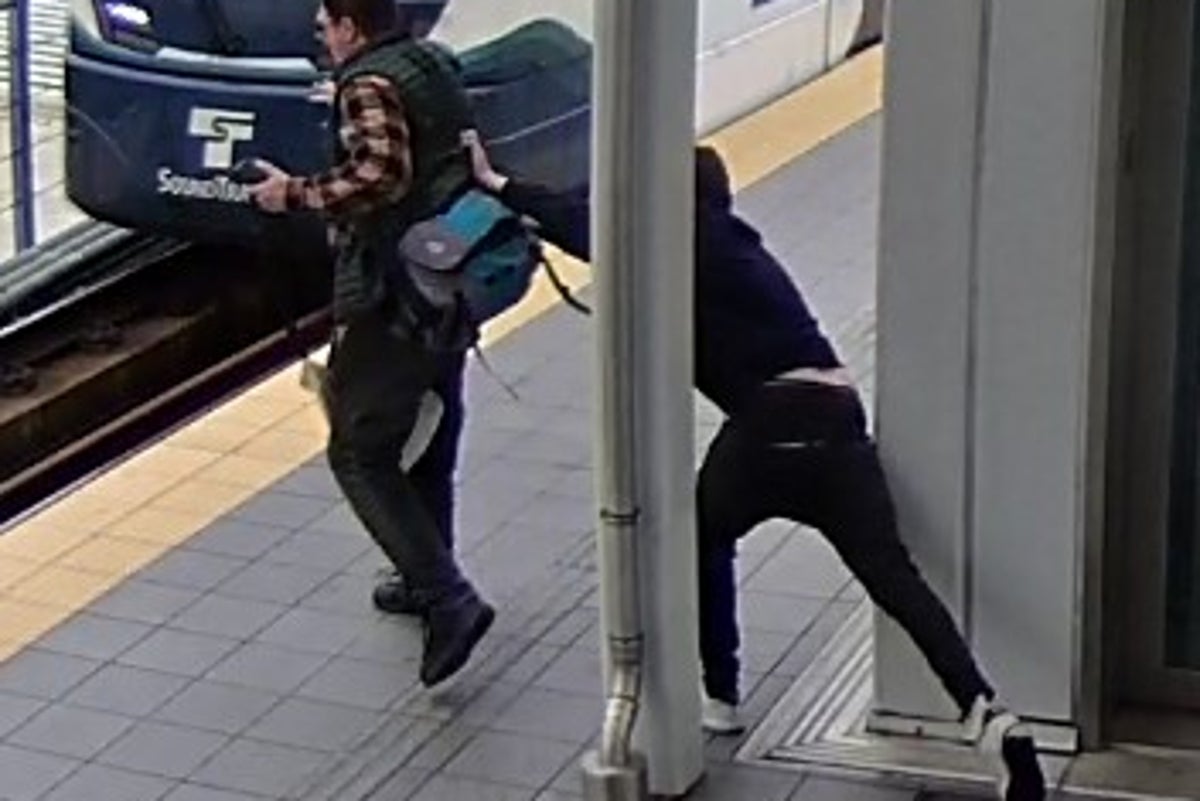
In a video that has since circulated with the viral speed of a nightmare, a man stands near the edge of the platform. He is unremarkable. He is every father, every office worker, every person who has ever checked their watch while wondering if they left the stove on. Behind him, a figure emerges from the shadows of the tile work. There is no argument. No shouted warning. Just a sudden, violent extension of arms.
A shove.
The physics of it are sickeningly simple. A human body, caught off guard, has no defense against momentum. One moment, the man is part of the morning rush; the next, he is falling into the dark gulch of the tracks, a space where the world ends in high-voltage rails and crushing steel.
The Anatomy of the Urban Shiver
We watch these clips through the safety of our glass displays, yet we feel a phantom jolt in our own spines. This isn't just about a crime; it is about the sudden evaporation of the "safe space." Psychologically, humans navigate the world using a series of invisible boundaries. We assume that the person standing three feet behind us is governed by the same social hardware that we are. We assume they have a conscience, a fear of consequences, and a basic thread of empathy that prevents them from extinguishing a life for no reason at all.
When that hardware fails in a stranger, it creates a ripple effect of hyper-vigilance.
Consider the "startle response." It is an evolutionary relic designed to keep us from being eaten by predators in the tall grass. In the modern city, that grass has been replaced by steel pillars and crowded stairwells. When we see a shove like this, our brains recalibrate. The next time you stand on that platform, you might find yourself leaning your back against a concrete wall. You might tuck your phone away. You might look over your shoulder, searching for the glitch in the crowd.
The Invisible Stakes of Transit Safety
The statistics tell a story of rare occurrences, but the human heart does not process data in percentages. While millions of people navigate subway systems globally every day without incident, the high-profile nature of unprovoked platform attacks highlights a growing tension in our urban centers. It is a tension between the necessity of public movement and the rising unpredictability of those left behind by social safety nets.
This isn't a problem that can be solved simply by adding more cameras. Cameras only record the tragedy; they do not catch the falling body.
Some cities have turned to physical barriers—floor-to-ceiling glass doors that only open when the train is perfectly aligned. It is a mechanical solution to a human problem. It turns the platform into a cage, protecting us from each other by admitting that the unspoken contract of the commute is officially dead. But the cost of retrofitting century-old tunnels is astronomical, often leaving the most vulnerable stations—the ones in the neighborhoods that need safety the most—at the bottom of the priority list.
The Ghost in the Machine
Who is the person who pushes?
We want them to be a monster. It’s easier that way. If they are a monster, we can pretend they are a different species entirely. But the reality is often more complex and far more unsettling. Frequently, these acts of "random" violence are the boiling over of long-simmering crises: untreated severe mental illness, the isolation of urban poverty, or a complete detachment from reality.
When a stranger creeps up on a platform, they aren't just attacking a man; they are attacking the very idea of the "public." They are the physical manifestation of a system that has frayed until the threads can no longer hold the weight of the people.
We talk about "situational awareness" as if it is a shield. We are told to keep our heads up and our eyes peeled. But there is a limit to how much awareness can do against a silent, unprompted assault. You can be the most vigilant person on the planet and still be at the mercy of the person standing behind you. That is the terrifying truth we try to bury under our podcasts and morning news feeds.
The Weight of the Aftermath
The man in the video survived. That is the miracle. But "survival" is a heavy word. It implies a continuation, but it rarely accounts for the change in the quality of that life. There is the physical trauma—the broken bones, the bruising, the possible contact with the third rail—and then there is the psychic scar.
How do you ever trust a crowded room again? How do you close your eyes in a public space without seeing that shadow lengthening behind you?
The bystander effect often gets blamed in these scenarios. We wonder why no one jumped in, why the crowd seemed to freeze. But the freeze is a biological imperative. It is the brain trying to reconcile a sight that should not exist. A man falling into the path of a train is a sensory overload that defies the logic of a Tuesday morning. By the time the brain says "help," the event is already history.
A New Way of Standing
The response to this shouldn't be a retreat into our shells, though the instinct is powerful. If we all stop using the subway, the city dies. If we all treat every stranger as a potential assailant, the community dies.
Instead, the conversation must shift toward a more aggressive form of urban empathy. It sounds counterintuitive—to be more empathetic in the face of violence—but the solution lies in addressing the ghosts before they reach the platform. It means demanding that the "invisible" people in our cities—the ones talking to themselves in the corner, the ones slipping through the cracks of the healthcare system—are seen and treated before their internal chaos turns external.
Safety is not just the absence of a shove. It is the presence of a functioning society.
Tomorrow, the sun will rise over the steel tracks. The turnstiles will click and hiss. The yellow line will sit there, a thin strip of paint that represents the boundary between a routine day and a life-ending fall.
We will stand there again. We have to. But perhaps we will stand a little differently. We might check our surroundings, yes, but we might also look at the person next to us with a new understanding of how much we rely on their humanity. We are all balanced on a very narrow ledge. The only thing truly keeping us from the tracks is the collective decision, made every single second by every single person in the crowd, to reach out a hand to help—or to simply do nothing at all.
The silence of the commute is no longer a vacuum. It is a choice.