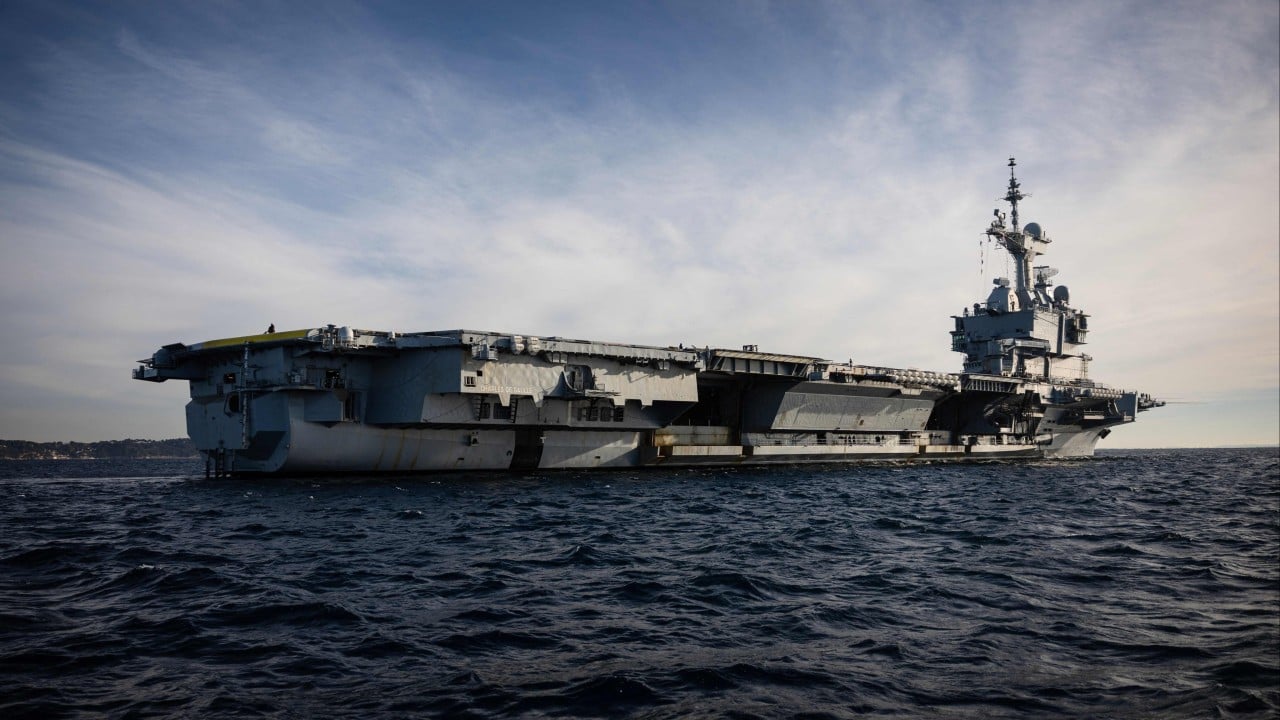
The deployment of the Charles de Gaulle, France’s only nuclear-powered aircraft carrier, to the Mediterranean is not a routine patrol. While official channels in Paris might frame the move as "strategic posturing" or a "contribution to regional stability," the reality is far more visceral. Emmanuel Macron is signaling that France refuses to be sidelined as the specter of a broader war with Iran looms. This is about maintaining the relevance of European hard power in a theater increasingly dominated by American hardware and Iranian proxies.
By moving the flagship of the Marine Nationale into striking distance of the Levant, France is attempting to create a "third way" of deterrence. It wants to show it can act independently of Washington while still anchoring the southern flank of NATO. This deployment places a massive, nuclear-propelled airfield—and its complement of Rafale M fighter jets—directly into the middle of the world’s most volatile maritime corridor.
The Weight of the Nuclear Option
The Charles de Gaulle is unique. Unlike the conventional carriers operated by the British or the Italians, it shares a common DNA with American supercarriers: nuclear propulsion. This allows the ship to remain at sea indefinitely, limited only by the endurance of its crew and the supply of aviation fuel for its jets. When Macron orders this specific vessel into a conflict zone, he is deploying a piece of sovereign French territory that can loiter off a coastline for months without needing to refuel.
This isn't just about the ship. It is about the Groupe Aéronaval (GAN). The carrier never travels alone. It is surrounded by a lethal ecosystem of destroyers, nuclear attack submarines, and replenishment tankers. This strike group creates a bubble of denial hundreds of miles wide. For Iran and its regional affiliates, the presence of the GAN complicates the math of escalation. Any miscalculation in the Mediterranean now risks a direct confrontation with a nuclear-armed Western power that has historically shown a high appetite for unilateral military intervention in the Middle East and Africa.
Intelligence Beyond the Horizon
A primary reason for this move, often overlooked by surface-level analysis, is the collection of Signal Intelligence (SIGINT). The Charles de Gaulle is a floating vacuum. Its sensors and the E-2C Hawkeye airborne early warning aircraft it carries allow France to map the electronic order of battle across the Eastern Mediterranean and into the fringes of Western Asia.
France needs its own data. It cannot rely solely on intelligence shared by the United States if it intends to maintain an independent foreign policy. By positioning the carrier near the center of the tension, French military intelligence can track Iranian-linked maritime movements, drone launch patterns, and communications in real-time. This provides Macron with the "strategic autonomy" he frequently champions. It is the difference between being a consumer of intelligence and a producer of it.
The Rafale M Factor
The teeth of the French carrier are its Rafale M multirole fighters. These aircraft are capable of performing "omnirole" missions—switching from air-to-air combat to precision ground strikes within a single sortie. In a hypothetical conflict involving Iran, these jets would be tasked with suppressing air defenses or striking high-value targets with SCALP-EG cruise missiles.
The Rafale is more than a weapon; it is a diplomatic tool. France has been aggressively selling these jets to regional players like Greece, Egypt, and the UAE. Deploying them on the Charles de Gaulle serves as a live demonstration of French military technology to current and prospective partners. It says that French equipment is not just for parade days—it is ready for the most dangerous airspace on the planet.
Mediterranean Friction Points
The Mediterranean is no longer a "European lake." It is a crowded, contested space where the interests of Russia, Turkey, Israel, and Iran collide. The arrival of a French carrier strike group adds a new layer of complexity to an already dense tactical environment.
- Hezbollah’s Reach: The proximity of the carrier to the Lebanese coast puts it within the theoretical range of anti-ship missiles. This necessitates a high state of readiness and constant anti-submarine warfare drills to counter the threat of asymmetric attacks.
- The Russian Presence: Russia maintains a significant naval footprint in Tartus, Syria. The French GAN will be operating in the same waters as Russian frigates and submarines, creating a constant game of cat-and-mouse that requires precise navigation and cool heads to avoid accidental escalation.
- Logistical Strain: Operating a carrier strike group is an expensive, grueling endeavor. The decision to keep the Charles de Gaulle in the Mediterranean instead of its home port in Toulon suggests that the French high command believes the window for a regional explosion is wide open.
The Limits of Sovereignty
While the deployment is an impressive show of force, it also highlights France’s vulnerabilities. A single carrier is a potent but fragile asset. If the Charles de Gaulle were to suffer a mechanical failure or—in a worst-case scenario—take damage in an engagement, France’s naval power projection would effectively vanish overnight. Unlike the U.S. Navy, which can rotate multiple carrier strike groups, France has no "Plan B" once its flagship is out of the fight.
This reality forces a specific kind of caution. Paris must balance its desire to look strong with the absolute necessity of protecting its most valuable military asset. This results in a dance of "armed diplomacy," where the ship is visible enough to deter but far enough away to remain secure.
A Message to Tehran and Washington
Macron’s move is a two-pronged message. To Tehran, it is a warning that Europe—or at least the most militarily capable part of it—will not stand by if the "Axis of Resistance" attempts to close maritime chokepoints or further destabilize the region. It puts French hardware in the path of Iranian ambitions.
To Washington, the message is different. It is a reminder that France remains a "first-entry" power. In any future negotiation regarding Iranian nuclear capabilities or regional security, France wants a seat at the head of the table. You don't get that seat by staying in port. You get it by putting a nuclear reactor and forty fighter jets in the middle of the crisis.
The Mediterranean has become the front line of a new era of great power competition. The presence of the Charles de Gaulle ensures that when the history of this period is written, France will not be a footnote. It will be a protagonist, for better or worse.
Monitor the movement of the Chevalier Paul, the air-defense destroyer typically escorting the carrier; its specific positioning relative to the Syrian and Lebanese coasts will indicate exactly how much risk the French command is willing to tolerate in the coming weeks.