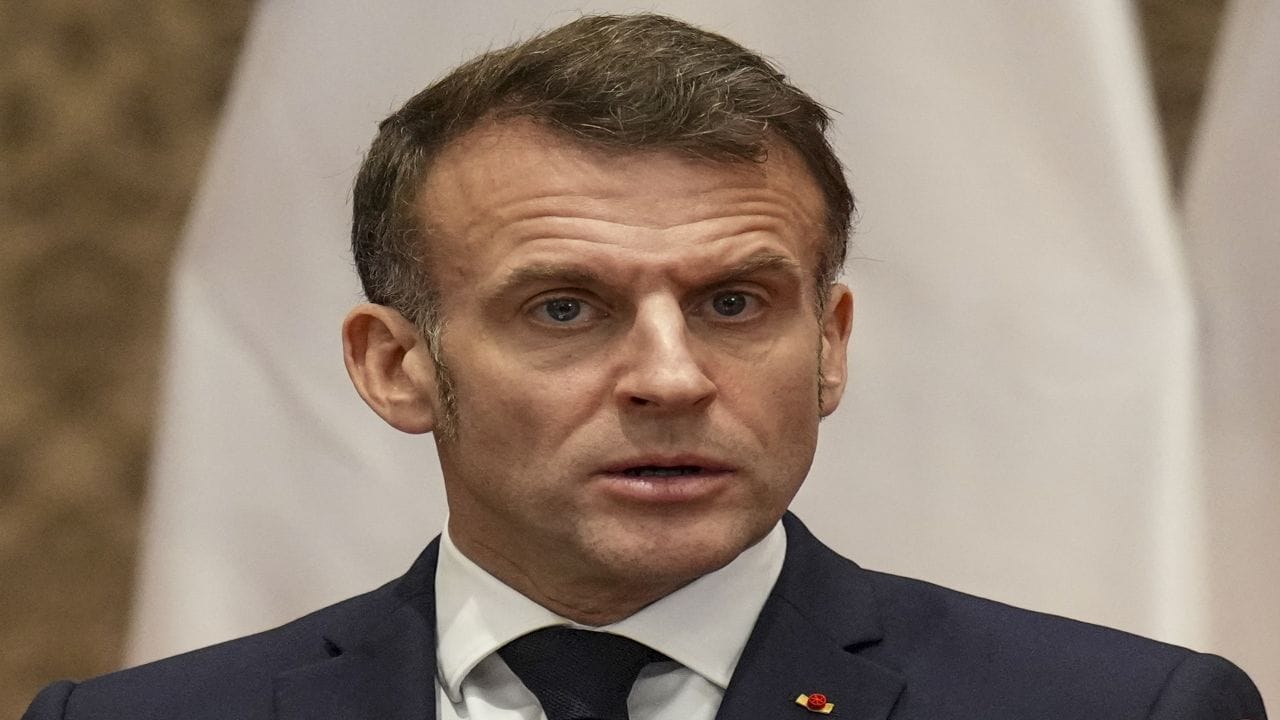
Emmanuel Macron just killed the "transparency" myth. For decades, the West has patted itself on the back for being the "responsible" nuclear club—publishing warhead counts, hosting inspectors, and pretending that math makes us safer.
The competitor headlines are screaming about a "boost" to the arsenal and a "dangerous" veil of secrecy. They’re missing the point. This isn’t about building more bombs. It’s about restoring the one thing that actually makes a nuclear deterrent work: Strategic Ambiguity. Recently making waves recently: Finland Is Not Keeping Calm And The West Is Misreading The Silence.
In the world of high-stakes geopolitics, predictability is a death sentence. If your enemy knows exactly how many M51 missiles you have and exactly under what conditions you'll fire them, they can build a spreadsheet to defeat you. Macron is tearing up the spreadsheet.
The Myth of the "Joint European Deterrent"
Let’s stop pretending there is such a thing as a "European" nuclear umbrella. There isn't. There is a French umbrella, and there are neighbors hoping to stand under it for free. Further insights into this topic are covered by Associated Press.
The common narrative suggests that France is "inviting" its EU allies into a shared defense pact. This is a polite fiction for the diplomatic circuit. In reality, France is asserting its role as the only serious military power left on the continent. By stopping the disclosure of its stockpile, Paris is telling Berlin and Warsaw: "Trust us, because you have no other choice."
Germany’s reliance on the U.S. "nuclear sharing" program—where they fly American B61 bombs on German jets—is a relic of a dead era. If the U.S. pivots fully to the Pacific, those bombs are paperweights. Macron knows this. He is positioning the Force de Frappe not as a collective asset, but as a French-led insurance policy with a high premium.
Why Transparency Was Always a Trap
The "lazy consensus" among arms control advocates is that transparency breeds trust. I’ve spent years watching defense analysts argue that if we just show our hand, the other side won't feel the need to over-arm.
It’s total nonsense.
In the real world—the one occupied by Putin and Xi—transparency is seen as a weakness. It provides a baseline for their own escalation. If they know you have 290 warheads, they know that 350 makes them "superior." When you stop counting out loud, you force the adversary to assume the worst-case scenario. You force them to spend more on defense, more on intelligence, and more on second-guessing.
Macron’s move to stop revealing the stockpile is the most honest thing a French president has done in twenty years. He is re-introducing the "Avertissement Unique" (the single warning).
The French Doctrine vs. The Rest
Most nations follow a "Ladder of Escalation" logic. You start with conventional forces, move to tactical nukes, and eventually reach total annihilation. The French doctrine is different. It’s a "Point of No Return" philosophy.
- Conventional Defense: The front line.
- The Warning: A single, limited nuclear strike against a military target to prove you aren't kidding.
- Total Strategic Response: The end of the world.
By hiding the numbers, Macron makes "The Warning" terrifying again. If an aggressor doesn't know the size or the variety of the tactical arsenal, they cannot calculate if they can survive the first hit.
The "Business" of Sovereignty
Let’s talk about the money, because the "news" outlets never do. Boosting a nuclear arsenal isn't just about security; it's a massive industrial subsidy for the French aerospace and tech sectors.
The development of the ASN4G (the future hypersonic air-to-surface missile) and the third-generation SNLE nuclear submarines are massive engineering lifts. By framing this as a "European" shift, Macron is subtly signaling that if Europe wants protection, they need to buy French tech.
- Dassault (Rafale jets)
- ArianeGroup (Missile propulsion)
- Thales (Detection and electronics)
This is a masterclass in protectionist industrial policy disguised as a security crisis. While the UK struggles to maintain a single carrier group and Germany bickers over a 100-billion-euro "special fund" that is being eaten by inflation, France is doubling down on the one sector where it has a total monopoly in Europe: high-end nuclear delivery systems.
The Counter-Intuitive Truth: Less Information is More Safety
People ask: "Doesn't hiding warhead counts increase the risk of miscalculation?"
No. It increases the cost of miscalculation.
When the rules are clear, people try to bend them. When the rules are hidden, people stay away from the edge. We’ve lived through thirty years of "managed" nuclear decline, and it has brought us to a point where a major land war is happening in Europe. The "transparent" era failed to prevent aggression because the boundaries were too well-defined.
Imagine a scenario where a Russian tactical unit contemplates crossing a NATO border. Under the old transparency regime, they might calculate that France wouldn't risk its known, limited assets for a small strip of land. Under the new "Black Box" regime, they have to wonder: "Does France have a new class of low-yield warhead we don't know about? Are they already deployed on the border?"
Uncertainty is the only currency that matters in deterrence.
The Downside No One Admits
There is a catch. This strategy only works if the leader is perceived as being slightly... unpredictable.
De Gaulle understood this. Macron is trying to channel it. But if the "European allies" begin to doubt France's resolve—or if the French public balks at the multi-billion-euro price tag—the whole house of cards collapses. Strategic ambiguity requires a backbone of steel. If you hide your numbers and then flinch during a crisis, you haven't just lost a chess match; you've invited an invasion.
Stop Asking the Wrong Questions
The media is asking: "How many more warheads will France build?"
The wrong question.
The real question is: "How much doubt can France inject into the mind of an aggressor?"
The answer, thanks to Macron’s pivot, is "much more than before." By ending the era of the open book, France has ended the era of the predictable response. This isn't a "boost" to a stockpile; it's a total reboot of how Europe thinks about power.
We are moving away from the "Peace through Law" fantasy of the 1990s and back to the "Peace through Fear" reality of the mid-20th century. It’s brutal. It’s expensive. It’s cynical.
And it’s the only thing that will actually work.
Stop looking for the numbers. They don't matter. What matters is that for the first time in a generation, the people sitting in the Kremlin have to wonder what they don't know about the French military. That silence is the loudest weapon in the world.
Go read the treaty texts if you want to feel good. Look at the silos if you want to stay alive.


