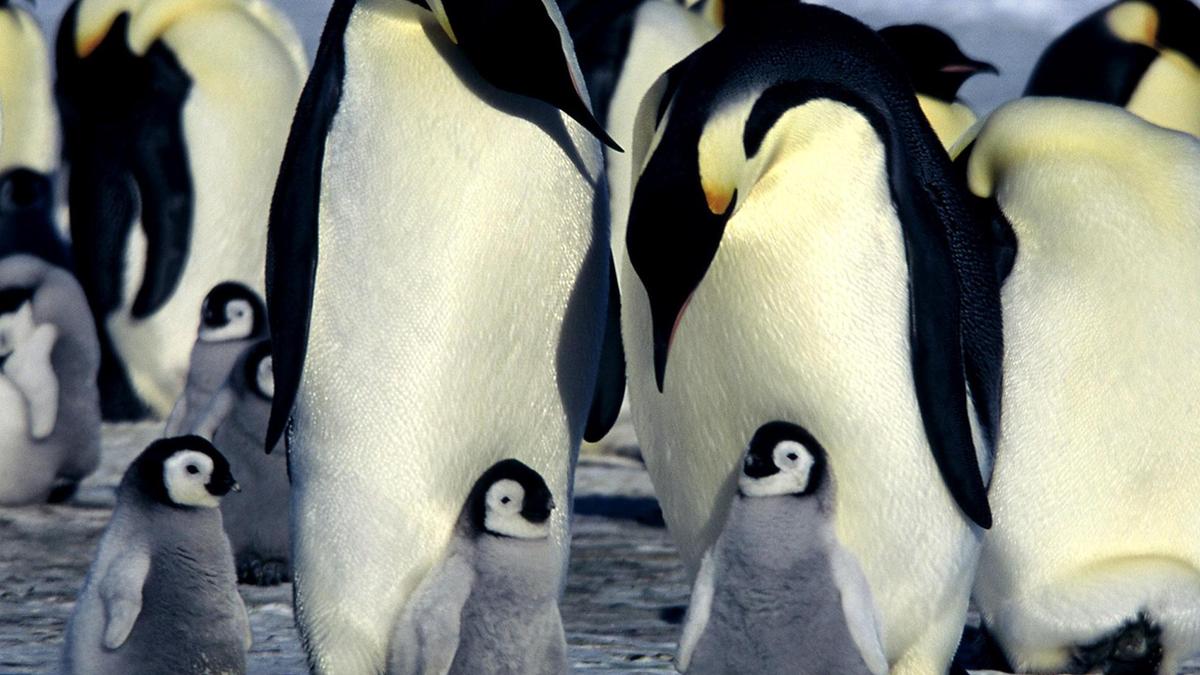
The recent decision by the International Union for Conservation of Nature (IUCN) to reclassify the Emperor penguin (Aptenodytes forsteri) as an endangered species is not merely a bureaucratic adjustment. It is a mathematical admission of a coming collapse. While general news outlets fixate on the "sadness" of the imagery, the cold reality lies in the structural breakdown of the Antarctic landfast ice. Without this specific type of ice, the Emperor penguin cannot complete its breeding cycle. If current warming trends hold, we are looking at the functional extinction of nearly 80% of all colonies by the end of the century.
This isn't a slow decline. It is a series of catastrophic "regime shifts" in the Southern Ocean.
The Physical Mechanics of a Dying Nursery
Emperors are unique among birds because they require a very specific platform for survival. They do not build nests on solid ground. Instead, they rely on landfast ice, which is sea ice attached to the shoreline or grounded icebergs. It must remain stable for at least nine months of the year.
If the ice breaks up too early, the chicks—which have not yet developed their waterproof adult feathers—are swept into the freezing ocean. They drown or freeze within minutes. This isn't a hypothetical threat. In the Bellingshausen Sea region, researchers have already documented "total breeding failure." Thousands of chicks died in a single season across multiple colonies because the ice vanished before they were ready to fledge.
The physics of this are unforgiving. As the atmosphere and the ocean warm, the structural integrity of the Antarctic ice fringe weakens from both above and below. We are seeing a shift from a predictable seasonal cycle to a chaotic one. When the ice goes, the generation goes with it. You cannot "rebuild" a colony once three or four consecutive years of zero recruitment have occurred. The math simply stops working.
The Krill Paradox and the Blue Economy
While surface ice is the most visible problem, the crisis extends deep into the water column. The Emperor penguin's diet consists primarily of fish, squid, and Antarctic krill. Krill are the bedrock of the entire Antarctic ecosystem, and they are currently being squeezed by two opposing forces.
First, krill larvae depend on the underside of sea ice for protection and food (algae). Less ice means fewer krill. Second, there is a burgeoning industrial interest in krill harvesting for the "health supplement" market and aquaculture feed. This creates a direct conflict between high-end consumer products and the caloric requirements of a species that must travel hundreds of miles to forage.
We often talk about conservation as if it exists in a vacuum. It doesn't. The Southern Ocean is a frontier for the "Blue Economy," where nations scramble for resources that were once too difficult to reach. By the time an animal is listed as endangered, the industrial machinery is usually already ten years ahead of the legislation.
The Limits of Sanctuary
Establishing Marine Protected Areas (MPAs) is the standard response. However, an MPA is a line on a map. It does not stop the water from warming. It does not prevent the acidification of the ocean, which threatens the shell-forming organisms that form the base of the food web.
There is an uncomfortable truth that many analysts avoid. We are trying to apply 20th-century conservation tools—which were designed to stop overhunting or direct habitat destruction—to a 21st-century problem of systemic thermal instability. You can stop a hunter from shooting a penguin. You cannot stop the sun from melting the nursery.
Satellite Surveillance and the Data Gap
Our understanding of the Emperor's decline has been revolutionized by high-resolution satellite imagery. We no longer need to land teams on the ice to count birds. We can track them by the brown stains of their guano against the white ice, visible from space.
This technology has allowed scientists to find "refuge" colonies that were previously unknown. But it also reveals a terrifying trend of displacement. As their traditional sites fail, penguins are forced to move. But there are only so many places where the ice remains stable. These "refugia" are becoming crowded, increasing the risk of disease transmission and localized resource depletion.
The data is clear, but the policy is stagnant. The Antarctic Treaty System, which governs the continent, requires consensus for major actions. In a fractured geopolitical environment, getting every nation to agree on stringent new protections is nearly impossible. Diplomacy is moving at a glacial pace, while the glaciers themselves are moving at a record clip.
The Myth of Adaptation
There is a persistent hope among some observers that the Emperor penguin will simply "adapt." Perhaps they will move further inland. Perhaps they will learn to breed on rock.
Biological evolution does not work on a fifty-year timeline. Emperors are evolutionarily hardwired for the ice. Their feet, their brooding pouches, and their social huddling behaviors are all precision-engineered for an environment of -40 degrees. On solid ground, they are vulnerable to predators and lack the proximity to the ice edge required for efficient hunting.
Expecting a species that has spent millions of years perfecting its relationship with ice to pivot to a terrestrial lifestyle in two generations is not optimism. It is a misunderstanding of biology.
The Resource Scramble
As the ice recedes, the Antarctic becomes more accessible. This isn't just about penguins; it is about the world's last great commons. Tourism is booming. Research stations are expanding. Every new human footprint brings the risk of invasive species and pathogens.
The "endangered" status should, in theory, trigger stricter controls on human activity. But the enforcement mechanisms in the Antarctic are notoriously thin. We are relying on the "honor system" among nations that are increasingly hungry for the minerals and bio-resources hidden beneath the Southern Ocean.
The Emperor is the sentinel. Its disappearance isn't just a loss of biodiversity; it is a signal that the Southern Ocean's heat sink is full. When the cooling system of the planet begins to fail, the inhabitants of the freezer are the first to know.
We have moved past the era of "raising awareness." The awareness is here. The listings are official. What remains is a stark choice between radical decarbonization or documenting the final huddles of a species that survived the ice age only to be defeated by the exhaust of the industrial one.
Stop looking for a silver lining. The ice is thinning, and the birds are running out of places to stand.