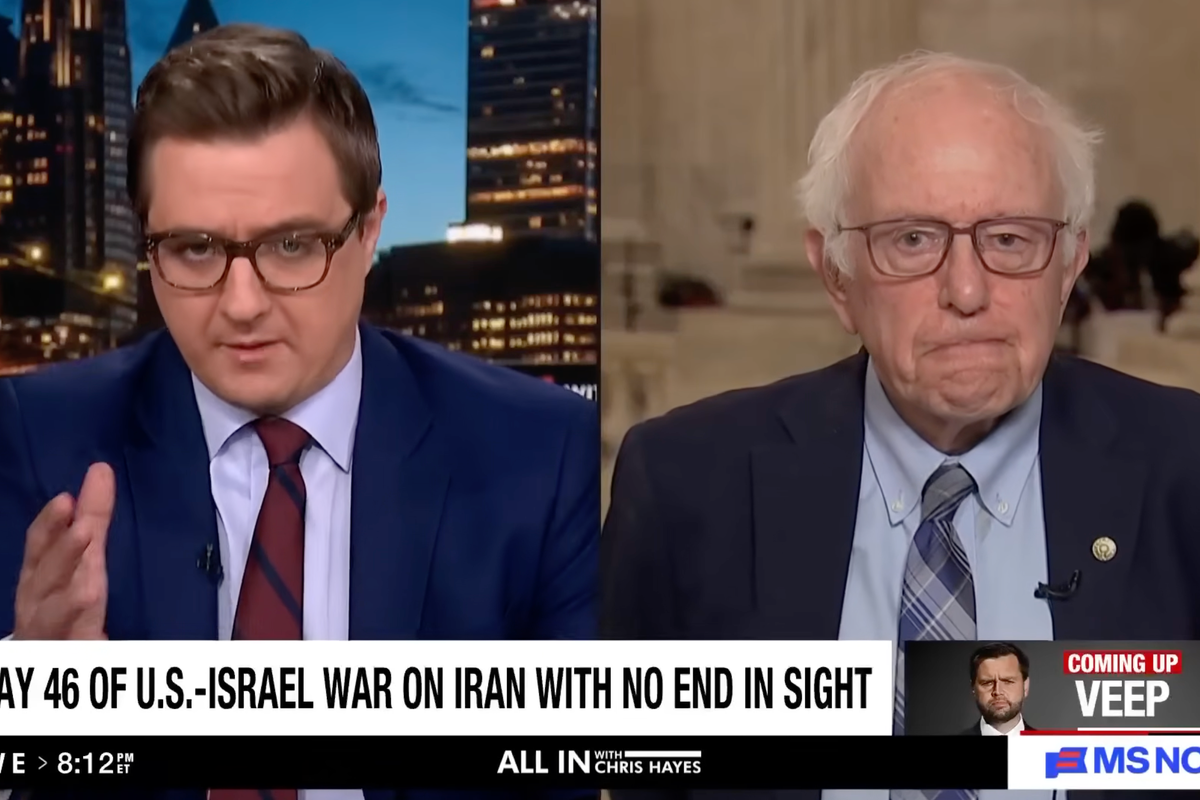
The correlation between Middle Eastern kinetic conflict and global energy pricing is governed by the Risk Premium Multiplier, a psychological and economic buffer that overrides immediate supply-demand fundamentals. When Senator Bernie Sanders responded to claims that a potential war with Iran would lower oil prices by increasing US production, he addressed a fundamental decoupling in energy economics: the delta between physical inventory and speculative fear. The assertion that domestic drilling acts as a total hedge against geopolitical instability ignores the reality of the globalized Brent benchmark.
The Mechanism of the Geopolitical Risk Premium
Oil is a fungible global commodity. Even if the United States achieves "energy independence" in net volume, the price paid by domestic consumers remains tethered to the global marginal cost of a barrel. Conflict in the Persian Gulf introduces three distinct inflationary pressures that local production cannot offset.
- The Strait of Hormuz Bottleneck: Approximately 20% of the world’s total petroleum liquids consumption passes through this 21-mile-wide chokepoint. Any threat to transit increases insurance premiums for tankers (Protection and Indemnity insurance), which is immediately priced into the landed cost of crude.
- Spare Capacity Erosion: Global markets rely on the "buffer" of unutilized production capacity, primarily held by Saudi Arabia. A war involving Iran threatens the physical infrastructure of neighboring producers, effectively pricing in a "scarcity event" before a single drop of oil is lost.
- Speculative Forward Pricing: Paper markets (futures and options) react to the probability of disruption. In a high-tension environment, the volume of "long" positions increases, creating a feedback loop that drives the spot price higher regardless of current US storage levels in the Strategic Petroleum Reserve (SPR).
The Fallacy of Domestic Production as a Price Shield
A common argument suggests that increased US shale output provides an impenetrable shield against Middle Eastern price shocks. This ignores the Quality Gradient and the Refining Paradox.
Most US shale produces "Light Sweet" crude, while many domestic refineries—particularly those on the Gulf Coast—are configured for "Heavy Sour" grades originally imported from Venezuela or the Middle East. This mismatch forces the US to export its own high-quality oil while continuing to import lower-quality feedstock. Consequently, US gasoline prices remain vulnerable to the global Brent-WTI spread.
The Cost Function of Regional Escalation
Quantifying the impact of an Iran-Israel or Iran-US conflict requires an analysis of the Disruption Duration Curve.
- Tier 1: Sabotage and Proxies: Low-level disruptions to pipelines or tankers typically add a $5 to $10 premium per barrel. This is a "temporary anxiety" tax.
- Tier 2: Direct Kinetic Engagement: Targeted strikes on Iranian or Saudi infrastructure (similar to the 2019 Abqaiq–Khurais attack) can remove 5 million barrels per day (mbpd) from the market instantly. In this scenario, price models suggest a floor of $120 per barrel.
- Tier 3: Total Blockade: A closure of the Strait of Hormuz would remove 17–20 mbpd. No amount of US shale production or IEA reserve releases can fill a gap of this magnitude. Analysts estimate prices could exceed $200 per barrel, triggering a global recessionary contraction.
Bernie Sanders’ "four-word response" (which historically aligns with his "No more endless wars" stance) targets the hidden cost of military intervention. Beyond the humanitarian and ethical variables, the economic cost of protecting energy transit through military force often exceeds the value of the energy itself. This is the Security Subsidy—the trillions of dollars in defense spending required to maintain "affordable" oil, which is never factored into the price at the pump but is reflected in the national debt and tax requirements.
Structural Vulnerabilities in the Energy Transition
The argument for increased drilling as a solution to war-induced price hikes is a short-term tactical maneuver applied to a long-term structural problem. The volatility of the internal combustion engine economy is a feature, not a bug.
- Elasticity of Demand: In the short term, oil demand is highly inelastic. People must drive to work regardless of price. This lack of flexibility gives geopolitical actors outsized leverage over Western economies.
- The SPR Depletion Risk: Using the Strategic Petroleum Reserve to suppress prices during political cycles reduces the "buffer" available for true national security emergencies. As the SPR hits historic lows, the US loses its primary non-military lever for stabilizing markets.
The Strategy of Strategic Decoupling
True energy security is not found in the volume of extraction, but in the diversification of the energy mix. Reducing the economy’s "Oil Intensity"—the amount of oil required to produce one unit of GDP—is the only way to neuter the influence of Middle Eastern conflict on domestic inflation.
The immediate strategic play for a sovereign state or a massive industrial enterprise is two-fold. First, accelerate the electrification of transport to move the primary energy burden from a globally traded, volatile commodity (oil) to locally generated, regulated utilities (electricity). Second, hedge against the inevitable "War Premium" by investing in downstream efficiencies rather than upstream expansion. Upstream expansion takes 5 to 10 years to reach the market; geopolitical shocks happen in 24 hours.
The math is clear: A barrel of oil produced in Texas cannot stop a missile in the Persian Gulf from raising the price of gas in Ohio. The only solution is to build a system where the missile no longer matters to the commuter. High-output domestic drilling is a bridge, but it is a bridge built on shifting sand. To achieve price stability, the objective must be the total elimination of the "Geopolitical Risk Premium" from the domestic inflation index.