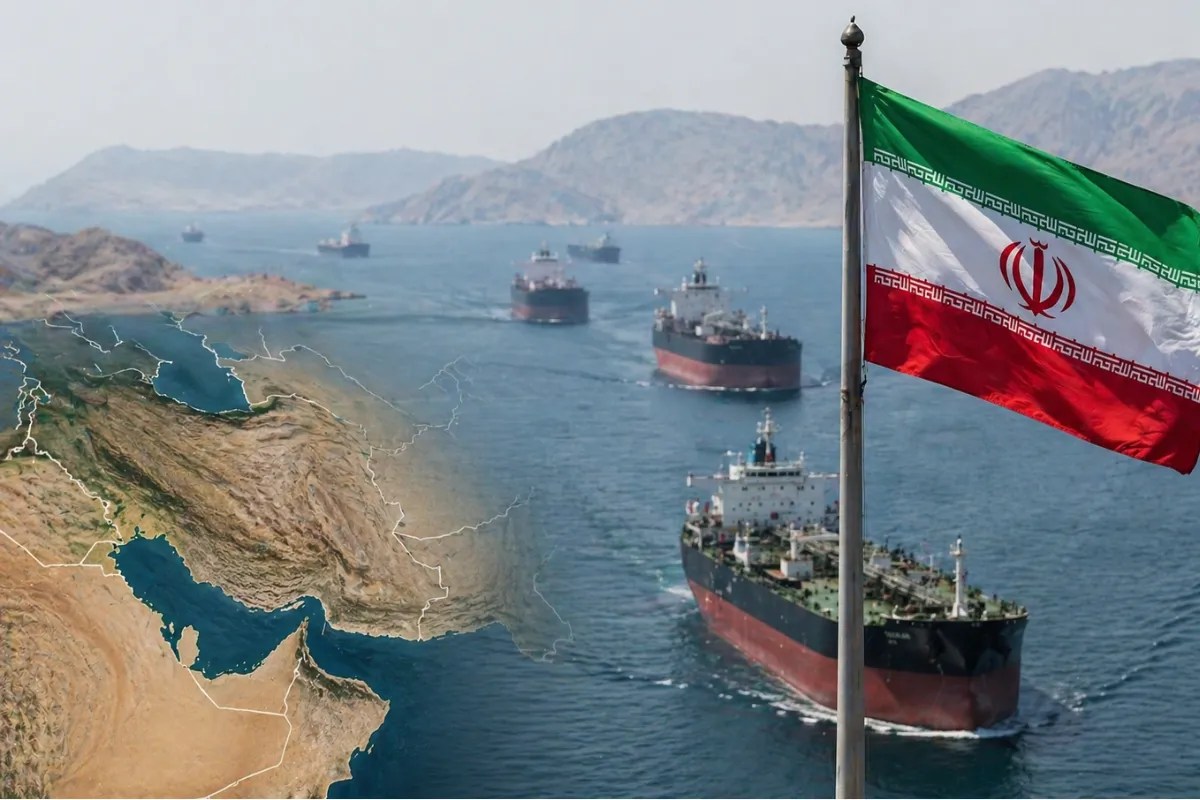
The maritime blockade of the Strait of Hormuz by United States naval assets forces a fundamental reconfiguration of energy and trade logistics for every nation bordering the Persian Gulf. For Pakistan, this disruption is not merely a diplomatic friction point but a direct threat to its energy security and balance of payments. By opening six emergency land routes to Iran, Islamabad has moved beyond its historical "neutrality" into a state of active geopolitical hedging. This shift represents a calculated effort to mitigate the risk of a total maritime shutdown while simultaneously attempting to extract concessions from both Washington and Tehran.
The logic of this maneuver rests on three distinct operational pillars: the mitigation of maritime choke-point risk, the formalization of gray-market trade, and the creation of a continental fallback for energy imports.
The Mechanics of Choke-Point Vulnerability
The Strait of Hormuz handles approximately 21% of the world’s petroleum liquids consumption. For Pakistan, which relies on the Middle East for the vast majority of its crude oil and Liquefied Natural Gas (LNG) requirements, any restriction in the Strait acts as a throttle on the national economy. A naval blockade—whether partial or total—triggers an immediate spike in insurance premiums for tankers (Protection and Indemnity or P&I insurance), effectively pricing maritime transit out of reach for a struggling economy.
The opening of land routes at Mand, Pishin, Gabd, and other secondary border crossings functions as a pressure-release valve. These routes shift the logistics burden from high-volume, high-risk maritime assets to lower-volume, lower-risk terrestrial fleets. While trucking cannot match the efficiency of a Very Large Crude Carrier (VLCC), the land corridors provide a continuous, albeit thinner, flow of essential goods that are immune to naval interdiction.
The Cost Function of Overland Diversion
The transition from maritime to land-based logistics involves a significant shift in the cost-per-ton-mile. Maritime shipping is governed by economies of scale; a single tanker carries millions of barrels. In contrast, the six land routes opened by Pakistan are governed by the "Last Mile" friction of the Baluchistan terrain.
- Infrastructure Degradation: The heavy axle loads of fuel tankers and freight trucks on underdeveloped provincial roads increase maintenance costs exponentially.
- Security Overheads: These land routes pass through regions with active insurgencies. Protecting these corridors requires a deployment of paramilitary forces, adding a "security tax" to every ton of freight.
- Customs and Rent-Seeking: Land borders are prone to administrative bottlenecks. The decentralization of trade through six different points increases the opportunities for local-level corruption compared to the centralized oversight of a port like Karachi or Gwadar.
Despite these costs, the land routes offer a "security of supply" premium. In a blockade scenario, the price of the commodity becomes secondary to its availability. Pakistan’s decision to open these routes suggests that the internal risk assessment has shifted from prioritizing cost-efficiency to prioritizing survival-ready redundancy.
Strategic Hedging: The "Double Game" Framework
Pakistan’s relationship with the United States and Iran is often characterized as a balancing act, but a more accurate term is "multivector hedging." This strategy seeks to maximize benefits from competing power centers while minimizing the fallout from their inevitable collisions.
The Washington Variable
Islamabad remains dependent on the United States for military hardware, counter-terrorism cooperation, and, crucially, influence within the International Monetary Fund (IMF). Supporting Iran through land routes risks triggering secondary sanctions under the Countering America's Adversaries Through Sanctions Act (CAATSA). However, Pakistan leverages its role as a regional stabilizer. By presenting these routes as "humanitarian" or "essential trade" corridors, Pakistan creates a gray area that makes it difficult for Washington to impose harsh penalties without destabilizing a nuclear-armed state.
The Tehran Variable
Iran offers Pakistan a geographical shortcut to European markets and a potential source of cheap energy through the long-delayed IP (Iran-Pakistan) gas pipeline. By opening these land routes during a period of American pressure, Pakistan secures a position of leverage with Tehran. It signals that it is willing to provide a lifeline, but this comes with the expectation of favorable pricing and Iranian cooperation in managing cross-border militancy.
The Formalization of the Gray Market
A significant portion of the trade between Iran and Pakistan has historically been informal—essentially a massive smuggling operation involving diesel, foodstuffs, and consumer goods. This informal economy deprives the Pakistani state of tax revenue and creates unregulated financial flows.
Opening six emergency land routes serves an unintended but vital economic function: the formalization of this trade. By establishing official checkpoints and customs protocols, the government can begin to capture tax revenue and monitor the flow of currency. This is particularly critical as Pakistan seeks to comply with Financial Action Task Force (FATF) standards regarding anti-money laundering and terror financing. Moving "smuggling" into the realm of "border trade" provides a veneer of legitimacy that helps insulate the economy from international scrutiny.
The Continental Fallback and Energy Architecture
The pivot toward Iran is part of a broader realization that maritime-only energy dependencies are a strategic liability. The IP Pipeline project has remained stagnant for decades due to the threat of US sanctions. However, the physical opening of land routes establishes the logistical precursor for terrestrial energy transport.
If the US blockade in the Hormuz remains a persistent threat, the argument for completing the pipeline—or at least increasing the volume of trucked LPG and refined petroleum—becomes undeniable. This creates a shift in Pakistan’s energy architecture from a maritime-centric model to a continental-hybrid model. This model integrates the China-Pakistan Economic Corridor (CPEC) assets with Iranian energy supply lines, effectively turning Pakistan into a transit hub rather than just a terminal consumer.
Risk Assessment and Limits of the Strategy
This strategy is not without severe limitations. The primary constraint is the capacity of the land routes themselves. The combined throughput of these six emergency routes is a fraction of what passes through the Port of Karachi in a single day. They are an emergency measure, not a replacement for maritime trade.
Furthermore, the "Double Game" relies on the assumption that the United States will continue to prioritize Pakistan's stability over strict sanction enforcement. This is a fragile assumption. If the US-Iran conflict escalates into open kinetic warfare, the land routes will become targets or, at the very least, subject to intense electronic and physical surveillance.
The second limitation is internal. The provinces of Baluchistan and Sistan-Baluchestan are volatile. Increasing trade through these regions provides a target for non-state actors who wish to disrupt the Pakistani state or Iranian interests. The economic benefit of the trade must be balanced against the cost of a permanent military presence to secure the convoys.
Structural Shift in Regional Power Dynamics
The activation of these land routes marks the end of the era where the Persian Gulf was the sole artery for Pakistani prosperity. It signals a move toward a "Greater Central Asia" economic logic, where borders are increasingly porous to trade even when they are politically contentious.
For the regional observer, the metric of success will not be the volume of trade in the first month, but the durability of the infrastructure being built around these routes. If Pakistan begins to invest in rail links or paved highways connecting these six points to the national grid, it confirms a permanent strategic pivot away from total Western maritime dependency.
The immediate tactical play for Pakistan is to utilize these corridors to stabilize domestic fuel prices and dampen inflation while maintaining a diplomatic dialogue with the US State Department. The long-term objective is to ensure that no single naval power—be it the US, India, or any other entity—can exercise a "kill switch" over the Pakistani economy. By diversifying the modes of entry, Islamabad is building a resilient, multi-modal trade network that prioritizes national sovereignty over geopolitical alignment.