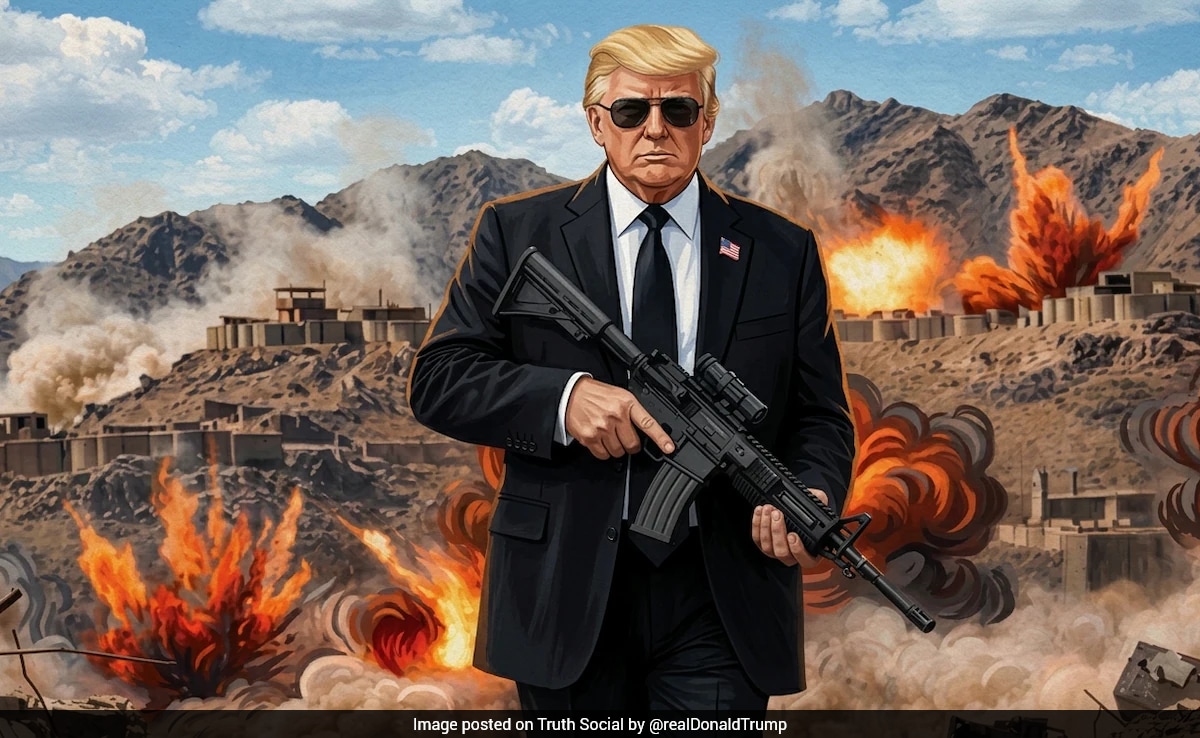
Visual signaling in modern statecraft operates as a high-stakes compression of military doctrine into a single, digestible unit of information. When Donald Trump integrates specific military iconography—such as a rifle—alongside explicit verbal warnings directed at the Iranian regime, he is not merely engaging in domestic political theater. He is attempting to recalibrate the Deterrence Calculus by shifting the perceived cost of Iranian non-compliance from economic attrition to kinetic engagement. This strategy rests on the assumption that credible threats require both the physical capacity for violence and the psychological willingness to deploy it, a concept formalized in game theory as the Madman Theory of international relations.
The Mechanics of Visual Signaling in Asymmetric Warfare
Effective deterrence relies on the formula $D = C \times P$, where $D$ is the strength of deterrence, $C$ is the perceived cost of an action to the adversary, and $P$ is the perceived probability that the threat will be executed. Traditional diplomatic channels often fail to communicate $P$ effectively because they are bound by bureaucratic inertia and predictable escalation ladders. Meanwhile, you can find similar developments here: The Uniform and the Bloodline.
By utilizing a rifle as a prop, the signaling mechanism bypasses traditional diplomatic filters. This visual choice serves three distinct analytical functions:
- Identity Alignment: It anchors the leader’s persona to a specific segment of the domestic electorate that prioritizes hard power, ensuring that any subsequent military action has a pre-mobilized base of support.
- Signaling Irrationality: By moving outside the norms of presidential decorum, the actor signals a willingness to ignore the "sunk costs" of international treaties or traditional alliances, making their future behavior less predictable and therefore more difficult for an adversary to model.
- Tactical Simplification: Complex geopolitical disputes regarding uranium enrichment or proxy funding are reduced to a binary of "compliance or confrontation."
The Three Pillars of the No More Nice Guy Framework
The shift from "Maximum Pressure"—a strategy primarily defined by the Economic Chokepoint Mechanism—to a "No More Nice Guy" posture suggests a transition into a more volatile phase of foreign policy. This framework is built on three pillars that redefine the US-Iran relationship. To explore the complete picture, we recommend the recent analysis by The New York Times.
1. The Erosion of Strategic Patience
Strategic patience assumes that time is an asset that allows for internal regime decay or the eventual success of sanctions. The new framework rejects this, treating time as a liability that allows an adversary to achieve technical milestones, such as nuclear breakout or advanced missile telemetry. The "No More Nice Guy" warning indicates that the window for diplomatic resolution is being artificially shortened to force a crisis point.
2. The Personalization of Conflict
While traditional statescraft deals with institutions, this approach targets individuals. By framing the warning as a personal directive, the signaling actor creates a direct feedback loop between their personal reputation and the state's military response. In this environment, any Iranian provocation is filtered not through a policy review board, but as a direct challenge to the leader’s credibility, significantly increasing the probability of a kinetic response.
3. Kinetic Substitution
The framework suggests that the marginal utility of further economic sanctions has reached its limit. When an economy is already heavily sanctioned, the "next unit" of economic pressure yields diminishing returns in terms of behavioral change. Kinetic substitution replaces economic variables with military ones, such as targeted strikes or naval interdictions, to re-establish a "fear floor" in the adversary's decision-making process.
Strategic Risk and the Credibility Gap
The primary risk in visual brinkmanship is the Credibility Gap. If a leader signals a high probability of violence through aggressive iconography but fails to act when a red line is crossed, the value of all future signals depreciates. This creates a dangerous incentive structure where the leader may feel compelled to enter a conflict they do not want, simply to preserve the integrity of their signaling system.
In the context of Iran, this creates a specific bottleneck. The Iranian leadership must distinguish between "cheap talk"—statements intended for domestic consumption—and "costly signals"—actions that involve real risk or resource expenditure. A photo with a rifle is a low-cost signal. For it to achieve the desired effect of deterrence, it must be backed by structural indicators, such as:
- Re-tasking of carrier strike groups to the Persian Gulf.
- Increased frequency of B-52 overflights in the CENTCOM area of responsibility.
- Publicized updates to the Integrated Air and Missile Defense (IAMD) systems of regional allies.
The Cost Function of Iranian Escalation
To understand if this visual strategy will work, one must map the Iranian regime's internal cost-benefit analysis. Iran operates on a Deep State Survivability model. Their primary objective is the preservation of the clerical system and its regional influence.
The Iranian response to a "No More Nice Guy" posture typically involves Calibrated Counter-Escalation. They test the boundaries of the new rhetoric through "gray zone" activities—actions that fall below the threshold of open war but high enough to challenge the adversary's resolve. This includes:
- Cyber Interdiction: Targeting critical infrastructure or financial systems to demonstrate a non-kinetic reach.
- Maritime Harassment: Using fast-attack craft to disrupt shipping lanes in the Strait of Hormuz, testing the US Navy's rules of engagement.
- Proxy Activation: Leveraging groups in Lebanon, Iraq, and Yemen to create a multi-front dilemma for US planners.
This creates a Feedback Loop of Escalation. If the US increases its visual and verbal threats, Iran may feel the need to demonstrate its own "No More Nice Guy" capability to avoid looking weak to its domestic hardliners and regional proxies.
Data-Driven Assessment of Rhetorical Efficacy
Historical analysis of presidential rhetoric suggests that while aggressive posturing can provide a short-term "rally around the flag" effect, its long-term efficacy in changing the behavior of a pariah state is inconsistent.
- Case A: Libya (2003). Intense rhetorical pressure combined with the visible "example" of the Iraq invasion led to Gaddafi’s renunciation of WMDs. Here, the $P$ (Probability) in the deterrence equation was perceived as 1.0.
- Case B: North Korea (2017). The "Fire and Fury" rhetoric led to a period of heightened tension followed by summits, but ultimately did not result in denuclearization. The $C$ (Cost) was deemed too high for the US to execute a strike due to the proximity of Seoul.
The Iran situation more closely mirrors Case B. The density of Iranian proxy networks and the complexity of the Strait of Hormuz make the "Cost" of a full-scale conflict extremely high for the United States. Consequently, the Iranian leadership may view a photo with a rifle as a high-variance signal that lacks the necessary structural backing to be a true precursor to war.
The Technological Component: AI and Information Warfare
The dissemination of the "No More Nice Guy" message is not accidental; it is optimized for the Algorithm-Driven Information Environment. Modern political strategy treats social media platforms as decentralized command centers. By creating "high-friction" content—images that provoke intense emotional responses—a leader ensures that their message achieves maximum reach without the need for traditional media buys.
This creates a Signal Saturation effect. The sheer volume of analysis and reaction to a single image or quote can drown out more nuanced policy discussions. For an adversary like Iran, this makes it difficult to parse the true intent of the US administration. Are they preparing for war, or are they feeding an algorithm? This ambiguity is both a strength and a weakness. It creates "strategic fog" that can deter an adversary, but it can also lead to miscalculation if the adversary perceives a bluff where there is actually intent, or vice versa.
Strategic Recommendations for Navigating the New Posture
The transition to a more aggressive visual and verbal stance requires a fundamental shift in how analysts and regional stakeholders prepare for the next 24 months. The following moves are critical for maintaining stability:
- Harden Regional Infrastructure: Allies in the Middle East must assume that the Iranian response to US rhetoric will be asymmetric. This means prioritizing cyber defense and point-defense systems over prestige military acquisitions.
- Establish Back-Channel Redundancy: When public rhetoric becomes hot, private channels must remain cold and functional. There must be a clear, non-public way to communicate "Off-Ramps" to avoid an accidental descent into kinetic conflict.
- Monitor the Oil-Risk Premium: Market participants should look past the headlines and monitor the actual flow of crude through the Strait of Hormuz. If the rhetoric begins to affect physical loading schedules, the probability of a "Black Swan" event in the energy markets increases by an order of magnitude.
The era of "Nice Guy" diplomacy is being replaced by a model of Performative Realism. In this model, the image of the weapon is as important as the weapon itself, but only if the person holding it is perceived as being willing to pull the trigger. The success or failure of this strategy will not be measured in likes or shares, but in whether or not the Iranian regime decides that the cost of further provocation has finally exceeded the benefits of regional hegemony.