The Grainy Evidence of a Persistent Haunting
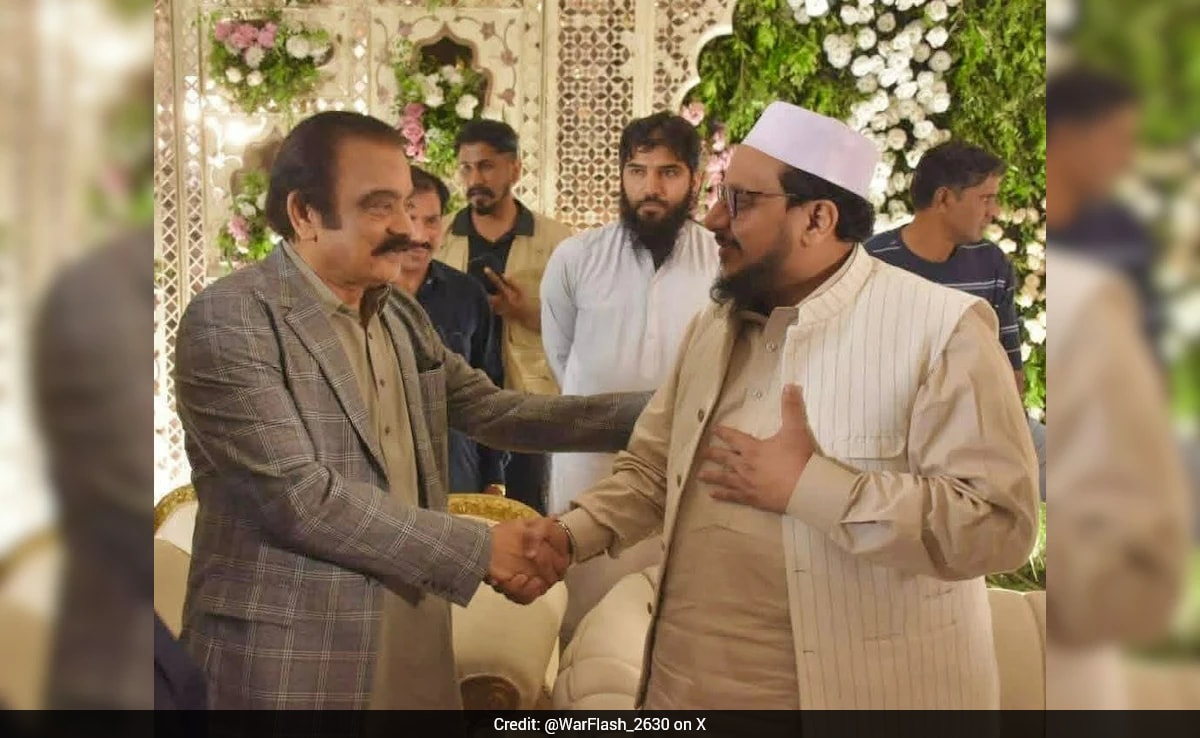
A single photograph can be a ghost story. It doesn't need to show a spectral figure in a Victorian hallway; often, it is most terrifying when it shows two men in the harsh light of a modern room, smiling as if the world isn't watching.
Recently, such a ghost appeared.
The image is simple. On one side stands Rana Iradat Sharif Khan, a man who carries the weight of officialdom as the Special Assistant to the Prime Minister of Pakistan. On the other stands Talha Saeed. The surname "Saeed" is not merely a family identifier in this part of the world. It is a heavy, dark bell that tolls across the international community. Talha is the son of Hafiz Saeed, the founder of Lashkar-e-Taiba—the architect of the 2008 Mumbai attacks that left a trail of blood across India’s financial heart.
When these two men share a frame, it isn't just a social encounter. It is a collision of worlds that the Pakistani state has spent decades swearing are separate. It is the visible stitching on a veil that is supposed to be seamless.
The Weight of a Surname
To understand why a simple handshake or a shared sofa matters, we have to look past the pixels and into the history of the men involved. Hafiz Saeed is not just a radical cleric; he is a global pariah with a $10 million American bounty on his head. For years, the narrative from Islamabad has been one of reform and "mainstreaming." They tell the world that the old ways are gone, that the networks of terror are being dismantled, and that the rule of law is the new North Star.
Then comes the photo.
Talha Saeed isn't just a bystander to his father’s legacy. The United States has designated him a terrorist in his own right. He has been linked to the financial and operational sinews of the Jamat-ud-Dawa, the "charitable" front for Lashkar-e-Taiba. When a high-ranking government aide sits with him, the "mainstreaming" argument starts to look less like a rehabilitation program and more like a merger.
Consider the optics for a moment. If you are a citizen of Lahore or Islamabad, trying to build a life in a country gripped by economic instability and the constant threat of extremist blowback, seeing this image feels like a betrayal. It tells you that while the laws apply to the shopkeeper and the teacher, there is a certain class of shadow-dwellers who remain untouchable, shielded by the very people who write the laws.
The Invisible Stakes of a Handshake
The stakes here aren't just political; they are existential. Pakistan currently walks a razor's edge with the Financial Action Task Force (FATF), the global watchdog for money laundering and terror financing. For years, the country was "greylisted," a status that strangled investment and acted as a scarlet letter on the global market.
Getting off that list required proving—beyond a shadow of a doubt—that the state had severed its ties with designated terrorists.
When a Prime Minister’s aide is seen with the scion of the Saeed empire, that proof evaporates. It suggests that the "terror nexus" isn't a remnant of the past, but a living, breathing part of the present. It’s as if the government is trying to clean a house while keeping the doors open for the very people who trashed it.
The danger is that this isn't an isolated incident. It is a pattern. In the labyrinth of South Asian politics, these "coincidental" meetings serve as signals. They tell the base of the extremist organizations that they still have friends in high places. They tell the international community that the promises made in high-ceilinged rooms in Paris or Washington are negotiable once the doors are closed.
The Human Cost of the Shadow Play
We often talk about these events in the cold language of diplomacy. We use words like "geopolitics," "asymmetric warfare," and "diplomatic friction." But there is a human cost to this shadow play.
Think of the families who lost everything in Mumbai. Think of the Pakistani soldiers who have died fighting splinter groups that were born from the same radical soil these leaders cultivated. When the state legitimizes the offspring of terror, it spits on those sacrifices. It creates a vacuum of moral authority.
If the person advising the Prime Minister cannot—or will not—distance himself from a designated terrorist, what hope does the average police officer have when he confronts a radicalized cell on the street? The chain of command isn't just about orders; it's about the integrity of the message. And right now, that message is garbled.
The photo of Rana Iradat Sharif Khan and Talha Saeed is a Rorschach test for the Pakistani state. To some, it is a sign of pragmatic politics, an attempt to keep "influential" figures within the fold. To the rest of the world, it is a smoking gun. It is evidence that the "deep state" and the "civilian state" are perhaps just two heads of the same hydra, sharing a meal and a smile while the rest of the world waits for the next explosion.
A Legacy That Refuses to Fade
The tragedy of this nexus is that it is self-perpetuating. Every time a government official grants an audience to someone like Talha Saeed, they give that person a piece of the state's own legitimacy. They tell the young, the disenfranchised, and the radicalized that the shortest path to power isn't through the ballot box, but through the threat of violence and the protection of the powerful.
The photo isn't a mistake. In politics at this level, there are no accidents of that magnitude. It was a choice. It was a statement that the ties that bind the Pakistani establishment to its radical proxies are thicker than the ink on any international treaty.
As the image circulates on social media and lands on the desks of intelligence agencies from New Delhi to London, the question isn't whether the nexus exists. The question is whether the state even cares that we can see it.
The ghost has stepped out of the shadows. It is sitting in a comfortable chair, sipping tea, and it has no intention of leaving.